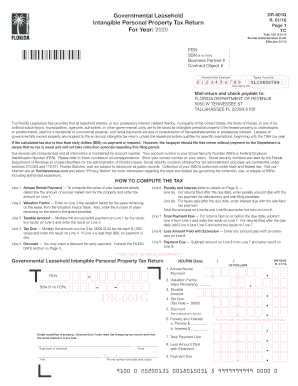
Partner # : Contract Object # : Handwritten Example Typed Example 0 1 2 3 4 5 6 7 8 9 0123456789 Use black ink. Mail return and check payable to: FLORIDA DEPARTMENT OF REVENUE 5050 W TENNESSEE ST TALLAHASSEE FL 32399-0100 The Florida Legislature has provided that all leasehold estates, or any possessory interest created thereby, in property of the United States, the State of Florida, or any of its political subdivisions, municipalities, agencies, authorities, or other governmenta.
Open form follow the instructions
Easily sign the form with your finger
Send filled & signed form or save
How to fill out the FL DoR DR-601G online
The FL DoR DR-601G form is essential for reporting leasehold estates and possessory interests in property owned by governmental entities in Florida. This guide will provide you with a step-by-step approach to completing the form accurately and efficiently online.
Follow the steps to complete the FL DoR DR-601G online.
- Press the ‘Get Form’ button to access the FL DoR DR-601G online and open the form in your preferred software or online editor.
- Enter your Federal Employer Identification Number (FEIN) or Social Security Number (SSN) in the appropriate fields.
- Provide the Business Partner Number and Contract Object Number, ensuring all information is correct.
- Calculate the Annual Rental Payment for the leasehold estate and enter this amount on Line 1.
- Look up the Valuation Factor based on the years remaining on your lease and complete Line 2 with this data.
- Multiply the amount on Line 1 by the Valuation Factor from Line 2 to determine the Taxable Amount, entering this on Line 3.
- Calculate the Tax Due by multiplying the Taxable Amount on Line 3 by the tax rate of 0.0005, and input the result on Line 4.
- If applicable, claim a Discount for early payment as noted in the instructions and write this amount on Line 5.
- If filing after the due date, complete Line 6 with the Penalty and Interest amounts as outlined in the instructions.
- Determine the Total Payment Due by following the instructions provided on Lines 7 and 9.
- Sign the form, date it, and include your title and phone number, making sure all information is accurately filled.
- Once all fields are completed, save your changes, and download, print, or share the finalized form as needed.
Complete your FL DoR DR-601G online to ensure timely filing and compliance.
Experience a faster way to fill out and sign forms on the web. Access the most extensive library of templates available.
Related content
Florida Department of Revenue Rule 12D-13.046 ... Form DR-601G, which repeats the language...
by DI Brandon · Cited by 142 — Bodily Harm ........................... 854. 2...
Get answers to your most pressing questions about US Legal Forms API.
Will Florida eliminate property taxes?
As of now, there are no definitive plans to eliminate property taxes in Florida. Property taxes are a significant revenue source for local governments, funding essential services. Keeping abreast of changes in tax legislation and understanding your responsibilities through resources like the FL DoR DR-601G can help you navigate these challenges efficiently.
Who needs to file a Florida tangible property tax return?
Any individual or business that owns tangible personal property in Florida must file a tangible property tax return. This includes items like machinery, furniture, and equipment. However, specific exemptions may apply, so it’s wise to review the FL DoR DR-601G guidelines or consult with professionals to determine your filing obligations.
Do I have to file a tangible property tax return in Florida?
Yes, if you own tangible personal property in Florida, you generally need to file a tangible property tax return. This requirement facilitates proper assessment and ensures compliance with state laws. To simplify the process and meet the FL DoR DR-601G stipulations, consider using the uslegalforms platform, which provides guidance on filing and maintaining proper records.
What does the IRS consider tangible property?
The IRS defines tangible property as assets that have physical form and can be touched or seen, such as buildings, machinery, and equipment. Tangible property plays a significant role in your tax filings and financial statements. It’s vital to differentiate these assets from intangible assets to follow regulations like the FL DoR DR-601G accurately.
What does tangible personal property tax exemption mean?
A tangible personal property tax exemption means that certain types of physical assets are not subject to taxation in Florida. This exemption often applies to specific items such as household goods or property used for certain business activities. Understanding how these exemptions work can help you save on taxes while complying with the FL DoR DR-601G requirements.
Who is exempt from intangible tax in Florida?
In Florida, certain individuals and organizations are exempt from paying intangible tax. For example, nonprofit organizations and government entities often qualify for this exemption. Additionally, individuals with financial institutions may find their intangible assets exempt. It’s essential to consult the FL DoR DR-601G guidelines for comprehensive details regarding eligibility.
Does property have to be tangible?
Not all property must be tangible. Intangible assets, which include items like bank accounts and stock options, are also considered property for certain tax purposes. However, when discussing taxable items, specifically tangible property, it's essential to focus on physical items that you can touch and measure. For tangible items, complete the FL DoR DR-601G to fulfill your tax obligations.
What is the personal income tax form for Florida?
Florida does not impose a state personal income tax, which simplifies tax obligations for residents. Therefore, there is no specific personal income tax form required for state filing. However, property owners should still be aware of their tangible property tax responsibilities and file the FL DoR DR-601G as needed. This can help you maintain compliance with local tax laws.
What is an example of something that is not considered tangible personal property?
Intangible assets are examples of what is not considered tangible personal property. This includes stocks, bonds, and intellectual property such as patents and trademarks. Since these items don’t have a physical form, they require different tax considerations. For reporting tangible assets, use the FL DoR DR-601G form to focus solely on physical property.
What is the difference between personal property and tangible personal property?
Personal property includes all movable items not classified as real estate, while tangible personal property specifically refers to physical items that have measurable value. This includes furniture, machinery, and inventory. Understanding this distinction is crucial when completing forms like the FL DoR DR-601G, which pertains to tangible assets. Using accurate definitions ensures compliance with tax regulations.
Use professional pre-built templates to fill in and sign documents online faster. Get access to thousands of forms.
If you believe that this page should be taken down, please follow our DMCA take down process here.
This form is available in several versions. Select the version you need from the drop-down list below.