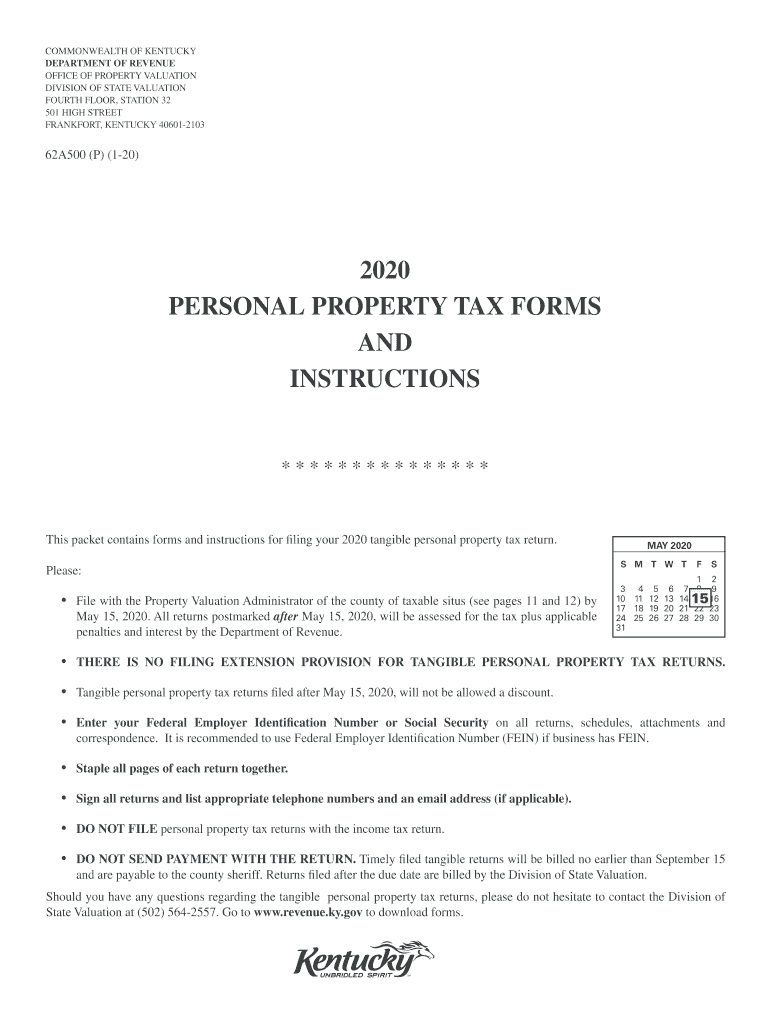
Of tangible personal property tax returns with property valued at $1,000 or less. Per HB 354, Sections 8, 9 and 81, KRS 132.010 and KRS 132.020 were amended to treat heavy rental equipment as inventory. Kentucky Department of Revenue Mission Statement As part of the Finance and Administration Cabinet, the mission of the Kentucky Department of Revenue is to administer tax laws, collect revenue, and provide services in a fair, courteous, and efficient manner for the benefit of the Commonwea.
Loading

Open form follow the instructions

Easily sign the form with your finger

Send filled & signed form or save
How to fill out the KY DoR 62A500 (P) online
Filling out the KY DoR 62A500 (P) form online is essential for reporting your tangible personal property tax in Kentucky. This guide provides step-by-step instructions to help you efficiently complete the form, ensuring compliance with state requirements.
Follow the steps to accurately complete the KY DoR 62A500 (P) form online.
- Click ‘Get Form’ button to obtain the KY DoR 62A500 (P) form and open it in your chosen digital editor.
- Enter your Federal Employer Identification Number or Social Security Number at the top of the form. Ensure you use the Federal Number if applicable.
- Provide your business name, telephone number, and address. It is crucial that you ensure the property location includes a street address and is not a P.O. box.
- Select the appropriate organization type and indicate whether this is a joint return or if property is present in multiple Kentucky counties.
- Complete the property assessment section by listing all tangible personal property assessed as of January 1 of the filing year. Attach any necessary ancillary schedules.
- For each property listed, include the original cost and the reported value using the provided calculation factors based on the economic life of the assets.
- Add up the totals from each schedule to obtain an overall total for both original cost and reported value. Ensure all calculations are accurate.
- Include any additional comments or explanations if necessary, particularly regarding any alternative valuation methods employed.
- Sign and date the form, and include contact information for both the taxpayer and any preparer if different.
- Once completed, save your changes, and prepare to submit the form digitally to the Property Valuation Administrator in your county before the deadline.
Ensure you complete your KY DoR 62A500 (P) submission online now to avoid late penalties.
Experience a faster way to fill out and sign forms on the web. Access the most extensive library of templates available.
Related content
Go to revenue.ky.gov to download forms. 62A500 (P) (1-25) ... These instructions do not...
Dec 31, 2022 — Revenue Form 62A500, Tangible Personal Property. Tax Return, is used to...
Get answers to your most pressing questions about US Legal Forms API.
Who must file Kentucky Form PTE?
Kentucky Form PTE must be filed by pass-through entities, such as partnerships and S corporations. These entities must report income that passes through to the owners for tax purposes. Understanding the filing requirements can be complicated, but the KY DoR 62A500 (P) serves as a valuable guide in navigating these responsibilities.
Does KY have a PTE tax?
Yes, Kentucky does have a Pass-Through Entity (PTE) tax that affects partnerships and S corporations. This tax requires that these entities file returns to report income distributed to their owners. For more information on the PTE tax, refer to the KY DoR 62A500 (P), which outlines what you need to know about compliance and filing.
Who must file KY form 725?
KY form 725 must be filed by any business that has gross income and is subject to Kentucky’s income tax structure. This form reports income, deductions, and calculates tax owed. For clarity, the KY DoR 62A500 (P) can help you correctly fill out this form and understand the implications of filing.
Who is exempt from Kentucky sales tax?
Certain entities, such as non-profit organizations and government agencies, are typically exempt from Kentucky sales tax. Additionally, specific goods, like prescription medications, may also qualify for exemptions. It is crucial to consult the KY DoR 62A500 (P) for a detailed list of exemptions to ensure compliance and understanding of your obligations.
Who is subject to KY llet?
KY llet applies to individuals or businesses that conduct sales of tangible personal property or certain services in Kentucky. If you are a seller and exceed a certain threshold in sales, you must comply with KY llet regulations. It's essential to stay informed on these rules for compliance, and the KY DoR 62A500 (P) can provide useful insights.
What is an example of a tangible personal property?
Tangible personal property includes items that you can physically touch, such as furniture, vehicles, and machinery. For example, office equipment used in a business setting qualifies as tangible personal property. Understanding what falls under this category is important, especially when filling out the appropriate forms, like those discussed in the KY DoR 62A500 (P).
Where to file a tangible personal property tax return?
In Kentucky, you file your tangible personal property tax return at your local county Property Valuation Administrator's office. Each county has its own office set up to handle property taxes. For more detailed instructions, refer to the KY DoR 62A500 (P), which provides insights on filing requirements and helps simplify the process.
How to calculate property taxes in Kentucky?
To calculate property taxes in Kentucky, you first need to determine the assessed value of your property. Multiply the assessed value by the local tax rate to arrive at your property tax amount. It's beneficial to refer to the KY DoR 62A500 (P) for specific guidelines, as these include regulations and resources that can clarify the tax calculation process.
What is not tangible personal property?
Items that are not tangible personal property include assets like stocks, bonds, and intellectual property rights. These assets lack physical form, differentiating them from tangible property for tax purposes. Understanding this distinction is key when navigating KY DoR 62A500 (P) regulations.
What are examples of intangible personal property?
Intangible personal property includes assets that do not have a physical presence, such as patents, trademarks, or stocks. While the KY DoR 62A500 (P) primarily focuses on tangible assets, being aware of both types of property is beneficial for comprehensive property tax assessments.
Use professional pre-built templates to fill in and sign documents online faster. Get access to thousands of forms.
If you believe that this page should be taken down, please follow our DMCA take down process here.
This form is available in several versions. Select the version you need from the drop-down list below.