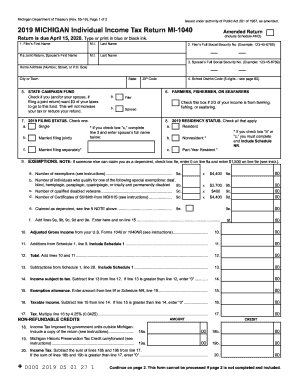
Line 14. If line 15 is greater than line 14, enter 0 ...................... 16. 00 17. Tax. Multiply line 16 by 4.25% (0.0425) ..................................................................................................... 17. 10. NON-REFUNDABLE CREDITS AMOUNT 00 CREDIT 18. Income Tax Imposed by government units outside Michigan. Include a copy of the return (see instructions)........................ 18a. 00 18b. 00 19. Michigan Historic Preservation Tax Credit carryf.
Open form follow the instructions
Easily sign the form with your finger
Send filled & signed form or save
How to fill out the MI MI-1040 online
Completing the MI MI-1040 form online can streamline the process of filing your individual income tax return for Michigan. This guide provides clear and concise instructions to help users successfully fill out each section of the form with ease.
Follow the steps to complete the form accurately.
- Press the ‘Get Form’ button to access the MI MI-1040 form and open it in your preferred online editor.
- Begin by entering the filer's first name, middle initial, and last name in the designated fields. If filing jointly, include the spouse's name as well.
- Input the full social security numbers for both the filer and the spouse, following the format provided.
- Provide the home address, including street number, city, and state, ensuring that all information is accurate.
- Check the box if you wish to contribute $3 to the state campaign fund. This decision does not affect your tax calculations.
- If applicable, check the box indicating that two-thirds of your income is derived from farming, fishing, or seafaring.
- Select your filing status by checking the appropriate box: single, married filing jointly, or married filing separately.
- Choose your residency status by marking all that apply: resident, nonresident, or part-year resident.
- Fill in the exemptions section, entering the number of exemptions and special exemptions if they apply to you.
- Complete the income section, including adjusted gross income and any additions or subtractions, to calculate your taxable income.
- Calculate the tax based on your taxable income and complete the tax liability section.
- Input any refundable credits and payments you are eligible for, including property tax and earned income tax credits.
- Review the lines for refunds or amounts due, calculating accordingly.
- If applicable, complete the direct deposit information for your refund by providing the routing number and account number.
- Finalize the form by providing signatures and dates for both the filer and spouse, if applicable.
- Once all information is complete and verified, you can save your changes, download, print, or share the form as needed.
Complete your MI MI-1040 form online today to ensure timely submission of your tax return.
Experience a faster way to fill out and sign forms on the web. Access the most extensive library of templates available.
Related content
Apr 15, 2025 — 2024 FILING STATUS. Check one. 8. 2024 RESIDENCY STATUS. Check all that...
Apr 18, 2023 — Michigan Historic Preservation Tax Credit (see instructions). 19a. 19b...
May 15, 2025 — A moonlight moth mix is a type of hunter's mix that players can drink to...
Get answers to your most pressing questions about US Legal Forms API.
What is the MI 1040 payment voucher?
The MI 1040 payment voucher, also known as the MI-1040-V, is a form you use to submit payments for your state income tax directly to the Michigan Department of Treasury. If you owe taxes when filing your MI-1040, this voucher allows you to ensure your payment is processed accurately. It’s essential to send this voucher with your payment to avoid potential late fees. Easily access this form through platforms such as uslegalforms to streamline your tax process.
Who is required to use Form 1040?
Form 1040 is required for individuals who meet the filing requirements based on their income, residency status, and other factors. If you earn income from various sources, including self-employment or investments, you must report this information on the 1040. Michigan also requires completion of the MI-1040 in conjunction with the federal form, depending on your circumstances. Tools like uslegalforms can assist you in ensuring compliance with both filings.
Who doesn't have to file a 1040?
You may not need to file a 1040 if your income is below the required filing threshold established by the IRS. Additionally, certain individuals, such as dependents or those only receiving non-taxable income, are exempt. Keep in mind that specific state requirements, like those for the MI-1040, may differ from federal rules. Therefore, check both state and federal guidelines to confirm if you need to file.
What is a MI 1040 tax form?
The MI 1040 tax form is the Michigan Individual Income Tax Return used by residents to report their taxable income to the state. This form allows you to calculate your tax liability based on your total income, deductions, and credits. Completing the MI-1040 accurately is crucial to avoid penalties or interest on unpaid taxes. Consider using online platforms like uslegalforms for guidance and easy access to the necessary forms.
Who has to file an MI 1040?
You need to file an MI 1040 if you are a Michigan resident with taxable income or if you have Michigan-sourced income as a non-resident. This includes wages, investment income, and other types of earnings. It’s important to determine your residency status accurately, as it affects your filing obligations. Using resources like uslegalforms can help ensure you complete the MI-1040 correctly.
Am I exempt from Michigan income tax?
Certain individuals may qualify for exemptions from Michigan income tax based on specific criteria, such as age, disability, or income level. If your income falls below the taxable threshold, you may not need to file the MI-1040. Additionally, certain retirement income may also be exempt. To confirm your eligibility for exemption, consult the Michigan Department of Treasury or a tax professional.
Who must file a Michigan income tax return?
In Michigan, you must file a state income tax return if your income exceeds a certain threshold, which depends on your filing status. Generally, if you are a resident and earned income during the year, you will need to complete the MI-1040 form. Additionally, non-residents with Michigan-sourced income are also required to file. Make sure to check the specific income limits to confirm your filing requirement.
What is a personal exemption on 1040?
A personal exemption on the 1040 form allows you to deduct a certain amount from your taxable income for yourself and dependents. This deduction reduces your taxable income, thus lowering your tax liability. When preparing your MI 1040, it's essential to include these exemptions to benefit from potential tax reductions.
How is MI tax calculated?
MI tax is calculated based on your taxable income after deductions and exemptions are applied. The state utilizes a flat tax rate, which simplifies the calculation process. Knowing how to properly calculate your tax can help you file your MI 1040 accurately and optimize your liabilities.
What is the personal property exemption in Michigan?
The personal property exemption in Michigan allows specific business personal property to be exempt from local taxes. This is crucial for small businesses as it can lead to significant savings. Always check for specific eligibility criteria on your MI 1040 to ensure you're maximizing your exemptions.
Use professional pre-built templates to fill in and sign documents online faster. Get access to thousands of forms.
If you believe that this page should be taken down, please follow our DMCA take down process here.
This form is available in several versions. Select the version you need from the drop-down list below.