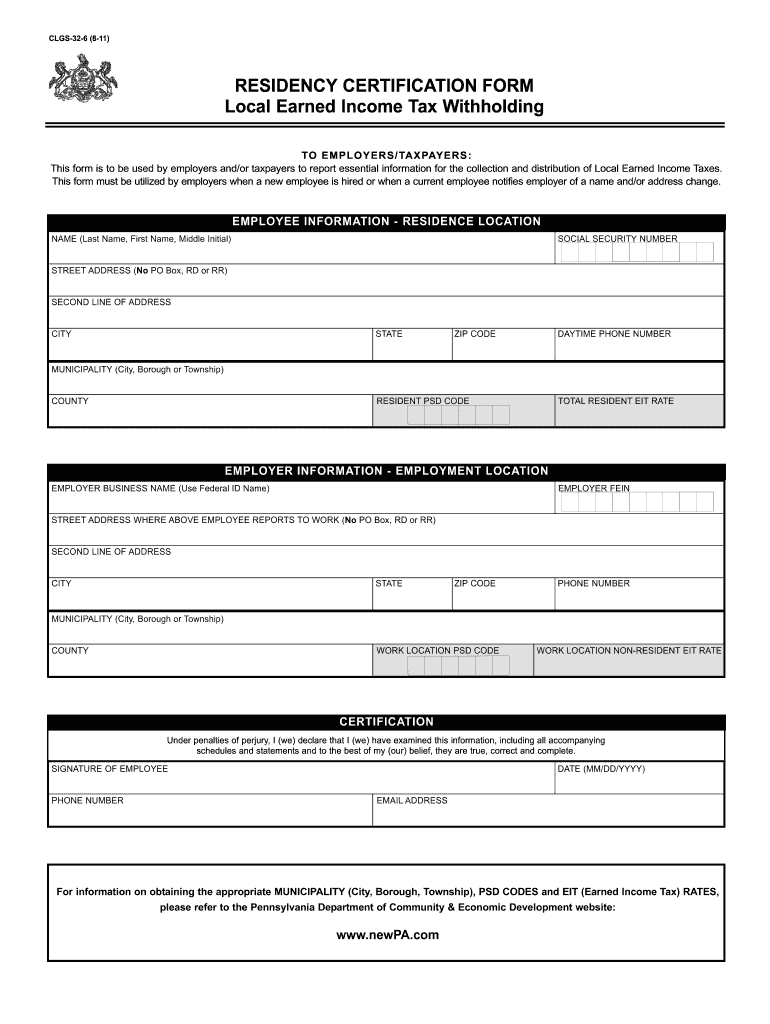
CLGS-32-6 8-11 RESIDENCY CERTIFICATION FORM Local Earned Income Tax Withholding TO E M P L O Y E R S / TA X PAY E R S This form is to be used by employers and/or taxpayers to report essential information for the collection and distribution of Local Earned Income Taxes. EMPLOYEE INFORMATION - RESIDENCE LOCATION NAME Last Name First Name Middle Initial SOCIAL SECURITY NUMBER STREET ADDRESS No PO Box RD or RR SECOND LINE OF ADDRESS CITY STATE ZIP CODE DAYTIME PHONE NUMBER MUNICIPALITY City Borough .
Loading

Open form follow the instructions

Easily sign the form with your finger

Send filled & signed form or save
How to fill out the PA DCED CLGS-32-6 online
The PA DCED CLGS-32-6 form is essential for employers and taxpayers to report necessary information for the collection and distribution of local earned income taxes. This guide provides a clear, step-by-step approach to completing the form online, ensuring accurate submission.
Follow the steps to successfully complete the PA DCED CLGS-32-6 form.
- Press the ‘Get Form’ button to access the PA DCED CLGS-32-6 and open it in your designated editor.
- Begin by entering the employee information. Fill out the fields for name, social security number, street address (avoid PO Boxes), second line of address, city, state, ZIP code, daytime phone number, municipality, county, resident PSD code, and total resident EIT rate.
- Next, provide the employer information. Input the employer business name following the Federal ID name, employer FEIN, the street address where the employee reports to work (again, avoiding PO Boxes), second line of address, city, state, ZIP code, phone number, municipality, county, work location PSD code, and work location non-resident EIT rate.
- In the certification section, ensure you understand the declaration and check the information for accuracy. Enter the signature of the employee, phone number, date, and email address.
- After completing all fields, review the information to confirm its completeness and correctness. You can then save changes, download the document, print it, or share it as necessary.
Complete your PA DCED CLGS-32-6 form online today for accurate local tax reporting.
Experience a faster way to fill out and sign forms on the web. Access the most extensive library of templates available.
Related content
please refer to the Pennsylvania Department of Community & Economic Development website:...
please refer to the Pennsylvania Department of Community & Economic Development website:...
Get answers to your most pressing questions about US Legal Forms API.
Do I need to file PA Schedule A?
You’ll need to file PA Schedule A if you itemize your deductions rather than taking the standard deduction. This form is essential for reporting unique deductions allowed by Pennsylvania. It’s advisable to follow the instructions linked with the PA DCED CLGS-32-6 to ensure you're correctly completing and submitting your forms.
How do I apply for a PA withholding account?
You can apply for a PA withholding account by submitting Form PA-100 online through the Department of Revenue's website. Make sure to provide all required information for proper processing. Utilizing the PA DCED CLGS-32-6 can streamline your setup for any associated withholding requirements.
What happens if I forgot to file local taxes in PA?
If you forget to file your local taxes in PA, you may incur penalties and interest on the unpaid amount. It's important to file as soon as possible to minimize these charges. Don’t forget that using the PA DCED CLGS-32-6 can help you in filing your necessary documents for local taxes.
How can I avoid underpayment penalty?
To avoid an underpayment penalty, make timely and accurate estimated tax payments based on your projected annual income. Review your withholding to ensure it meets at least 90% of your total tax due or matches last year's tax. For further guidance, consider resources like the PA DCED CLGS-32-6.
Where do I file a PA extension?
You can file a PA extension using the PA Department of Revenue's e-file system or by submitting Form REV-276 to the appropriate county or local tax office. Ensure that you submit it by the original due date of your tax return to avoid penalties. The PA DCED CLGS-32-6 form can be part of your filing process for related document submissions.
Who is exempt from Pennsylvania local services tax?
Individuals who earn less than a certain threshold may qualify for exemption from the Pennsylvania local services tax. Moreover, certain classifications, such as active duty military members, are often excluded from this tax. To confirm your eligibility, it's wise to consult local regulations and the guidelines provided in the PA DCED CLGS-32-6. This will ensure you have accurate information regarding any potential exemptions.
What is the local tax rate for PA?
Local tax rates in Pennsylvania differ significantly based on your municipality. Most residents will find that the local Earned Income Tax typically ranges from 1% to 3%. Also, additional rates may apply depending on the local services tax. To find your specific tax rate, check your local authority’s guidance and the PA DCED CLGS-32-6 form.
What income is taxable for PA local earned income tax?
In Pennsylvania, the local earned income tax applies to wages, salaries, commissions, and net profits from business activities. This tax targets all income earned within the state, regardless of where you reside. Therefore, consultants and freelancers should also consider their earnings. For detailed guidelines regarding taxable income, the PA DCED CLGS-32-6 is a great resource.
How much local tax is deducted from the paycheck in PA?
Local tax deductions in Pennsylvania can range from 0% to over 3%, depending on your municipality. Many areas impose a local Earned Income Tax alongside the state tax, which could lead to a cumulative effect on your paycheck. To understand your specific local tax deductions, review your local tax rate and consult relevant documents. The PA DCED CLGS-32-6 can assist in clarifying these deductions.
How do you calculate local tax withheld?
Local tax withheld is calculated based on the municipal tax ordinance where you live or work. Employers usually use the local tax rate provided by their jurisdiction to determine the right amount to withhold from each paycheck. Since local tax rates differ, it is crucial to check the specific rate for your area. For accurate calculations, refer to the PA DCED CLGS-32-6 form.
Use professional pre-built templates to fill in and sign documents online faster. Get access to thousands of forms.
If you believe that this page should be taken down, please follow our DMCA take down process here.
This form is available in several versions. Select the version you need from the drop-down list below.