Loading
Get Ny Dtf Ifta-101 (formerly Ifta-101-mn) 2019-2026
How it works
-

Open form follow the instructions
-

Easily sign the form with your finger
-

Send filled & signed form or save
How to fill out the NY DTF IFTA-101 (Formerly IFTA-101-MN) online
Filling out the NY DTF IFTA-101 form online can be a straightforward process when you understand each section and its requirements. This guide provides step-by-step instructions to assist you in accurately completing the form to ensure compliance.
Follow the steps to successfully complete the online form.
- Click the ‘Get Form’ button to access the document and open it in your preferred editing tool.
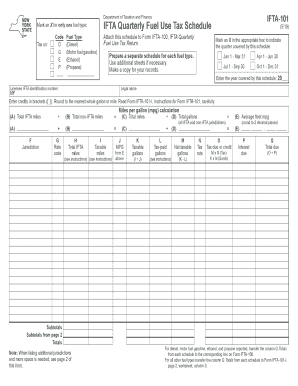
- Mark an X in the box for only one fuel type, selecting from diesel, motor fuel gasoline, ethanol, or propane. Ensure that this reflects the type you are reporting for the quarter.
- Indicate the quarter you are covering by marking an X in the appropriate box.
- Enter the year that corresponds to this schedule in the designated field.
- Provide your legal name in the relevant section, ensuring accuracy as it appears on official documentation.
- Complete the miles calculation section: list total IFTA miles, total non-IFTA miles, and calculate total miles and average fleet mpg as instructed.
- Fill out the jurisdiction details on page 1 and page 2, ensuring you calculate and enter taxable miles, gallons, tax rates, and total due correctly.
- If additional space is needed for jurisdictions, utilize page 2 of the form as indicated.
- Review the calculations in the subtotals and ensure they accurately reflect the data you have entered.
- Once completed, you can save your changes, download the document, print it for your records, or share it as needed.
Take the next step and complete your NY DTF IFTA-101 online today!
Related links form
To calculate miles per gallon for IFTA, divide the total taxable miles driven by the total gallons of fuel consumed. This simple formula plays an important role in the NY DTF IFTA-101 (Formerly IFTA-101-MN) calculations. Keeping track of both figures enables you to manage tax liabilities effectively. Continuous monitoring of miles per gallon can also enhance your overall fuel efficiency.