Loading
Get Ny Dtf Ft-960 2011-2026
How it works
-

Open form follow the instructions
-

Easily sign the form with your finger
-

Send filled & signed form or save
How to fill out the NY DTF FT-960 online
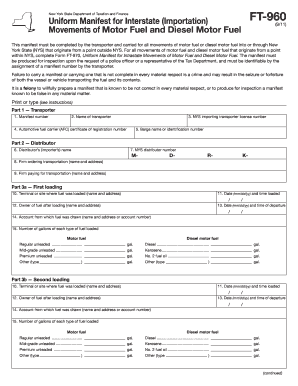
This guide provides a detailed overview of how to complete the NY DTF FT-960 form online. Designed for transporters of motor fuel and diesel motor fuel into or through New York State, this form is essential for compliance and legal documentation.
Follow the steps to complete the form effectively.
- Click the ‘Get Form’ button to obtain the form and open it in your editor.
- In Part 1, enter the manifest number, name of the transporter, NYS importing transporter license number, automotive fuel carrier certificate of registration number, and barge name or identification number.
- In Part 2, provide the distributor’s name and NYS distributor number, as well as the name and address of the firm ordering transportation and the firm paying for transportation.
- For Part 3a, enter the terminal or site where fuel was loaded along with the date and time of loading. Fill in the owner's name and address after loading, the date and time of departure, account from which fuel was drawn, and the number of gallons of each type of fuel loaded.
- Repeat Step 4 for Part 3b if you have a second loading, ensuring all information is accurate and complete.
- In Part 4a, document the terminal or site for off-loading, date and time of delivery, account into which fuel is to be delivered, and the number of gallons of each type of fuel to be off-loaded.
- Follow the same instructions for Part 4b and 4c for additional off-loadings, noting all required details.
- Once completed, you can save changes, download the form, print it for your records, or share it as necessary.
Complete your NY DTF FT-960 form online today to ensure compliance with state regulations.
When deciding what to put for your withholding allowance, consider your personal financial circumstances and tax situation. Use the IRS withholding calculator or consult a tax professional to help estimate the appropriate number. This ensures that you neither under-withhold nor over-withhold, aligning closely with your tax obligations when filing your return.