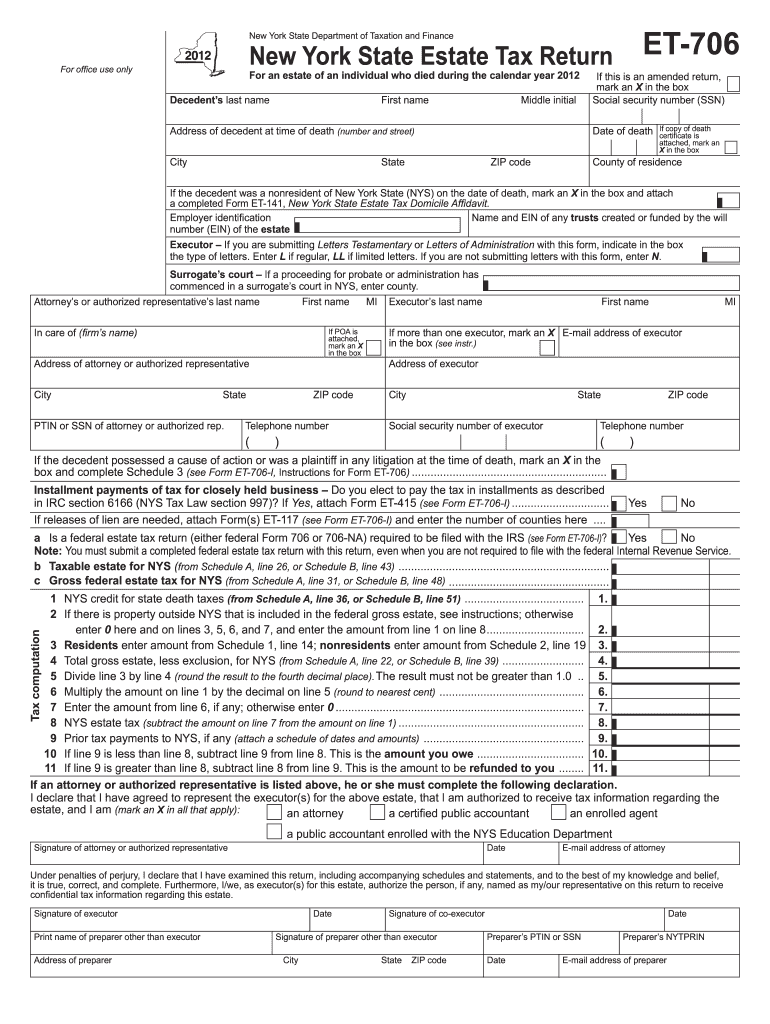
R state death taxes (from Schedule A, line 36, or Schedule B, line 51) ....................................... 1. 2 If there is property outside NYS that is included in the federal gross estate, see instructions; otherwise enter 0 here and on lines 3, 5, 6, and 7, and enter the amount from line 1 on line 8. .............................. 2. . 3 Residents enter amount from Schedule 1, line 14; nonresidents enter amount from Schedule 2, line 19 3. 4 Total gross estate, less.

Open form follow the instructions

Easily sign the form with your finger

Send filled & signed form or save
How to fill out the NY DTF ET-706 online
Filling out the NY DTF ET-706 form is an essential step for managing the estate tax obligations of individuals who have passed away. This guide provides a clear and supportive approach to completing the form online, ensuring a smooth process for users regardless of their legal experience.
Follow the steps to complete the NY DTF ET-706 form online.
- Click ‘Get Form’ button to access the form and open it in the editor. This action allows you to begin entering the required information.
- Begin by entering the decedent's last name, first name, and middle initial. Ensure that you use accurate spelling to avoid any issues with processing.
- Provide the address of the decedent at the time of their death, including the street number, city, state, and ZIP code.
- Indicate if this is an amended return by marking an X in the provided box, and include the decedent's Social Security number (SSN) and date of death.
- Specify the county of residence and indicate if the decedent was a nonresident of New York State by marking the respective box. If applicable, attach a completed Form ET-141.
- Fill in the employer identification number (EIN) of the estate and provide the name and EIN of any trusts created or funded by the will.
- Indicate the type of letters received, if any, using the provided options. If no letters are submitted, mark N in the box.
- Complete the details for the executor, including their name, address, email, and social security number. Ensure that all information is accurate.
- If applicable, cover details regarding any causes of action the decedent was involved in and confirm whether tax payments for closely held businesses will be made in installments.
- Proceed to calculate the tax by filling out the relevant lines in the tax computation section, ensuring you refer to any federal estate tax returns as required.
- Sign and date the form once all necessary information is entered. Make sure both the executor and any authorized representatives sign where necessary.
- Finally, users can save changes, download, print, or share the completed form for submission.
Begin filling out the NY DTF ET-706 online today to ensure compliance with New York estate tax requirements.
Experience a faster way to fill out and sign forms on the web. Access the most extensive library of templates available.
Related content
Yes. No. Note: You must submit a completed federal estate tax return with this return...
by GB Born · Cited by 82 — The United Nations Convention on the Recognition and...
This publication contains information on the emula- tion of 1401, 1440, and 1460 object...
Get answers to your most pressing questions about US Legal Forms API.
When must a form 706 be filed?
Form 706 must be filed within nine months after the date of death of the individual whose estate is being administered. However, you may apply for a six-month extension if more time is needed to gather necessary information. It is advisable to stay informed of the deadlines associated with the NY DTF ET-706 to avoid penalties.
Do I have to file an estate tax return in NY?
Yes, in New York, you are required to file an estate tax return if the gross value of the estate exceeds the state's estate tax threshold. This return is crucial for determining any estate taxes owed, ensuring compliance with state law. For assistance with the process and to ease the filing of the NY DTF ET-706, consider using tools available through USLegalForms.
Do you have to file a 706 to get a step up in basis?
You do not need to file Form 706 solely to receive a step-up in basis, as this adjustment occurs automatically upon inheritance. However, filing the form is essential for estates exceeding the IRS exemption threshold, allowing for proper tax calculations. Utilizing resources like USLegalForms can help manage the requirements of the NY DTF ET-706 effectively.
How to establish stepped-up basis?
To establish a stepped-up basis, you must determine the fair market value of the property at the date of the owner's death. Documentation supporting this valuation, such as appraisals or market analyses, is beneficial. When discussing this basis in estate planning and tax filings, including forms like the NY DTF ET-706, clear records can simplify the process.
Does the IRS require an appraisal for stepped-up basis?
While the IRS does not explicitly require an appraisal for stepped-up basis, obtaining one is often advisable. An appraisal provides a credible value for the property, minimizing disputes with the IRS in case of audits. This can be particularly important when filing the NY DTF ET-706, as accurate valuation directly impacts estate tax obligations.
What is the requirement for filing form 706?
To file Form 706, also known as the United States Estate (and Generation-Skipping Transfer) Tax Return, your estate must exceed a specific exemption amount set by the IRS. This form is necessary to report and calculate estate taxes due, ensuring compliance with federal regulations. For detailed guidance, you may consider using a service like USLegalForms to navigate the complexities of the NY DTF ET-706.
Do I have to report the sale of inherited property to the IRS?
Yes, when you sell inherited property, you must report the sale to the IRS. The sale of the inherited property may have tax implications, particularly concerning capital gains taxes. Understanding the NY DTF ET-706 can further clarify your obligations and potential deductions associated with the inherited property transaction.
Do I need to file an estate tax return in NY?
If the estate exceeds the New York threshold, you must file an estate tax return in NY. It's critical to consult the NY DTF ET-706 for specific guidelines and ensure that you meet all filing requirements. Ignoring these obligations can lead to penalties, so taking action promptly is advisable.
Who signs 706 if there is no executor?
If there is no executor, a court-appointed administrator can sign form 706. Alternatively, a close family member may be able to serve in this role. Understanding the NY DTF ET-706 process can help clarify the necessary steps to appoint an administrator and file correctly.
Do all estates have to file federal estate income tax returns?
Not all estates need to file federal estate income tax returns, but if an estate earns income over a certain amount, filing is required. It's important to evaluate the estate's income and understand the correlation with your NY DTF ET-706 obligations. Consulting with a tax professional is always wise.
Use professional pre-built templates to fill in and sign documents online faster. Get access to thousands of forms.
If you believe that this page should be taken down, please follow our DMCA take down process here.
This form is available in several versions. Select the version you need from the drop-down list below.