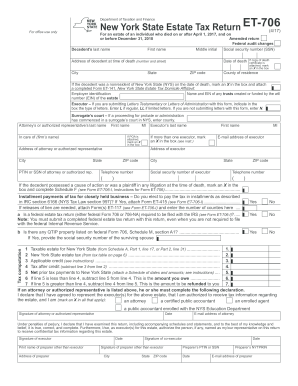
F, it is true, correct, and complete. Furthermore, I/we, as executor(s) for this estate, authorize the person, if any, named as my/our representative on this return to receive confidential tax information regarding this estate. Signature of executor Print name of preparer other than executor Address of preparer Date Signature of co-executor Signature of preparer other than executor City State ZIP code Date Preparer s PTIN or SSN Date Preparer s NYTPRIN E-mail address.

How it works
  • Open form

    Open form follow the instructions

  • Easily sign form

    Easily sign the form with your finger

  • Share form

    Send filled & signed form or save

How to fill out the NY DTF ET-706 online

The New York State Estate Tax Return (ET-706) is a necessary document for individuals who are managing the estate of someone who passed away in New York State. This guide provides detailed, step-by-step instructions to help you complete the form accurately and efficiently online.

Follow the steps to successfully complete the NY DTF ET-706 online.

  1. Press the ‘Get Form’ button to access the New York State Estate Tax Return and open it in your preferred online tool.
  2. Begin by filling out the Decedent’s last name, first name, middle initial, social security number, and last address at the time of death.
  3. Indicate the date of death and provide the decedent's county of residence.
  4. If applicable, check the box to confirm that you are attaching a copy of the death certificate.
  5. Specify if the decedent was a nonresident of New York State by marking the appropriate box and attaching Form ET-141 if necessary.
  6. Complete the section for any trusts created or funded by the will, including their names and Employer Identification Numbers (EINs).
  7. Indicate the type of Letters Testamentary or Letters of Administration if submitting with this form.
  8. Provide the attorney's or authorized representative's information, including name, address, and contact details.
  9. Complete relevant fields related to any cause of action the decedent was involved with, marking the box if applicable.
  10. Fill in the tax computation section starting with the taxable estate and subsequent calculations as provided on the form.
  11. If an attorney is involved, they must complete their declaration and signature in the designated section.
  12. Review all sections for accuracy, then proceed to save any changes you made to the form, download it, and print or share it as needed.

Complete your documents online with confidence today!

Get form

Experience a faster way to fill out and sign forms on the web. Access the most extensive library of templates available.

Related content

ET-706 - New York State Estate Tax Return

Yes. No. Note: You must submit a completed federal estate tax return with this return...

Learn more
The New York Convention: A Self-Executing Treaty

by GB Born · Cited by 82 — The United Nations Convention on the Recognition and...

Learn more
1401/1440/1460 Emulator Programs Compatibility...

This publication contains information on the emula- tion of 1401, 1440, and 1460 object...

Learn more
Questions & Answers

Get answers to your most pressing questions about US Legal Forms API.

Contact support

Does every estate have to file a form 706?

Not every estate is required to file Form 706; only those exceeding the federal estate tax exemption amount must do so. Filing is crucial in determining tax obligations and ensuring compliance with both federal and state regulations. Additionally, when relevant, the NY DTF ET-706 may also apply in these cases. If you're uncertain, seeking advice from a qualified professional can help clarify your filing requirements.

To avoid New York state estate tax, one effective strategy is to understand gifting limits and how to utilize them. Transferring assets below the exemption limit can minimize potential estate tax liabilities. It is also advisable to explore strategies and support related to the NY DTF ET-706 for tailored approaches. Consult with a tax planner for personalized advice on this matter.

In New York State, you can inherit up to a certain amount without owing any estate taxes, which changes based on current tax laws. Familiarizing yourself with the exemption limits can help you understand your inheritance better. Utilizing resources related to the NY DTF ET-706 can assist you in navigating any potential tax implications. Consulting with an expert can provide peace of mind as you manage your inheritance.

NYS DTF sales tax is the tax applied to the sale of goods and services in New York State. This tax is vital for businesses operating within the state and helps fund public services. If you're a business owner, understanding how to correctly apply and collect this tax using the proper forms, like the NY DTF ET-706, is essential. Staying compliant with sales tax regulations safeguards your business.

You do not need to file Form 709 if you have made gifts that fall below the annual exclusion limit. Since this form is used for reporting gift taxes, many individuals may find they are not required to file, especially if gifts are below the threshold. However, it is important to consider estate tax implications, particularly in the context of the NY DTF ET-706. Consulting a tax professional can provide clarity.

You must file Form 706 if the gross value of the estate exceeds the federal exemption limit. This form is essential for federal estate tax return purposes and helps determine tax liability. In New York, you may also need to consider the state-specific regulations and forms, including the NY DTF ET-706. Keeping accurate records is crucial for fulfilling this requirement.

Estate tax typically applies to the value of a deceased person's estate, which includes all assets owned at the time of death. In New York, estates exceeding a certain threshold may be subject to tax. Understanding this tax is crucial for accurate filing, especially when using forms like the NY DTF ET-706. Consulting with a professional can help clarify your situation and obligations.

Yes, you must report the sale of inherited property to the IRS. When you sell inherited property, you typically need to calculate your gain or loss, which involves the property's fair market value at the time of the deceased's death. This information is essential when using form NY DTF ET-706 and can impact any estate tax considerations. Proper reporting ensures compliance with tax regulations and helps you avoid potential issues.

If you find yourself in a situation without an executor, you should first check if any family members or friends are willing to take on the role. If not, consider petitioning the probate court for an administrator to manage estate affairs. It's also advisable to seek legal help to guide you through this process. Using platforms like USLegalForms can provide the necessary templates and guidance to address your unique circumstances.

The executor, or administrator of the estate, typically fills out the IRS form 706. In cases where there is no executor, another responsible individual managing the estate can complete this form. Ensuring that you accurately report the necessary details, including assets and liabilities, is crucial for compliance. Services like USLegalForms can assist you in navigating this paperwork efficiently.

Get This Form Now!

Use professional pre-built templates to fill in and sign documents online faster. Get access to thousands of forms.

If you believe that this page should be taken down, please follow our DMCA take down process here.

NY DTF ET-706 Form

This form is available in several versions. Select the version you need from the drop-down list below.

Get NY DTF ET-706