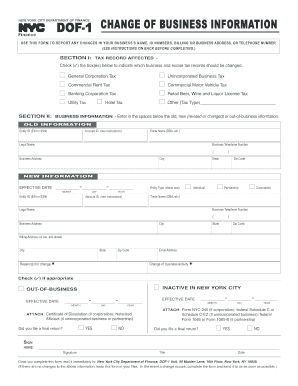
ONE NUMBER. (SEE INSTRUCTIONS ON BACK BEFORE COMPLETING.) SECTION I: TAX RECORD AFFECTED - Check (3) the box(es) below to indicate which business and excise tax records should be changed. n n n n n n n n General Corporation Tax Commercial Rent Tax Banking Corporation Tax n Utility Tax Hotel Tax SECTION II: BUSINESS INFORMATION OLD INFORMATION Entity ID (EIN or SSN) Unincorporated Business Tax Commercial Motor Vehicle Tax Retail Beer, Wine and Liquor License Tax Other (Tax Type).

How it works
  • Open form

    Open form follow the instructions

  • Easily sign form

    Easily sign the form with your finger

  • Share form

    Send filled & signed form or save

How to fill out the NY DOF 1 online

Filling out the NY DOF 1 form is essential for notifying the New York City Department of Finance about any changes to your business information. This guide offers a comprehensive overview and step-by-step instructions to help you complete the form efficiently and accurately.

Follow the steps to successfully complete your NY DOF 1 form.

  1. Click ‘Get Form’ button to access the NY DOF 1 form and open it for editing.
  2. In Section I, tax record affected, check the box(es) corresponding to the tax records that will be updated. Make sure to select all that apply.
  3. Proceed to Section II, Business Information. Enter your old information such as Entity ID (EIN or SSN), Account ID, Trade Name, Legal Name, Business Telephone Number, and Business Address in the designated fields.
  4. Now, fill in the new information in the appropriate sections. Include the new Entity ID, Account ID, Trade Name, Legal Name, Business Telephone Number, and Business Address.
  5. Indicate the effective date of the changes by filling in the month, day, and year.
  6. Select the Entity Type (individual, partnership, or corporation) and provide necessary details, including reasons for the change.
  7. Sign the form, including your title and the date, and ensure all fields are completed accurately.
  8. Once you complete the form, save your changes, and choose to download, print, or share the form as needed, then mail it to the New York City Department of Finance.

Complete your NY DOF 1 form online today to ensure your business information is up to date.

Get form

Experience a faster way to fill out and sign forms on the web. Access the most extensive library of templates available.

Related content

DOF-1 CHANGE OF BUSINESS INFORMATION

The purpose of Form DOF-1, Change of Business Information, is to pro- vide a simple and...

Learn more
New York Dept Of Finance

New York Dept Of Finance · 1. Property Assessment and Taxation · 2. Tax Collection and...

Learn more
MANUAL DO USUÁRIO

IEC 60601-1-1:2000, Equipamentos Médicos Elétricos – Parte 1-1. Requisitos Gerais de...

Learn more
Questions & Answers

Get answers to your most pressing questions about US Legal Forms API.

Contact support

What's the difference between a CPA and a tax preparer?

A CPA, or Certified Public Accountant, has completed extensive education and passed a rigorous exam, allowing them to offer a wide range of financial services beyond tax preparation. In contrast, a tax preparer focuses primarily on preparing tax returns. If you need assistance with either, US Legal Forms can guide you in choosing the right service for your needs.

To contact the NYC Department of Finance (DOF), you can visit their official website or call their dedicated customer service line. They provide comprehensive resources for tax inquiries, payments, and assistance. For additional help on navigating NYC tax forms or finding specific documents, check out US Legal Forms for quick and easy access.

No, box 16 and box 1 on the NY W-2 serve different purposes. Box 1 shows your total taxable income, while box 16 reflects the amount of income subject to NY state tax. If you're looking for detailed guidance on tax documents, US Legal Forms can help clarify these definitions and provide the necessary forms.

Yes, being a tax preparer can be a great side hustle, especially during tax season. To get started, you may need to obtain certain certifications and ensure you stay updated on tax laws. If you're looking for tools and resources to assist you, the US Legal Forms platform offers valuable materials that can help you navigate tax preparation.

Tax class 1 in NYC consists of residential properties with one to three units, including homes and small apartment buildings. This classification generally benefits from lower tax rates compared to other classes, making it more affordable for homeowners and small landlords. For detailed information on tax assessments and appeals related to class 1 properties, resources like USLegalForms can provide valuable assistance.

The mission of the NYC Department of Finance (NY DOF) focuses on promoting the effective collection of revenue, maintaining equitable property taxation, and ensuring transparency in financial operations. They aim to serve the public interest by providing exceptional service and clear communication. Understanding the mission can enhance your experience while engaging with NYC's financial processes.

Receiving a letter from the NYC Department of Finance (NY DOF) can happen for various reasons, such as changes to your property tax assessment, billing inquiries, or notification about upcoming deadlines. It's important to read the letter carefully and respond promptly to any requests for information. If you have questions regarding the letter, consider reaching out to an expert or using platforms like USLegalForms for additional guidance.

In the context of a partnership firm, DOF stands for Deed of Formation. This document outlines the terms and conditions under which the partnership operates. Having a clear Deed of Formation is crucial as it establishes the relationship among partners, including their roles, responsibilities, and profit-sharing arrangements.

In New York, partnerships are generally not taxed at the entity level, meaning income is passed through to the partners. Each partner reports their share of income on their personal tax returns, subjecting it to their individual tax rates. It's essential to consult a tax professional to navigate the specific implications of partnership taxation in New York.

Class 1 properties in NYC are primarily residential buildings with up to three units, such as single-family homes and small apartment buildings. Conversely, Class 2 properties include larger rental buildings, commercial properties, and mixed-use properties. The taxation rates and regulations may differ between these classes, affecting property owners in various ways.

Get This Form Now!

Use professional pre-built templates to fill in and sign documents online faster. Get access to thousands of forms.

If you believe that this page should be taken down, please follow our DMCA take down process here.

NY DOF 1 Form

This form is available in several versions. Select the version you need from the drop-down list below.

Get NY DOF 1