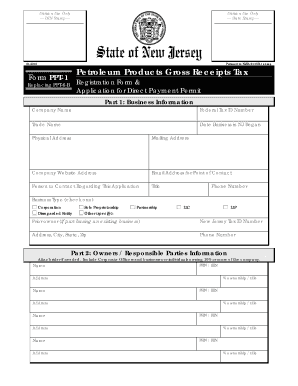
Division Use Only DLN Stamp Date Stamp 01-2013 Pursuant to NJSA 54 15B-1 et seq Petroleum Products Gross Receipts Tax Form PPT-1 Registration Form Application for Direct Payment Permit Replacing PPT-6-B Part 1 Business Information Company Name Federal Tax ID Number Trade Name Date Business in NJ Began Physical Address Mailing Address Company Website Address Email Address for Point of Contact Person to Contact Regarding This Application Title Phone Number Business Type check one Corporation Sole .

How it works
  • Open form

    Open form follow the instructions

  • Easily sign form

    Easily sign the form with your finger

  • Share form

    Send filled & signed form or save

How to fill out the NJ PPT-1 (Formerly PPT-6-B) online

Filling out the NJ PPT-1 form correctly is crucial for businesses seeking to register for the Petroleum Products Gross Receipts Tax and apply for a Direct Payment Permit. This guide provides step-by-step instructions to help you navigate the process with confidence.

Follow the steps to complete the NJ PPT-1 online.

  1. Click 'Get Form' button to obtain the form and open it in the editor.
  2. Complete Part 1: Business Information. Provide details such as your company name, federal tax ID number, trade name, and addresses (physical and mailing). Don’t forget to include your email address for contact and the business type.
  3. In Part 2: Owners / Responsible Parties Information, list individuals or businesses who own 10% or more of the company. Ensure to attach a rider if you have more individuals to include.
  4. In Part 3: Business Activities, describe the business model and regular activities, and list your intended suppliers, customers, and products you plan to sell.
  5. For Part 4: Application for Direct Payment Permit, indicate whether your business is requesting a Direct Payment Permit or simply needs to register for the Petroleum Products Gross Receipts Tax.
  6. Complete Part 5: Affirmation by having the owner or authorized officer sign and print their name and title, affirming the completeness and accuracy of the information provided.
  7. Finally, save your changes, and you can either download, print, or share the completed form as needed.

Complete the NJ PPT-1 form online today to ensure your business is properly registered.

Get form

Experience a faster way to fill out and sign forms on the web. Access the most extensive library of templates available.

Related content

Petroleum Products Gross Receipts Tax (Ppgrt)...

Oct 14, 2016 — Taxpayers that qualify for this exclusion and do not currently hold a...

Learn more
New Jersey Renewable Energy Market Assessment

Aug 2, 2004 — Rutgers University's Center for Energy, Economic and Environmental Policy...

Learn more
Site Remediation Program Monitored Natural...

Mar 1, 2012 — Technical Guidance. DATE. 3/1/2012. Page 2. Version: 1.0. March 1, 2012...

Learn more
Questions & Answers

Get answers to your most pressing questions about US Legal Forms API.

Contact support

What is the gross receipts tax rate for petroleum in New Jersey?

The gross receipts tax rate for petroleum products in New Jersey varies based on the type of product sold. This tax applies to businesses that deal specifically in petroleum, making it essential for compliance. By exploring details about the NJ PPT-1 (Formerly PPT-6-B), you can gain insights that will clarify your tax obligations.

The New Jersey gross receipts tax is a tax levied on the total revenue a business generates. This tax applies to various business sectors and helps fund state initiatives. For businesses affected by these taxes, understanding how to file and comply is crucial, especially in relation to NJ PPT-1 (Formerly PPT-6-B).

New Jersey has a fuel tax levied on gasoline and diesel fuel. This tax helps fund transportation projects and maintenance of infrastructure throughout the state. Staying informed about the fuel tax not only assists in compliance but also relates to the details covered under NJ PPT-1 (Formerly PPT-6-B).

Yes, New Jersey imposes a gross receipts tax on certain businesses for their total sales. This tax applies to various sectors, including services and goods sales, with specific rates and exemptions. If you operate in New Jersey, understanding the gross receipts tax further complements your knowledge of NJ PPT-1 (Formerly PPT-6-B).

The petroleum Superfund tax is a federal tax dedicated to funding the cleanup of hazardous waste sites. This tax rate is typically calculated based on the quantity of petroleum products sold. By learning more about this tax and its implications through resources such as NJ PPT-1 (Formerly PPT-6-B), you can better navigate your responsibilities as a taxpayer.

New Jersey's gross income tax is a tax on the income earned by individuals and businesses, distinct from the gross receipts tax. This tax applies to various forms of earned income, including wages, interest, and dividends. Understanding both the gross income tax and the gross receipts tax is vital for financial planning in New Jersey. The NJ PPT-1 (Formerly PPT-6-B) can provide necessary guidance to ensure compliance with both tax types.

The gross receipts tax serves as a way for states to generate revenue from businesses' total sales. Essentially, it taxes the overall income a business makes before deducting any expenses. This tax helps fund public services, making it essential for state operations. Understanding the NJ PPT-1 (Formerly PPT-6-B) can clarify how these taxes impact your business.

Filling out the ST-4 form in New Jersey requires accurate input of relevant financial details regarding your business operations. This form is crucial for those seeking exemptions from sales tax under specific circumstances. Utilizing resources available through uslegalforms can simplify the process, ensuring you adhere to requirements while filing the NJ PPT-1 (Formerly PPT-6-B).

New Jersey's gross income tax is a tax applied to income earned by residents and some non-residents within the state. The rates vary based on income brackets, ensuring a fair tax system. For businesses dealing with petroleum products, adherence to the regulations under NJ PPT-1 (Formerly PPT-6-B) is vital for effective compliance.

In the United States, the petroleum tax varies by state and is typically imposed on the sale of crude oil and its derivatives. This tax contributes to federal and state infrastructure, environmental, and public health programs. Understanding the implications of these taxes can be crucial, especially when filling out forms such as NJ PPT-1 (Formerly PPT-6-B).

Get This Form Now!

Use professional pre-built templates to fill in and sign documents online faster. Get access to thousands of forms.

If you believe that this page should be taken down, please follow our DMCA take down process here.

Get NJ PPT-1 (Formerly PPT-6-B)