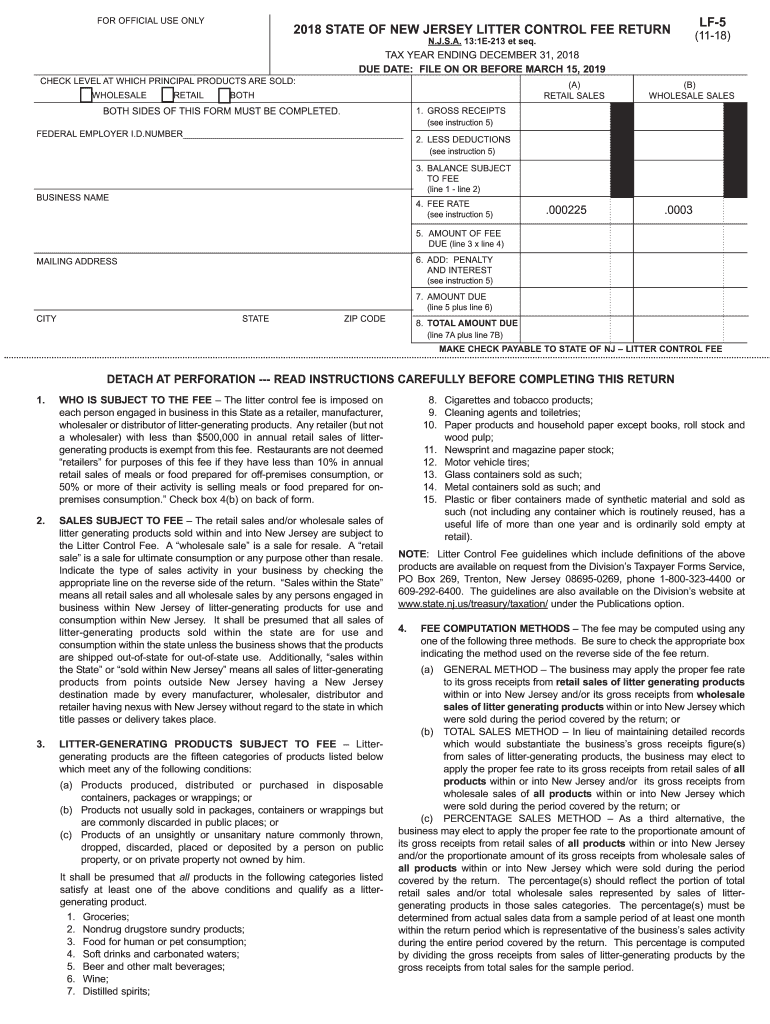
Ackages or wrappings; or (b) Products not usually sold in packages, containers or wrappings but are commonly discarded in public places; or (c) Products of an unsightly or unsanitary nature commonly thrown, dropped, discarded, placed or deposited by a person on public property, or on private property not owned by him. It shall be presumed that all products in the following categories listed satisfy at least one of the above conditions and qualify as a littergenerating product. 1. Groceries; 2.
Loading

Open form follow the instructions

Easily sign the form with your finger

Send filled & signed form or save
How to fill out the NJ DoT LF-5 online
The NJ DoT LF-5 form is essential for reporting litter control fees for businesses operating in New Jersey. This guide provides a straightforward approach to assist users in accurately completing the form online, ensuring compliance with state regulations.
Follow the steps to complete the NJ DoT LF-5 online effectively.
- Press the ‘Get Form’ button to access the NJ DoT LF-5 form online and open it in the editor.
- Indicate the sales level at which the principal products are sold by selecting either wholesale, retail, or both.
- Enter the federal employer identification number in the designated field.
- In Section A, input the gross receipts from both retail and wholesale sales of litter-generating products within New Jersey.
- Document any deductions applicable to the gross receipts in line 2.
- Calculate the balance subject to the fee by subtracting line 2 from line 1.
- Select the appropriate fee rate and compute the amount due by multiplying the balance by the fee rate.
- Add any applicable penalties and interest to line 5 to determine the total amount due.
- Complete the principal business activity section and check the applicable items regarding exemption from the fee.
- Sign and date the form on the line designated for authorized officer, and ensure the return preparer's signature and information are provided.
- Finally, confirm all entries are complete, save changes, and proceed to download, print, or share the completed form.
Complete your NJ DoT LF-5 form online today for a streamlined submission experience.
Experience a faster way to fill out and sign forms on the web. Access the most extensive library of templates available.
Related content
WHO IS SUBJECT TO THE FEE – The litter control fee is imposed on each person engaged in...
by EY Hajj · 2021 · Cited by 6 — NJDOT developed and implemented PBS for five...
Dec 17, 2007 — THE CLEAR SPACE IN THE CURB OPENING. (OR EACH INDIVIDUAL CLEAR SPACE, IF...
Get answers to your most pressing questions about US Legal Forms API.
What is the 3.5 sales tax in New Jersey?
New Jersey imposes a 3.5% sales tax on certain goods and services, which is an essential source of revenue for state operations. This tax structure is part of broader financial regulations regulated by NJ DoT LF-5. Understanding this tax can help you make informed decisions while shopping, and platforms like US Legal Forms can guide you through any related legal forms and compliance you might need.
Is NJ Transit part of NJ DOT?
Yes, NJ Transit operates under the New Jersey Department of Transportation (NJ DOT). It's crucial for commuters to understand this connection, as NJ Transit plays a key role in public transportation infrastructure. The NJ DoT LF-5 initiatives often influence transit development, ensuring that transportation services are efficient and accessible for everyone throughout the state.
What is the fine for littering in New Jersey?
Littering in New Jersey can lead to significant fines, with penalties ranging from $500 to $1,000 for first-time offenders. This violation aligns with the NJ DoT LF-5 regulations, which aim to promote cleanliness and environmental awareness. If you want to avoid these fines, it's essential to dispose of waste properly and educate others about the importance of keeping our communities clean.
How to order NJ tax forms?
Ordering NJ tax forms is straightforward and can be done through the New Jersey Division of Taxation's website. You can also use services like uslegalforms to access the NJ DoT LF-5 and other essential documents conveniently. It's a smart move to keep the necessary forms on hand, especially as deadlines approach. Ensure you have the correct forms to avoid any issues with your filing.
Who needs to file a NJ state tax return?
You need to file a New Jersey state tax return if your income exceeds the thresholds set by the state. This rule applies to both residents and non-residents with income generated in New Jersey. Utilizing the NJ DoT LF-5 can help determine your filing obligations and ensure you meet all necessary requirements. Always check with a tax professional for personalized advice.
Who needs to file NJ 500?
Individuals earning income in New Jersey generally need to file the NJ 500. This includes residents and non-residents who meet specific income thresholds. Utilizing the NJ DoT LF-5 can help clarify if you are required to file, making the experience smoother. Files must be submitted timely to avoid unnecessary complications.
Who must file NJ inheritance tax return?
Anyone receiving an inheritance in New Jersey may need to file an NJ inheritance tax return. This requirement depends on the relationship to the deceased and the value of the inheritance received. Utilizing the NJ DoT LF-5 can simplify the process, ensuring you adhere to the tax obligations properly. Always consult the guidelines to ensure you take the correct steps.
Do I have to file NJ 500?
Filing the NJ 500 is necessary for various income situations, particularly if you earn income in New Jersey. If your income meets the reporting thresholds, you must submit this form to the state. The NJ DoT LF-5 can guide you through the filing process, helping you understand whether you fall under the requirement. It's crucial to stay compliant to avoid penalties or interest charges.
Who is eligible for anchor tax relief NJ?
To qualify for anchor tax relief in New Jersey, you must meet specific criteria set by state regulations. This includes being a property owner or a renter who meets income limits. The NJ DoT LF-5 form can help streamline your application process, ensuring you receive the benefits you deserve. Make sure to review the eligibility requirements thoroughly to enhance your chances of approval.
Who needs to file NJ state taxes?
If you are a resident of NJ, according to the NJ department of revenue, you are required to file an NJ resident state income tax return if: your filing status is married filing jointly and your gross income from everywhere for the entire year was more than the filing threshold of $20,000.
Use professional pre-built templates to fill in and sign documents online faster. Get access to thousands of forms.
If you believe that this page should be taken down, please follow our DMCA take down process here.
This form is available in several versions. Select the version you need from the drop-down list below.