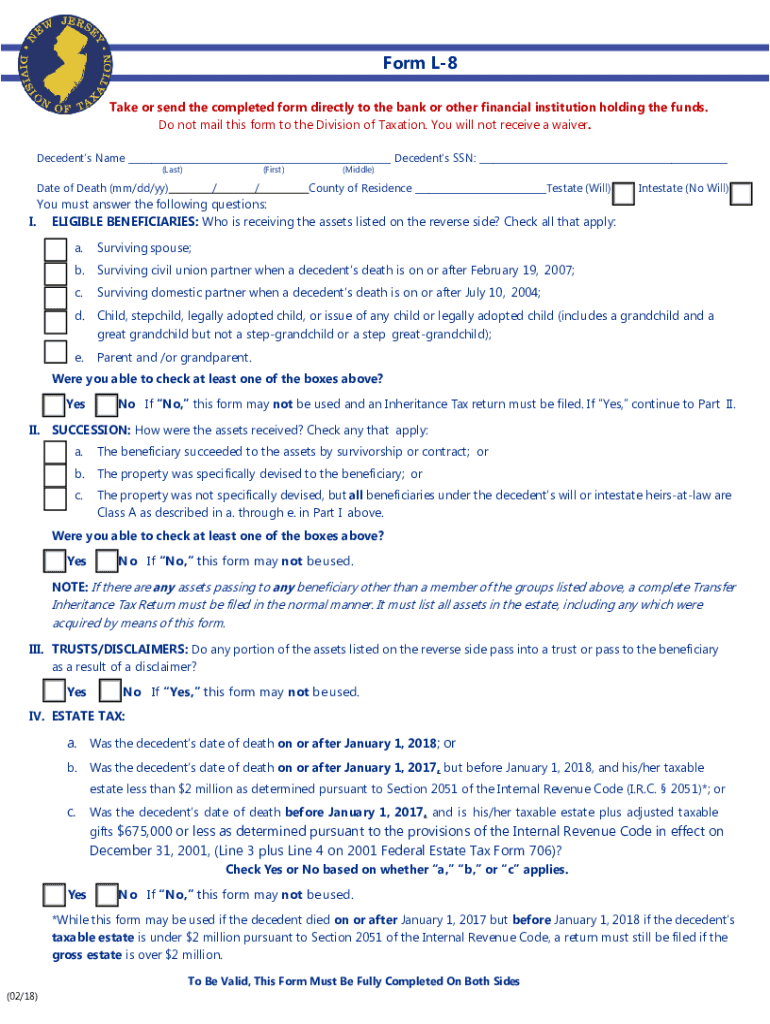
And New Jersey investment bonds. This form cannot be used for real estate. For real estate investments, use Form L-9. This form can be completed by: The executor; Administrator; The surviving Class A joint tenant (often a spouse or civil union partner); or Class A Payable On Death (POD) beneficiary of the assets for which release is sought. PART I ELIGIBLE BENEFICIARIES: Check the box or boxes corresponding to the type of beneficiary who is receiving the.
Loading

Open form follow the instructions

Easily sign the form with your finger

Send filled & signed form or save
How to fill out the NJ DoT L-8 online
The NJ DoT L-8 is a critical form for releasing non-real estate investments of a deceased individual in New Jersey. This guide will provide you with detailed, step-by-step instructions on how to competently fill out the NJ DoT L-8 online, ensuring that you understand the various components of the form.
Follow the steps to complete the NJ DoT L-8 form successfully.
- Click the ‘Get Form’ button to obtain the form and open it in the online editor.
- Begin by filling out the decedent’s name and Social Security number. Also, include their date of death and county of residence, selecting whether the decedent died with a will (testate) or without a will (intestate).
- In Part I, check the appropriate boxes to identify the eligible beneficiaries receiving the assets. Ensure at least one box is checked as the form cannot be used if none apply.
- Move to Part II and indicate how the assets are passing to the beneficiary by selecting the corresponding checkbox. Confirm that at least one of the options is applicable.
- Proceed to Part III, where you must confirm if the assets pass through a trust or disclaimer. Answer accordingly, as this could affect your ability to use the form.
- In Part IV, assess if the estate is subject to New Jersey Estate Tax by checking the appropriate options and ensuring that the correct qualifying criteria are met.
- Part V requires you to list each asset clearly, providing its description, how it is registered, and the date of death value. Pay particular attention to listing each bank account separately.
- In Part VI, provide the names of each beneficiary and their relationship to the decedent, using only terms from the Class A beneficiary list.
- Finalize by signing the form in the designated area, ensuring your signature is notarized, and completing the section for the releasing institution.
- Submit the completed form directly to the appropriate financial institution; do not mail it to the Division of Taxation.
Complete your forms online to ensure a smooth and efficient process for releasing non-real estate assets.
Experience a faster way to fill out and sign forms on the web. Access the most extensive library of templates available.
Related content
Use this form for release of: • New Jersey bank accounts;. • Stock in New Jersey...
Permit conditions for specific highway occupancy permits are set forth in (a)1 through 24...
Nov 1, 2009 — Cuidados sobre a bateria de lítio substituível. A bateria utilizada...
Get answers to your most pressing questions about US Legal Forms API.
How to avoid inheritance tax in NJ?
To avoid inheritance tax in NJ, strategic financial planning is crucial. Consider gifting during your lifetime, establishing irrevocable trusts, or utilizing strategic estate planning techniques. Seek professional advice that incorporates the NJ DoT L-8 to explore all available options tailored to your specific situation.
Who has to file an inheritance tax return in NJ?
In New Jersey, the estate executor is responsible for filing the inheritance tax return. This requirement applies to estates that exceed the set threshold based on the beneficiary's class. Notably, the NJ DoT L-8 provides essential guidelines and forms that facilitate this process, ensuring compliance and accuracy.
Who pays the NJ inheritance tax calculator?
The NJ inheritance tax calculator is often utilized by the estate's executor or administrator. They determine the tax liability based on the relationship of beneficiaries and the value of the inheritance. By using resources like the NJ DoT L-8, they can ensure accurate calculations and compliance with tax obligations.
What is the inheritance tax waiver in New Jersey?
The inheritance tax waiver in New Jersey allows certain beneficiaries to avoid tax on inherited assets. This waiver applies primarily to Class A beneficiaries like spouses, children, and parents. Understanding the qualifications for this waiver can significantly impact your tax liability, so consult the NJ DoT L-8 documentation for detailed requirements.
How do I keep my inheritance from being taxed?
Keeping your inheritance from being taxed involves proactive planning and understanding tax laws. You may consider establishing a trust or making timely gifts to beneficiaries. Additionally, seeking guidance from professionals familiar with NJ DoT L-8 can provide you with tailored strategies to preserve your inheritance.
How much can you inherit in NJ without paying taxes?
In New Jersey, the amount you can inherit without incurring taxes depends on your relationship to the deceased. Class A beneficiaries, such as spouses and children, have significant exemptions, while Class B and C beneficiaries face different thresholds. It’s essential to check the latest NJ DoT L-8 regulations, as these amounts can change.
How to avoid paying inheritance tax in NJ?
To avoid paying inheritance tax in NJ, you can consider several strategies. First, you might gift assets to your heirs while you are still alive, as this could help reduce your taxable estate. Furthermore, utilizing trusts can protect your assets and minimize tax liability. Finally, consult the NJ DoT L-8 guidelines to understand applicable exemptions.
Do you have to report inheritance on a tax return?
While you do not have to report inherited property as income on your federal tax return, you may need to file an inheritance tax return in New Jersey. Reporting and understanding your tax obligations regarding inherited assets is essential for compliance. Tools like uslegalforms can assist you in managing these requirements effectively.
Who files a NJ inheritance tax return?
Typically, the executor or administrator of an estate is responsible for filing the NJ inheritance tax return. This includes submitting necessary forms like the L-8 to ensure all taxable assets are accounted for. Proper filing helps prevent delays and potential penalties in the estate settlement process.
Who is exempt from NJ inheritance tax?
In New Jersey, certain individuals such as spouses, civil union partners, and direct descendants are generally exempt from paying inheritance tax. Additionally, charities and educational institutions may also qualify for exemptions. Understanding these exemptions can significantly impact how you approach inheritance tax filings.
Use professional pre-built templates to fill in and sign documents online faster. Get access to thousands of forms.
If you believe that this page should be taken down, please follow our DMCA take down process here.