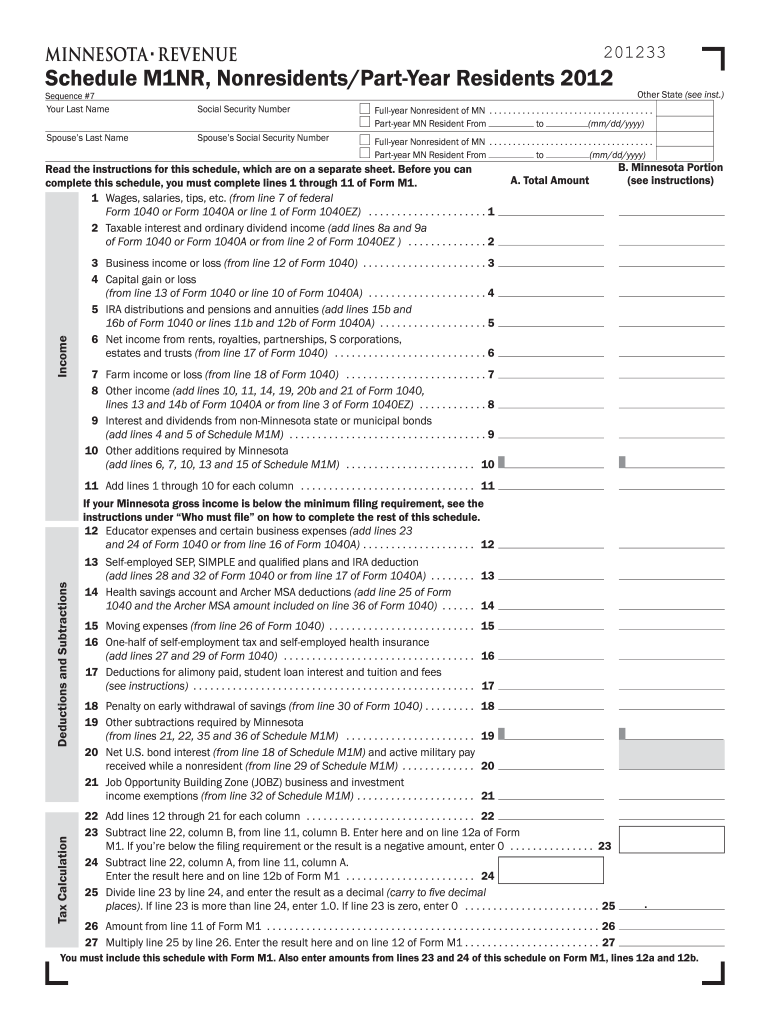
. . . . . . . . . . . . . . . . . . . . Part-year MN Resident From to (mm/dd/yyyy) Spouse s Last Name Spouse s Social Security Number Full-year Nonresident of MN . . . . . . . . . . . . . . . . . . . . . . . . . . . . . . . . . . . Part-year MN Resident From to (mm/dd/yyyy) Tax Calculation Deductions and Subtractions Income instructions for this schedule, which are on a separate sheet. Before you can Read the this schedule, you must complete lines 1 through 11 of Form M1. co.
Loading

Open form follow the instructions

Easily sign the form with your finger

Send filled & signed form or save
How to fill out the MN DoR Schedule M1NR online
Filling out the MN DoR Schedule M1NR is essential for nonresidents and part-year residents of Minnesota to accurately report their income and reduce their Minnesota tax liability. This guide provides a clear, step-by-step approach to completing the form online, ensuring you understand each section and the necessary details required.
Follow the steps to complete your MN DoR Schedule M1NR online
- Use the ‘Get Form’ button to access the MN DoR Schedule M1NR and open it in the designated editor for online completion.
- Begin by entering your last name and social security number at the top of the form to identify your submission.
- Indicate your residency status by checking the appropriate box to denote whether you are a full-year nonresident of Minnesota or a part-year resident, specifying the dates of residency in the provided fields.
- Enter your spouse’s last name and social security number if applicable, followed by their residency status as well, mirroring the steps you took for your own information.
- In the tax calculation section, begin listing your income sources. Enter amounts for wages, salaries, tips, etc., as per the guidance in the instructions provided with the form.
- Continue filling in additional income sources such as taxable interest, business income, capital gains, IRA distributions, and other relevant income, ensuring you clearly distinguish between your total earnings and those attributable to Minnesota (column A and B).
- After listing your income, move on to the deductions section where you will identify allowable deductions, including educator expenses, IRA contributions, and any other applicable subtractions as provided in the specific instructions.
- Complete the calculations for total income and deductions to determine your net taxable amount, filling in the results in the designated lines as instructed.
- Review your entries for accuracy and completeness, ensuring all required fields are filled before proceeding.
- Once satisfied with the information provided, save your changes, and you may choose to download, print, or share the completed Schedule M1NR form as necessary.
Begin filling out your MN DoR Schedule M1NR online today to ensure compliance and accurate reporting.
Experience a faster way to fill out and sign forms on the web. Access the most extensive library of templates available.
Related content
Minnesota Taxable Income | Minnesota Department of Revenue year resident All of your...
It provides for the allocation of federal income and deductions, and Minnesota additions...
Get answers to your most pressing questions about US Legal Forms API.
How to file a non-resident tax return?
To file a non-resident tax return, you will need your income information and requisite forms, including the MN DoR Schedule M1NR. Start by completing your federal tax return, then use the non-resident forms to report state-specific income. For a streamlined experience, consider using platforms like uslegalforms to access the necessary documents and instructions.
What is schedule M1NR?
Schedule M1NR is a form used to report non-resident income for Minnesota tax purposes. It helps non-residents calculate their tax liability based on income earned within the state. Understanding Schedule M1NR is crucial for ensuring accurate tax filings and compliance with Minnesota's tax regulations.
Who must file a Minnesota nonresident tax return?
You must file a Minnesota nonresident tax return if you earned income sourced from Minnesota and did not reside in the state during the tax year. This includes wages from Minnesota employers as well as income from rental properties. By filing the MN DoR Schedule M1NR, you will fulfill your state tax obligations.
How are non-resident US citizens taxed?
Non-resident US citizens are generally taxed only on income earned within the United States. This can include wages, interest, dividends, and rental income sourced from a specific state, such as Minnesota. To report this income accurately, filing the MN DoR Schedule M1NR is essential for non-residents with Minnesota-sourced income.
How do I file taxes for a state I don't live in?
To file taxes for a state where you do not reside, you need to gather your income data from that state. You will typically complete a non-resident tax return and possibly include forms like the MN DoR Schedule M1NR for Minnesota income. Using user-friendly platforms like uslegalforms can simplify the filing process and provide essential forms you need.
Can I use TurboTax if I am non-resident?
Yes, you can use TurboTax for your non-resident tax returns. This software provides guidance for completing the MN DoR Schedule M1NR and ensures you accurately report your Minnesota income. The intuitive interface of TurboTax can help streamline your filing process, making it easier to manage your taxes.
Do I need to file Schedule M?
Filing Schedule M may be necessary if you have income sourced from Minnesota as a non-resident. It allows the Minnesota Department of Revenue to assess your tax liability accurately. If you have received income from Minnesota, you should consider filing this schedule to ensure compliance with state tax laws.
At what age is Social Security no longer taxable?
Social Security benefits can be taxable regardless of age, depending on your overall income. The taxation of these benefits typically begins when your income exceeds certain thresholds. It is wise to consult resources or tools, such as the MN DoR Schedule M1NR, to determine how your taxes may be affected as you age.
Does Minnesota have tax breaks for seniors?
Yes, Minnesota offers various tax breaks and credits for seniors to ease their tax burden. These benefits may include increased property tax refunds and special deductions, which can be critical in retirement planning. If you are a senior receiving Social Security, learning about how these breaks interact with your MN DoR Schedule M1NR is important.
How do I get a Schedule E?
To obtain a Schedule E, you need to fill out the required forms provided by the Minnesota Department of Revenue. Schedule E is primarily used for reporting rental income, so be sure to include accurate details. If you're also considering your nonresident tax obligations, look into the MN DoR Schedule M1NR for clarity on your overall tax situation.
Use professional pre-built templates to fill in and sign documents online faster. Get access to thousands of forms.
If you believe that this page should be taken down, please follow our DMCA take down process here.
This form is available in several versions. Select the version you need from the drop-down list below.