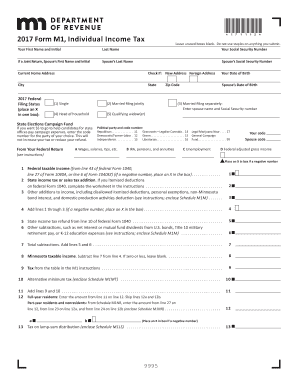
. . . . . . . 7 8 Minnesota taxable income. Subtract line 7 from line 4. If zero or less, leave blank. . . . . . . . . . . . . . . . . . . . . . . . . . 8 9 Tax from the table in the M1 instructions . . . . . . . . . . . . . . . . . . . . . . . . . . . . . . . . . . . . . . . . . . . . . . . . . . . . . . . . . 10 Alternative minimum tax (enclose Schedule M1MT) . . . . . . . . .

How it works
  • Open form

    Open form follow the instructions

  • Easily sign form

    Easily sign the form with your finger

  • Share form

    Send filled & signed form or save

How to fill out the MN DoR M1 online

Navigating tax forms can be challenging, but with the right guidance, you can successfully complete the MN DoR M1. This guide is designed to help you understand each section of the form and provide clear instructions for filling it out online.

Follow the steps to complete your MN DoR M1 online.

  1. Click the ‘Get Form’ button to obtain the MN DoR M1 form and open it in your online editor.
  2. Fill in your first name and initial in the designated fields. If you are filing a joint return, enter your spouse's first name and initial as well.
  3. Leave any unused boxes blank and avoid using staples on any documents you submit.
  4. Enter your last name and your Social Security number in the respective fields. If applicable, also enter your spouse's last name and Social Security number.
  5. Provide your current home address. If you have a new address or a foreign address, check the appropriate boxes.
  6. Indicate your filing status by placing an X in one of the boxes for single, married filing jointly, married filing separately, head of household, or qualifying widow(er).
  7. Provide your date of birth and your spouse's date of birth in the designated sections.
  8. Complete the income sections by reporting wages, salaries, tips, and other relevant income. Use federal adjusted gross income as a reference.
  9. Follow the instructions to calculate your total income and any necessary subtractions for Minnesota taxable income.
  10. Calculate your tax using the tables provided in the M1 instructions, and if applicable, complete additional sections for alternative minimum tax and other credits.
  11. Fill in the details for your Minnesota income tax withheld and any estimated tax payments made for the year.
  12. Provide your bank account information for a direct deposit refund if applicable.
  13. Review all entered information for accuracy. Ensure to sign and date the form at the bottom.
  14. Once completed, save your changes. You can then download, print, or share the MN DoR M1 form as needed.

Start your tax preparation by completing the MN DoR M1 online today.

Get form

Experience a faster way to fill out and sign forms on the web. Access the most extensive library of templates available.

Related content

Business Income Tax Returns - Minnesota.gov

To compute Minnesota income tax, the proprietor uses Form M1, the individual income tax...

Learn more
Description of the third instar larvae of five...

by MA Morón · 2014 · Cited by 19 — Right mandible with 1 small tooth on inner margin...

Learn more
Manual de Instruções

Descarte de pilhas e baterias. Após o uso, as pilhas/baterias podem ser dispostas em lixo...

Learn more
Questions & Answers

Get answers to your most pressing questions about US Legal Forms API.

Contact support

Do I need to file taxes as a non-resident?

Yes, as a non-resident, you are required to file taxes if you earn income from Minnesota sources. This entails reporting your income on the MN DoR M1 form, even if you reside outside the state. Filing your taxes accurately ensures that you stay compliant and avoid potential penalties. Make sure to review your tax obligations thoroughly to avoid any surprises.

You can obtain paper tax forms from the Minnesota Department of Revenue website or local offices. Alternatively, places like libraries and community organizations often provide access to these forms. If you prefer a digital solution, you can also use uslegalforms to get organized paper tax forms for use in your filing process. Having the right forms is essential for smooth tax filing.

Nonresidents who earn income from Minnesota sources must file a tax return. This includes wages, business income, and certain investment income. When using the MN DoR M1 form, nonresidents can report their earnings and fulfill their tax obligations accurately. Ensure you meet the filing requirements to avoid penalties.

The M1 form is the Minnesota Individual Income Tax Return used by residents to report their annual income. It captures various income sources, deductions, and credits. When completing your tax return, using the MN DoR M1 ensures that you accurately report your tax liabilities. This form is essential for both individual taxpayers and tax professionals alike.

Yes, Minnesota does tax nonresident income that is earned from sources within the state. If you work or have business income in Minnesota, you must report this on your tax return using the MN DoR M1 form. Be aware of any deductions you may claim as a nonresident, which can help reduce your taxable income. Understanding your tax obligations as a nonresident is crucial for compliance.

You must file a Minnesota tax return if you are a resident, nonresident, or part-year resident with certain levels of income. If your income exceeds the filing thresholds set by the MN DoR M1, you are required to file. Each situation may vary, so reviewing your income sources and residency status is essential. Be sure to check Minnesota's specific requirements to ensure compliance.

To avoid the MN underpayment penalty, ensure you meet your tax liability for the year. You can accomplish this by making timely estimated tax payments or by withholding enough from your paycheck. Additionally, you should check the MN DoR M1 guidelines for safe harbor amounts, which can help you avoid penalties. Staying informed about your tax obligations is key.

You may be disqualified from an IRS payment plan if you have not filed all required tax returns or if you owe more than a certain amount in taxes. It's important to stay compliant and ensure your financial situation meets IRS requirements before applying for a payment plan. For your Minnesota taxes, be sure to check the MN DoR M1 criteria to ensure eligibility.

If you owe taxes, setting up a payment plan is straightforward. Begin by gathering your tax information and the MN DoR M1 form. Reach out to the Minnesota Department of Revenue to explore available options for payment plans. By taking this step, you can alleviate stress while ensuring you meet your tax obligations.

Yes, you can set up a payment plan for your MN state taxes. The Minnesota Department of Revenue offers flexible payment options tailored to your financial situation. To initiate the process, complete the MN DoR M1 and apply for a payment agreement either online or via mail. Being proactive about your tax obligations allows you to manage your finances effectively.

Get This Form Now!

Use professional pre-built templates to fill in and sign documents online faster. Get access to thousands of forms.

If you believe that this page should be taken down, please follow our DMCA take down process here.

MN DoR M1 Form

This form is available in several versions. Select the version you need from the drop-down list below.

Get MN DoR M1