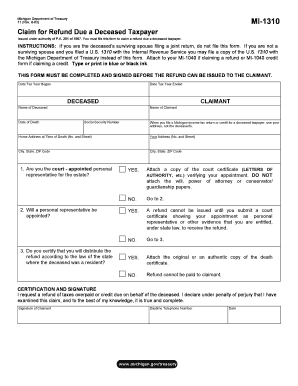
Reset Form MI-1310 Michigan Department of Treasury 11 Rev. 8-03 Claim for Refund Due a Deceased Taxpayer Issued under authority of P. A. 281 of 1967. You must file this form to claim a refund due a deceased taxpayer. INSTRUCTIONS If you are the deceased s surviving spouse filing a joint return do not file this form. If you are not a surviving spouse and you filed a U.S. 1310 with the Internal Revenue Service you may file a copy of the U.S. 1310 with the Michigan Department of Treasury instead of.
Loading
Open form follow the instructions
Easily sign the form with your finger
Send filled & signed form or save
How to fill out the MI MI-1310 online
The MI MI-1310 form is essential for claiming a refund due to a deceased taxpayer in Michigan. This guide will provide you with detailed instructions on how to accurately fill out this form online, ensuring a smooth and efficient process.
Follow the steps to successfully complete the MI MI-1310 form.
- Click ‘Get Form’ button to access the MI MI-1310. This will allow you to download and open the form in the editor of your choice.
- In the designated fields, enter the date the tax year began and the date the tax year ended. These dates are crucial for processing your claim efficiently.
- Provide the name of the deceased individual, along with their date of death. Accurate information is necessary to validate the claim.
- Fill in the claimant's name and social security number. If you are not the surviving spouse, ensure your information is complete.
- Enter the home address at the time of death for the deceased, followed by your own current address. This will help the authorities confirm your identity.
- Answer the question regarding whether you are the court-appointed personal representative for the estate. If yes, you must attach a copy of the court certificate verifying your appointment.
- If you are not the personal representative, you will need to provide evidence that you are entitled under state law to receive the refund.
- Next, determine if a personal representative will be appointed for the estate. This affects how the refund can be processed.
- Certify that you will distribute the refund according to the law of the state where the deceased was a resident. This is a legal affirmation necessary for completing the form.
- Sign the form where indicated, and include your daytime telephone number and the date of signing. This ensures that your claim is complete.
- Once you have completed all required fields and attached any necessary documents, save your changes. You can download, print, or share the form as needed.
Complete the MI MI-1310 form online today to ensure your claim for refund is processed promptly.
Experience a faster way to fill out and sign forms on the web. Access the most extensive library of templates available.
Related content
You must file this form to claim a refund that is being claimed for a deceased taxpayer...
Apr 15, 2020 — a U.S. Form 1310 or Michigan Claim for Refund Due a. Deceased Taxpayer...
This document contains instructions necessary for the installation and operation of the...
Get answers to your most pressing questions about US Legal Forms API.
Do you need to send a death certificate to the IRS?
Typically, you do not need to send a death certificate to the IRS when filing a deceased person's tax return. However, it's advisable to be prepared to provide it if requested, particularly when claiming a refund using Form 1310. Keeping a copy on hand can help streamline communication with the IRS regarding your filing of the MI-1310. Always ensure you retain necessary documentation for your records.
Can you file a deceased person's tax return electronically?
Yes, you can file a deceased person's tax return electronically, provided you are using the correct IRS forms, including Form 1040 and Form 1310. This method allows you to claim any available refund faster and securely. With the MI-1310 added to your electronic filing, you will enhance the chances of smooth processing. It’s essential to double-check that all information is accurate before submitting.
Can form M 1310 be filed electronically?
Yes, you can file Form M-1310 electronically if you are submitting your Michigan tax return online. Many tax software options support this form, allowing for efficient and straightforward filing. Utilizing the MI-1310 feature will not only save time but also help ensure that claims for refunds are processed accurately. Check your software's documentation to ensure compliance with MI state requirements.
Where do I file my MI tax return?
You should file your MI tax return online through the Michigan Department of Treasury’s e-file system or send it by mail to the specified address for MI tax returns. Using an online platform, such as US Legal Forms, can make this process easier by providing the necessary forms and guidance. If you're claiming a refund, consider using the MI-1310 form to streamline your filing. Ensure you verify the tax return’s address based on your situation.
What IRS forms can be filed electronically?
There are numerous IRS forms that can be filed electronically, including Form 1040, Form 941, and, importantly, Form 1310. Electronic filing simplifies tax processes and increases accuracy, helping you avoid costly errors. By leveraging the MI-1310 functionality, you can ensure a seamless filing experience for deceased individuals. Always check the IRS website for the complete list of forms eligible for electronic filing.
Can form 1310 be filed electronically in ProSeries?
Yes, ProSeries allows you to file Form 1310 electronically, streamlining the process for tax professionals. This form easily integrates with your client’s returns through the ProSeries platform, making it user-friendly. By using the MI-1310 feature, you can enhance your workflow and manage your clients’ needs effectively. Always keep your software updated to utilize the latest features.
Can form 1310 be filed electronically with the IRS?
Yes, Form 1310 can be filed electronically with the IRS when combined with the regular tax return. Most tax software supports this form, ensuring an efficient filing process. By using the MI-1310 form electronically, you can save time and ensure your submission is accurate. Always check the specific software guidelines to verify electronic filing capabilities.
How do I file income tax for a deceased person?
To file income tax for a deceased person, you will use the IRS Form 1040 and include Form MI-1310 to claim any refund due. Ensure to report the deceased's income for the tax year and provide all relevant documentation. Additionally, you may need to attach a copy of the death certificate along with the return. Completing this process accurately will facilitate a smooth filing experience.
Who is entitled to a deceased person's tax refund?
Generally, the deceased person's tax refund is provided to their estate, which may be claimed by the executor or a legally designated representative. If a spouse is surviving, they may claim the refund without the need for a formal process. Filing form MI 1310 is often necessary to receive the refund directly. Ensuring you have the correct documentation will help expedite this process.
Who must file a Michigan trust return?
A Michigan trust return must be filed by any trust that generates taxable income. This includes both revocable and irrevocable trusts that earn income while also holding assets. If the trust has a taxable income exceeding the state threshold, it is required to file a Michigan trust return. Filing the appropriate returns ensures compliance with Michigan tax laws.
Use professional pre-built templates to fill in and sign documents online faster. Get access to thousands of forms.
If you believe that this page should be taken down, please follow our DMCA take down process here.
This form is available in several versions. Select the version you need from the drop-down list below.