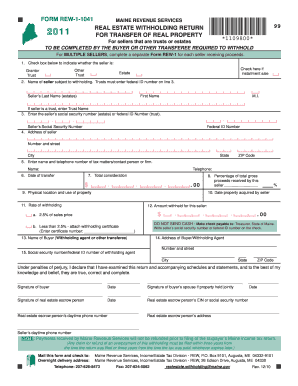
SFEREE REQUIRED TO WITHHOLD For MULTIPLE SELLERS, complete a separate Form REW-1 for each seller receiving proceeds. 1. Check box below to indicate whether the seller is: Other Trust Grantor Trust Check here if installment sale Estate 2. Name of seller subject to withholding. Trusts must enter federal ID number on line 3. Seller s Last Name (estates) First Name M.I. If seller is a trust, enter Trust Name 3. Enter the seller s social security number (estate) or federal ID Number (trus.
Open form follow the instructions
Easily sign the form with your finger
Send filled & signed form or save
How to fill out the ME REW-1-1041 online
This guide provides a detailed, step-by-step approach to accurately completing the ME REW-1-1041 form online. Designed for users of all experience levels, it aims to simplify the process and ensure compliance with Maine's real estate withholding requirements.
Follow the steps to accurately complete the ME REW-1-1041 form.
- Press the ‘Get Form’ button to acquire the ME REW-1-1041 form, which will open in the online document editor.
- Review the form's purpose to ensure you are required to file it as a buyer. You must withhold state income tax when acquiring property from a nonresident seller.
- In Block 1, indicate the type of seller by checking the appropriate box (Other, Trust, Estate).
- In Block 2, provide the name of the seller subject to withholding, ensuring the correct format for trusts.
- In Block 3, enter the seller's social security number or federal ID number as appropriate.
- Input the seller's address in Block 4, including the number, street, city, state, and ZIP code.
- In Block 5, enter the name and telephone number of the person or firm responsible for tax matters.
- In Block 6, indicate the date of the property transfer.
- Enter the total consideration amount in Block 7. This is the total sales price of the property.
- In Block 8, specify the percentage of the total proceeds that are being received by the seller.
- Complete Block 9 with the physical location of the property and its intended use (e.g., rental property, principal residence).
- In Block 10, enter the date the property was acquired by the seller.
- Specify the rate of withholding in Block 11. Typically, this will be 2.5% but verify any specific conditions.
- In Block 12, input the amount withheld for the seller and ensure it is calculated correctly.
- Complete Block 13 with the name of the buyer or withholding agent.
- Fill out Block 14 with the address of the buyer or withholding agent, ensuring all details are accurate.
- In Block 15, provide the social security number or federal ID number for the withholding agent.
- Review and sign the form at the bottom. Include any required signatures from spouses or escrow persons if applicable.
- Once all fields are completed and reviewed for accuracy, you can save changes, download the completed form, print it for your records, or share it as needed.
Start filling out the ME REW-1-1041 online today to ensure a smooth real estate transaction.
Experience a faster way to fill out and sign forms on the web. Access the most extensive library of templates available.
Related content
• REW-1-1041- For sellers who will report this sale on the Maine fiduciary income tax...
§5250-A(2), or the REW filer for such buyer, must, for returns due on or after January 1...
Press the shutter button to capture an image. ƈ By using the camera's digital processor...
Get answers to your most pressing questions about US Legal Forms API.
Do I need to file a Maine estate tax return?
If the value of an estate exceeds $5.6 million, you will likely need to file a Maine estate tax return. This can include assets such as real estate, business interests, and other properties. Filing the correct forms, including the ME REW-1-1041, ensures that you meet all obligations. Utilizing resources like uslegalforms can simplify this process, helping you navigate the legal requirements more effectively.
What states have zero capital gains tax?
Some states, such as Alaska, Florida, Nevada, South Dakota, Texas, Washington, and Wyoming, have no capital gains tax. Living in these states can be beneficial if you frequently realize capital gains. While planning your investments, consider how state taxes impact your returns. Always stay informed about tax laws as these can influence your strategies when completing forms like ME REW-1-1041.
What is the capital gains rate in Maine?
In Maine, the capital gains tax rate typically mirrors the regular income tax rate, with tax rates ranging from 5.8% to 7.15%. Capital gains are taxed as income, meaning that understanding how they fit into your overall tax strategy is crucial. When filing your taxes, using the ME REW-1-1041 form can help clarify your tax responsibilities. It's wise to consult a tax professional for personalized guidance.
Do I have to file a 1041 as a beneficiary?
As a beneficiary, you may need to file a 1041 tax return if the estate earns income during the tax year. This return, known as ME REW-1-1041, reports income generated by the estate. Generally, if the estate's income exceeds $600, the fiduciary must file the 1041 form. It is advisable to seek professional advice to determine your specific filing requirements.
How to avoid estate tax in Maine?
To avoid estate tax in Maine, consider strategic estate planning, such as gifting assets while you are still living or establishing trusts. Additionally, being aware of the current exemptions and deductions available can help manage the estate's value effectively. Consulting with tax professionals and utilizing resources like the ME REW-1-1041 can greatly assist in this planning process.
Who must file a Maine nonresident tax return?
Nonresidents who earn income from sources in Maine, such as rental properties or business operations, must file a Maine nonresident tax return. Even if you do not owe tax, filing is essential to avoid penalties and ensure compliance. Utilizing resources like the ME REW-1-1041 will streamline your tax filing process and help you understand your obligations better.
What is the property gains tax in Maine?
In Maine, capital gains on property sales are taxed as income, and the rate is determined by your income bracket. The state typically taxes long-term capital gains at a rate between 5.8% and 7.15%. If you are selling property, it is important to keep these rates in mind while planning your finances. The ME REW-1-1041 can assist you in reporting any capital gains accurately.
What is the food and BEV tax in Maine?
The food and beverage tax in Maine, commonly applied to dining and prepared foods, is subject to the state's general sales tax rate. Currently, this rate is set at 5.5% for most taxable items. Understanding these taxes is vital for both residents and businesses to ensure compliance. For those navigating tax forms, the ME REW-1-1041 can play a crucial role in reporting these amounts correctly.
How do I report income from Schedule K-1 form 1041?
Reporting income from Schedule K-1 on form 1041 involves including the amounts listed under the specific categories shown on K-1. This includes distributions that beneficiaries have received which must be reported on the estate's return. Familiarizing yourself with the ME REW-1-1041 can clarify how to properly report these figures. Leveraging uslegalforms can also help streamline your reporting process.
How to calculate tax due on form 1041?
To calculate the tax due on form 1041, first, determine the total income and then subtract allowable deductions. This calculation results in the taxable income, which can be assessed against current tax rates. Understanding the ME REW-1-1041 provisions can assist you in accurately computing your liability. Using tools or services such as uslegalforms can further simplify this process.
Use professional pre-built templates to fill in and sign documents online faster. Get access to thousands of forms.
If you believe that this page should be taken down, please follow our DMCA take down process here.
This form is available in several versions. Select the version you need from the drop-down list below.