Nsideration received by the transferor (seller) on the transfer. A completed Form REW-1-1041 (for sellers that are trusts or estates), Form REW-1-1040 (for sellers who are individuals or sole proprietors), and/or Form REW-1-1120 (for sellers that are corporations) must accompany the remittance. WHO MUST FILE: A buyer (individual, firm, partnership, association, society, club, corporation, estate, trust, business trust, receiver, assignee or any other group or combination acting as a unit) of a M.
Open form follow the instructions
Easily sign the form with your finger
Send filled & signed form or save
How to fill out the ME REW-1-1041 online
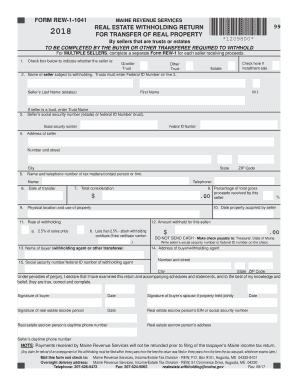
The ME REW-1-1041 is a crucial form for buyers facilitating a real estate transaction involving trusts or estates in Maine. This guide will provide you with a comprehensive overview of each section of the form, ensuring that you can successfully complete it online.
Follow the steps to complete the ME REW-1-1041 accurately.
- Press the ‘Get Form’ button to obtain the form and open it in your browser.
- In Block 1, check the appropriate box to indicate whether the seller is a grantor, trust, or other type of seller.
- In Block 2, enter the seller's name. If the seller is a trust, also provide the Federal ID Number in the designated area of Block 3.
- Complete Block 3 by entering the seller’s social security number if they are an estate, or the Federal ID Number if they are a trust.
- Fill out Block 4 with the seller's address, including number and street, city, state, and ZIP code.
- In Block 5, provide the name and telephone number of the tax matters contact person or firm.
- Enter the date of transfer in Block 6.
- In Block 7, input the total consideration for the property.
- Indicate the percentage of total gross proceeds received by the seller in Block 8.
- Specify the date the property was acquired by the seller in Block 10.
- Complete Block 11 by checking the correct option for the rate of withholding. If you have a withholding certificate that allows for a reduced rate, enter the certificate number.
- In Block 12, enter the total amount withheld for this seller.
- Input the name of the buyer (withholding agent) in Block 13.
- Fill in Block 14 with the address of the buyer or withholding agent.
- In Block 15, enter the social security number or Federal ID number of the withholding agent.
- Sign and date the form as the buyer in the designated area. If applicable, include the signature of the buyer’s partner.
- Once all sections are filled out, review the form for accuracy, and then choose to save changes, download the completed form, print it, or share it as necessary.
Complete your ME REW-1-1041 online today and ensure a smooth real estate transaction.
Experience a faster way to fill out and sign forms on the web. Access the most extensive library of templates available.
Related content
• REW-1-1041- For sellers who will report this sale on the Maine fiduciary income tax...
§5250-A(2), or the REW filer for such buyer, must, for returns due on or after January 1...
Press the shutter button to capture an image. ƈ By using the camera's digital processor...
Get answers to your most pressing questions about US Legal Forms API.
What is the rew tax in Maine?
The REW tax in Maine relates to the estate tax information captured in filings like the ME REW-1-1041. This tax is determined based on the value of the estate and applies to the total gross estate. Understanding how the REW tax affects your filings is essential, and uslegalforms can assist you in navigating these regulations effectively.
Is Schedule K-1 considered income?
Yes, Schedule K-1 is considered income that you need to report on your tax returns. It details your share of income, deductions, and credits from partnerships, S corporations, and trusts. When handling the ME REW-1-1041 form, it is important to include all K-1 income in your calculations. Utilizing uslegalforms can smooth out the reporting process and clarify any complex terms.
Where do I report income from Schedule K-1?
Income from Schedule K-1 should be reported on the appropriate lines of your tax return, depending on the type of income. Common types include ordinary income, capital gains, and dividends, each going in specific sections. To effectively manage your filing related to the ME REW-1-1041, you may consider using uslegalforms for additional resources and guidance.
Where do I report K1 trust income on 1040?
You report K1 trust income on Form 1040 using the information listed on your K-1. Typically, you will include it on lines that pertain to dividends, capital gains, or other income types. Keeping the ME REW-1-1041 in mind will help you ensure you're compliant while using our platform can assist in understanding how to report this income accurately.
How do I report income from Schedule K-1 form 1041?
To report income from Schedule K-1 form 1041, you should gather the information provided on the K-1 and include it in your income section on your tax return. Each type of income reported on the K-1 must be reported in the appropriate category for tax purposes. Understanding this reporting helps you meet the ME REW-1-1041 standards, and our services can provide clarity on these steps.
How to fill out form 1041?
Filling out form 1041 involves gathering necessary financial documents and accurately entering income information. You will need to itemize deductions, report distributions, and ensure compliance with regulations such as the ME REW-1-1041. If you find the form complicated, uslegalforms offers templates and guidance to streamline this process.
Are K-1 estate distributions considered income?
Yes, K-1 estate distributions are indeed considered income. Recipients must report this income on their tax returns. When dealing with the ME REW-1-1041 form, it is crucial to understand how these distributions impact your overall tax liability. Our resources can guide you through this complex area efficiently.
What is considered gross income for form 1041?
Gross income for form 1041 includes all income received by the estate or trust during the tax year. This typically encompasses interest, dividends, capital gains, and rental income. It's essential to accurately report all types of income to comply with the ME REW-1-1041 requirements. If you're unsure, seeking assistance from uslegalforms can simplify the process.
How to avoid estate tax in Maine?
To avoid estate tax in Maine, you should explore legal strategies prior to asset distribution. Establishing trusts or using certain types of accounts may help minimize tax liability. It's advised to consult with a tax professional to plan effectively. Additionally, ensuring your documents, such as the ME REW-1-1041 if applicable, are correctly managed can assist in navigating tax responsibilities.
Do I need to file taxes as a non-resident?
Yes, you need to file taxes as a non-resident if you have income from Maine sources. This includes income from employment, business activities, or other taxable services. Filing the ME REW-1-1041 ensures you fulfill your tax obligations and provides a method to report your income accurately. This step is crucial for avoiding penalties from tax authorities.
Use professional pre-built templates to fill in and sign documents online faster. Get access to thousands of forms.
If you believe that this page should be taken down, please follow our DMCA take down process here.
This form is available in several versions. Select the version you need from the drop-down list below.