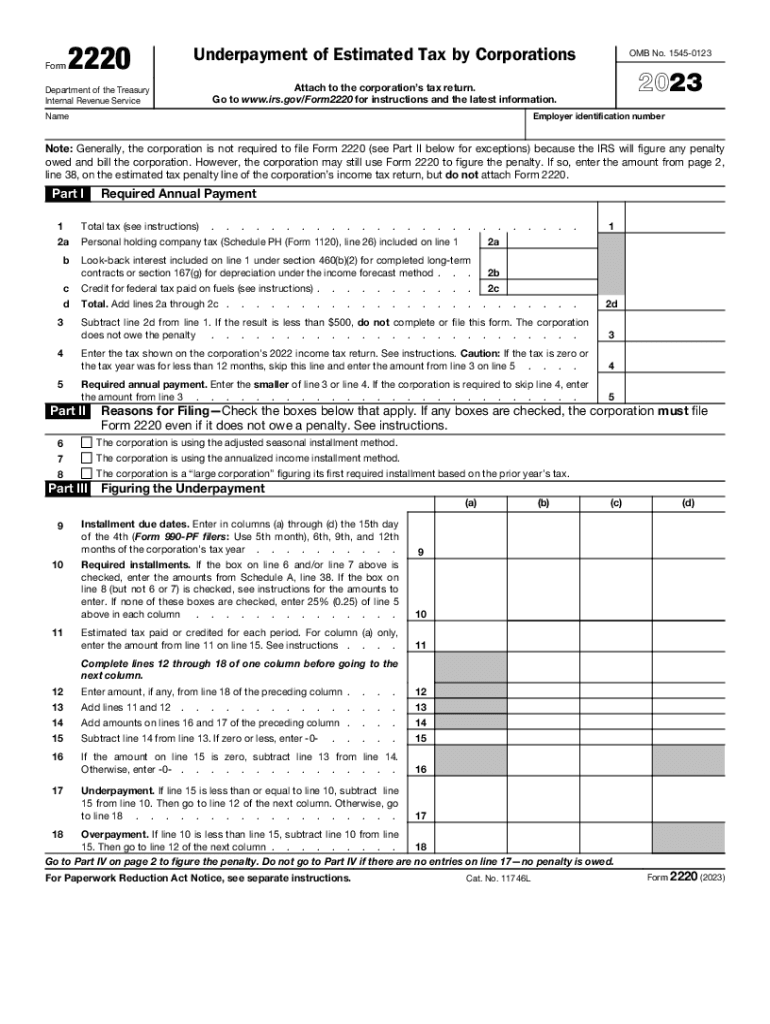
2220Underpayment of Estimated Tax by CorporationsDepartment of the Treasury Internal Revenue ServiceAttach to the corporations tax return. Go to www.irs.gov/Form2220 for instructions and the latest.
Loading

Open form follow the instructions

Easily sign the form with your finger

Send filled & signed form or save
How to fill out the IRS 2220 online
The IRS 2220 form is crucial for corporations to report underpayment of estimated tax. This guide provides a clear, step-by-step method for filling out the form correctly, ensuring you understand each component involved in the process.
Follow the steps to complete the IRS 2220 form online.
- Click ‘Get Form’ button to obtain the form and open it in the editor.
- Enter the employer identification number in the designated field. This number is essential for identifying your corporation for tax purposes.
- Fill in the name of the corporation as it appears on the tax return. Make sure there are no spelling errors.
- In Part I, complete the 'Required Annual Payment' section. Begin by entering the total tax from your tax return.
- Complete lines 2a to 2c by entering relevant amounts for personal holding company tax and look-back interest as applicable.
- Calculate the total of lines 2a to 2c and proceed to subtract line 2d from line 1.
- Refer to line 3 and enter the tax from the corporation's previous year's income tax return.
- Determine the 'Required Annual Payment' based on the smaller amount between line 3 and line 4, then fill in line 4.
- In Part II, check any applicable boxes that require filing the form even if there is no penalty owed.
- In Part III, enter installment due dates and required installments in the designated columns (a) to (d).
- Follow through with lines 9 to 18, completing calculations pertaining to underpayment for each column.
- Proceed to Part IV to figure out the penalty if applicable. Enter all required information for the date of payment and underpayment amounts.
- Finally, review all entries for accuracy before saving changes, downloading, printing, or sharing the completed form.
Complete your IRS 2220 form online to ensure accurate filing and adherence to tax regulations.
Experience a faster way to fill out and sign forms on the web. Access the most extensive library of templates available.
Related content
Feb 4, 2019 - A corporation will not have to pay a penalty if the tax shown on the...
(a) Addition to taxExcept as otherwise provided in this section, in the case of any...
(j) Modifications for taxable years 2018 through 2025 .... (C) Inflation adjustmentIn the...
Get answers to your most pressing questions about US Legal Forms API.
How is the underpayment penalty calculated?
The Underpayment Penalty occurs when a taxpayer uses IRS Form 2210 to calculate the amount of taxes he or she owes, subtracting the amount already paid in estimated taxes throughout the year. ... A taxpayers total tax liability is less than $1,000. The taxpayer did not owe any taxes for the previous year.
Why would a corporation need to file a tax return even if it has no income?
C corporations are required to file returns and pay income tax on its profits, or taxable income. This requirement to file a tax return which is done on Form 1120 isn't contingent on whether the business engages in transactions during the year that earns money for shareholders.
How often is a corporation required to file Form 1120 with the IRS?
Form 1120 is akin to Form 1040 for an individual taxpayer. A C corporation must file Form 1120 whether it has income to report or not. According to the Internal Revenue Service, a corporation must file its income tax return by the 15th day of the third month after the end of its tax year.
What is the penalty for not filing corporate tax return?
Failing to File When you fail to file a Form 1120 by the deadline, the corporation is charged a monthly penalty that's equal to 5 percent of any income tax that remains unpaid.
Do I need to file a corporate tax return?
Filing Requirement The instructions for Internal Revenue Service Form 1120, the standard tax return for corporations, are quite clear: All corporations based in the United States "must file an income tax return whether or not they have taxable income."
When must a corporation file a tax return?
An S corporation must always file its annual tax return by the 15th day of the third month following the end of the tax year, generally March 15. The business is responsible for reporting all financial activity on Form 1120S and attaching a Schedule K-1 for each shareholder.
Do I have to file Form 1120?
Unless exempt under section 501, all domestic corporations (including corporations in bankruptcy) must file an income tax return whether or not they have taxable income. Domestic corporations must file Form 1120, unless they are required, or elect to file a special return.
Who can sign an 1120 tax return?
The IRS's instructions for Form 1120, the standard corporate income tax return, stipulate that the return must be signed by an officer of the company. The instructions list several acceptable potential signers: the president, the vice president, the treasurer, the assistant treasurer, or the chief accounting officer.
How do I prepare a 1120 tax return?
0:13 2:20 Suggested clip Learn How to Fill the Form 1120 US Corporation Income Tax ReturnYouTubeStart of suggested clipEnd of suggested clip Learn How to Fill the Form 1120 US Corporation Income Tax Return
What is an 1120 tax return?
Form 1120 (officially the "U.S Corporate Income Tax Return") is one of the IRS tax forms used by corporations (specifically, C corporations) in the United States to report their income, gains, losses, deductions, credits and to figure out their tax liability.
Use professional pre-built templates to fill in and sign documents online faster. Get access to thousands of forms.
If you believe that this page should be taken down, please follow our DMCA take down process here.