An inactive or closely held corporation . . . . . . . . . . . . . . . . . . . . . . . . . . . . . . . . . . . . . . . . . . . . . . . . . . . . . . . . . . . . . . . . . . . . . . . . . . . . . . . . . . . . . . . . . . . . . . . . . . . . . . . . 15 Fill in if the decedent made any transfer under Internal Revenue Code sections 2035, 2036, 2037 or 2038 in which an asset has been excluded from the gross estate . . . . . . . . . . . . . . . . . . . . . . . . . . . . . . . . . . . . . . . . . . . .

How it works
  • Open form

    Open form follow the instructions

  • Easily sign form

    Easily sign the form with your finger

  • Share form

    Send filled & signed form or save

How to fill out the MA DoR M-706 online

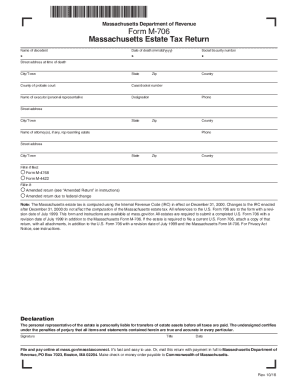
Filling out the MA DoR M-706, the Massachusetts Estate Tax Return, can seem complicated. This guide provides step-by-step instructions to ensure that all users, regardless of their legal experience, can complete the form accurately and efficiently.

Follow the steps to fill out the MA DoR M-706 online.

  1. Click the ‘Get Form’ button to access the MA DoR M-706 form and present it for completion.
  2. Begin by entering the name of the decedent, along with their date of death and Social Security number. This information is essential for identifying the estate.
  3. Provide the street address, city or town, state, and zip code where the decedent resided at the time of death. Additionally, indicate the county of the probate court handling the estate.
  4. Next, fill in the name and contact information of the executor or personal representative of the estate, ensuring that their title and signature are included.
  5. Report any insurance policies in the estate not included in the gross estate by attaching Form(s) 712 as required.
  6. Indicate the marital status of the decedent at the time of death and provide any relevant information concerning a deceased spouse if applicable.
  7. Complete sections regarding joint property, interests in partnerships, and any exclusions that might apply under the Internal Revenue Code.
  8. Proceed to calculate the total gross estate, following the corresponding sections from the U.S. Form 706 as referenced in the M-706 instructions.
  9. Finalize the form by ensuring all required signatures and declarations are completed, certifying that all information is accurate under penalties of perjury.
  10. After reviewing the entire document for accuracy, users can save changes, download, print, or share the form as necessary.

Complete and submit your MA DoR M-706 online for a streamlined filing experience.

Get form

Experience a faster way to fill out and sign forms on the web. Access the most extensive library of templates available.

Related content

DOR Estate Tax Forms and Instructions

May 14, 2025 — The Department now issues, Certificate Releasing Massachusetts Estate...

Learn more
Appendix Revenue Impact of Increasing the Estate...

To compute the maximum federal credit for state estate taxes, the July 1999 revision of...

Learn more
Manual do usuário

Conecte essa TV LED Smart Philips à Internet e descubra um novo mundo de televisão...

Learn more
Questions & Answers

Get answers to your most pressing questions about US Legal Forms API.

Contact support

What withholding percentage should I choose?

Choosing the right withholding percentage depends on various factors, including your income level and potential deductions. The MA DoR M-706 can assist in understanding your expected tax liability, helping you make an informed choice. You may wish to consult the Massachusetts withholding tables or a tax professional for the best approach tailored to your situation. Properly setting your withholding can lead to fewer surprises during tax time.

MA withholding refers to the process where Massachusetts requires employers to deduct state income tax from employees' paychecks. This deduction is essential for fulfilling your tax obligations and is governed by guidelines in the MA DoR M-706. Understanding how much is withheld can help you manage your finances better throughout the year. Keeping track of your withholdings ensures that you will be well prepared for tax season.

Withholding from your paycheck means that your employer deducts a portion of your earnings for taxes before you receive them. This deduction helps cover your federal and state income tax liabilities, including Massachusetts taxes. It is part of your overall tax strategy, including the considerations outlined in the MA DoR M-706. Staying informed about your withholdings can prevent surprises during tax season.

Determining how much to withhold for Massachusetts taxes depends on several factors, including your income, filing status, and allowances claimed. Typically, using the MA DoR M-706 can help guide you through estimating your tax liability. You may want to use the state’s tax withholding calculator or consult a tax advisor for personalized assistance. Adjustments to your withholding can ensure you are not overpaying or underpaying taxes.

The recent legislation regarding the Massachusetts estate tax has made notable adjustments, primarily impacting the filing threshold and tax rates. Under the MA DoR M-706, estates above $1 million are now subject to estate taxes. Understanding these changes is vital for estate planning, as it can impact inheritances significantly. Always consult a tax professional when navigating these new laws.

Individuals in Massachusetts must file the MA DoR M-706 if their estate meets certain size thresholds upon their passing. Generally, if the total value of the estate exceeds $1 million, the executor or administrator must submit this form. It is essential to determine the estate’s value accurately, as this affects tax implications. Failing to file when required may lead to penalties and interest.

You can obtain Massachusetts state tax forms from several sources, including the official Massachusetts Department of Revenue website. Many forms, including the MA DoR M-706, can be downloaded online for convenience. Staying organized with your tax documentation will streamline your filing process.

Inheritance rules in Massachusetts involve various statutory laws that dictate how assets are distributed among heirs. These rules apply differently based on whether or not there is a will. By utilizing the MA DoR M-706, you can clarify these rules and plan effectively for your legacy.

The maximum amount you can inherit without incurring taxes in Massachusetts aligns with the estate tax exclusion limit set by state law. Staying updated on this limit is essential, as it can fluctuate. The MA DoR M-706 form can simplify understanding your inheritance tax obligations and aid in effective financial planning.

In Massachusetts, the amount you can inherit without paying taxes is dictated by the estate tax exclusion limit. If the estate's value is below this limit, you may not owe taxes at all. Consult the MA DoR M-706 to check the current exclusion amount and ensure you are informed on any changes.

Get This Form Now!

Use professional pre-built templates to fill in and sign documents online faster. Get access to thousands of forms.

If you believe that this page should be taken down, please follow our DMCA take down process here.

Get MA DoR M-706