Rm 706, page 1, line 15. If this return is for the estate of a Massachusetts resident decedent who did not own real estate and/or tangible personal property in another state, omit Parts 2 and 3 and enter this amount in Part 4, line 1. If this return is for the estate of a Massachusetts resident decedent who owned real estate and/or tangible personal property in another state, complete Parts 2 and 4 and omit Part 3. If this return is for the estate of a nonresident decedent with Massachusetts pro.
Open form follow the instructions
Easily sign the form with your finger
Send filled & signed form or save
How to fill out the MA DoR M-4422 online
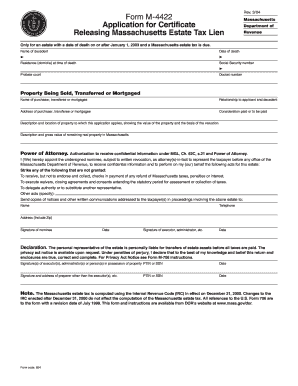
This guide provides clear and supportive instructions for completing the MA DoR M-4422, the application for a certificate releasing the Massachusetts estate tax lien. Designed for estates with a date of death on or after January 1, 2003, this form is essential for those managing estate transactions.
Follow the steps to accurately complete the MA DoR M-4422.
- Click the ‘Get Form’ button to obtain the form and open it in the editing interface.
- Begin by entering the full name of the decedent, along with their date of death and social security number. This information is crucial for identifying the estate.
- Input the decedent's residence at the time of death and the probate court details, including the docket number, to ensure proper documentation.
- In the section regarding the property being sold, transferred, or mortgaged, provide the name and address of the purchaser or transferee, including their relationship to the applicant and the decedent.
- Detail the consideration paid or to be paid along with a description and location of the property, ensuring the valuation is clearly stated.
- Complete the power of attorney section if applicable. This allows the designated nominee to represent the taxpayer and receive confidential information.
- Fill in the tentative Massachusetts estate tax information, ensuring you enter the total gross estate and any applicable tax credits.
- For residents with property in other states, ensure you complete the relevant parts of the computation of tax sections to reflect values accurately.
- Review the total Massachusetts estate tax due and any penalties before signing the form, ensuring all sections have been appropriately filled out.
- Once everything is complete, you can save changes, download, print, or share the form for submission.
Complete and file your MA DoR M-4422 online to ensure compliance and facilitate estate transactions.
Experience a faster way to fill out and sign forms on the web. Access the most extensive library of templates available.
Related content
Form M-4422. Application for Certificate ... File this return with payment in full to:...
by T da Rocha Bastos · 2021 — O artigo pretende estimular a reflexão bioética sobre a...
5 Damagedorbrokenpump. 6 Damagedcontrolvalve. 1 Engage cold weather clutch. 2. Replace or...
Get answers to your most pressing questions about US Legal Forms API.
What is form M 4422?
Form M-4422 is the Massachusetts estate tax waiver form, which informs the state about the assets and values involved in an estate. It's important for resolving estate tax liability before property transfers can occur. Executors must utilize the MA DoR M-4422 adequately to ensure all information is reported. This form is essential for those navigating estate taxation in Massachusetts.
What do I need to file an estate tax return?
When filing an estate tax return, you will typically need essential documents such as the will, death certificate, and an inventory of all assets. Identifying liabilities and any prior tax returns may also be necessary. The MA DoR M-4422 elaborates on the forms and information needed specifically within Massachusetts, guiding you through the process.
What is the new law for the Massachusetts estate tax?
The new law for the Massachusetts estate tax includes an exemption threshold set at $1 million, which has remained the same for several years. Additionally, the rates increase progressively based on the estate's value. Understanding this law is crucial for estate planning to avoid surprises down the road. The MA DoR M-4422 provides insights into how to navigate these regulations.
How do you file a tax return for a deceased person?
To file a tax return for a deceased person, you will need to use the correct tax forms for the year that the person passed away. Generally, the final return is due on April 15 of the following year. Be sure to indicate that the person is deceased and include a copy of the death certificate if required. Utilizing the MA DoR M-4422 can help you understand the particulars for Massachusetts filers.
How do you file taxes as an executor?
As an executor, you are responsible for filing the estate's tax returns. This involves collecting all financial information and filing Form 706 if the estate meets the federal threshold. It's crucial to adhere to deadlines set by the IRS and Massachusetts. Tools and resources, like the MA DoR M-4422, can simplify the paperwork.
What documents are needed to file an estate tax return?
To file an estate tax return, you will need various documents including the deceased's death certificate, a will, property valuations, and a list of assets and debts. Additionally, gathering previous tax returns may also be necessary. The MA DoR M-4422 outlines specific documentation requirements for Massachusetts, ensuring you have all you need.
What does the IRS require for estates?
The IRS requires estates to file an estate tax return if the gross estate exceeds certain thresholds. Generally, the threshold is set at $12.92 million for 2023. Executors must gather all necessary information, including assets, debts, and expenses, to accurately report the estate's value. Always consider consulting forms like the MA DoR M-4422 for detailed requirements.
How much can you inherit in Massachusetts without paying taxes?
In Massachusetts, you can inherit any amount without paying an inheritance tax, as the state doesn't levy such a tax. Nevertheless, if the total estate exceeds $1 million, you may be subject to estate taxes. It is wise to familiarize yourself with the MA DoR M-4422 to determine your obligations and make informed decisions.
What is a 4422?
The term '4422' often refers to the MA DoR M-4422, a form related to Massachusetts estate taxes. This form is essential for individuals handling estates to report values accurately. Understanding the purpose of the 4422 can simplify your estate management and ensure you meet necessary legal requirements.
What is the most you can inherit without paying taxes?
In Massachusetts, you can inherit any amount without facing an inheritance tax, as no such tax exists in the state. However, you should be aware of the estate tax threshold, which is $1 million. If the total estate value exceeds this amount, tax obligations may arise, making it essential to consult resources related to the MA DoR M-4422.
Use professional pre-built templates to fill in and sign documents online faster. Get access to thousands of forms.
If you believe that this page should be taken down, please follow our DMCA take down process here.
This form is available in several versions. Select the version you need from the drop-down list below.