Unt from Part 1, line 2 . . . . . . . . . . . . . . . . . . . . . . . . . . . . . . . . . . . . . . . . . . . . 2 03 Estate or inheritance taxes actually paid to other states. . . . . . . . . . . . . . . . . . . . . . . . . . . . . . . . . . . . . . . . . . . . . . . . . . . . 3 04 Gross value of real estate and tangible personal property in other states . . . . . . . . . . . . . . . . . . . . . . . . . . . . . . . . . . . . . . 4 05 Percentage of estate in other states. Divide line 4 by line 1.
Open form follow the instructions
Easily sign the form with your finger
Send filled & signed form or save
How to fill out the MA DoR M-4422 online
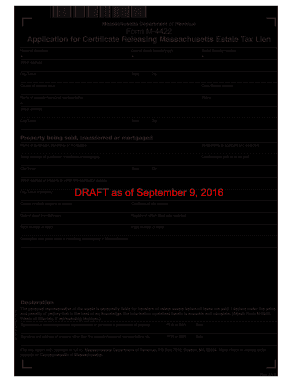
The MA DoR M-4422 form is essential for applying for a certificate that releases a Massachusetts estate tax lien. This guide will provide you with comprehensive, step-by-step instructions on how to fill out and submit this form online, ensuring you complete it accurately and efficiently.
Follow the steps to fill out the MA DoR M-4422 form online.
- Click ‘Get Form’ button to access the MA DoR M-4422 form and open it in your chosen document editor.
- Begin by filling in the name of the decedent and their date of death in the specified format (mm/dd/yyyy). Provide the decedent's Social Security number as well.
- Enter the decedent's street address, city or town, state, and zip code to clearly identify their residence.
- Indicate the county of the probate court, along with the case or docket number related to the estate.
- Complete the section for the executor or personal representative by providing their name, contact information, street address, city or town, state, and zip code.
- Detail the property being sold, transferred, or mortgaged by entering the name of the purchaser, transferee, or mortgagee, along with their relationship to the applicant and the decedent.
- Include the street address of the purchaser, transferee, or mortgagee, as well as their city or town, state, and zip code.
- Fill in the description of the property associated with this application, including the address and the city or town where it is located.
- Provide information about the certificate of title number, the date of the deed, and the registry where the deed was recorded.
- Complete the tentative Massachusetts estate tax section and other relevant parts by entering the required amounts as instructed.
- Review all provided information for accuracy and completeness. Ensure that you sign the declaration and include any necessary attachments, like Form M-2848 for a Power of Attorney.
- Once all sections are completed and reviewed, save your changes, and download or print the form for submission.
Complete your form online now to ensure timely processing of your application.
Experience a faster way to fill out and sign forms on the web. Access the most extensive library of templates available.
Related content
Form M-4422. Application for Certificate ... File this return with payment in full to:...
by T da Rocha Bastos · 2021 — O artigo pretende estimular a reflexão bioética sobre a...
5 Damagedorbrokenpump. 6 Damagedcontrolvalve. 1 Engage cold weather clutch. 2. Replace or...
Get answers to your most pressing questions about US Legal Forms API.
What is the new law for the Massachusetts estate tax?
The new law for the Massachusetts estate tax introduces adjustments that can affect planning for estate transfers. It maintains the $1 million exemption threshold, but increases scrutiny on higher-value estates. Utilizing forms like the MA DoR M-4422 becomes increasingly important to ensure compliance and maximize the benefits of your estate, so staying updated on these changes is vital.
What is form M 4422?
Form M 4422, or MA DoR M-4422, is used for estate tax purposes in Massachusetts. This form allows individuals to declare their estate’s value and calculate any potential tax liabilities. Proper completion of this form is essential for ensuring compliance with state tax regulations and for protecting your inherited assets.
What are the rules for inheritance in Massachusetts?
Inheritance rules in Massachusetts state that assets are passed according to the terms of a will or by state law if there is no will. Additionally, the state imposes an estate tax if the total estate value exceeds $1 million. Staying informed about regulations, including the MA DoR M-4422 form, helps you navigate your inheritance confidently.
What is the most you can inherit without paying taxes?
The maximum amount you can inherit without paying taxes in Massachusetts is $1 million. This exemption applies to the total estate value before taxes are assessed. To ensure you manage your inheritance successfully, consider filling out the MA DoR M-4422 form for accurate reporting of your estate and inheritance.
How much can you inherit in Massachusetts without paying taxes?
In Massachusetts, you can inherit up to $1 million without incurring any inheritance taxes due to advantageous estate tax exemptions. However, if your estate’s total value exceeds this threshold, tax implications may arise. It is essential to understand the specifics and consider utilizing the MA DoR M-4422 to provide clarity regarding your inheritance.
What is a 4422?
The 4422 refers to the form MA DoR M-4422, which is used to report the transfer of assets and provide necessary information regarding estate taxes in Massachusetts. This form is critical in ensuring compliance with state tax laws and helps prevent complications during the inheritance process. Knowing how to fill it out correctly can save time and ensures your estate is handled smoothly.
How to avoid inheritance tax in Massachusetts?
To avoid inheritance tax in Massachusetts, you should understand estate planning strategies that can minimize tax liability. Consider using trusts, gifting assets during your lifetime, and taking full advantage of exemptions. Utilizing the MA DoR M-4422 form can help you navigate your tax obligations and preserve your estate for your heirs. Consulting a tax professional for tailored advice is also beneficial.
How to avoid estate tax in MA?
To avoid estate tax in Massachusetts, individuals often consider gifting assets during their lifetime or setting up trusts. Strategic planning can effectively reduce the taxable estate. Utilizing Form MA DoR M-4422 will assist in clarifying your estate's tax obligations and ensuring that you maximize your deductions. Consulting with an estate planner can also provide tailored strategies suited to your situation.
Do I have to file an estate tax return in Massachusetts?
In Massachusetts, if your estate exceeds the exemption limit set by the state, you are required to file an estate tax return. The current exemption is $1 million. Even if your estate is below this threshold, you might still want to file Form MA DoR M-4422 for documentation purposes. Additionally, seeking guidance from professionals can help ensure compliance with all legal obligations.
What documents are needed to file an estate tax return?
To file an estate tax return, you typically need a death certificate, financial records, property assessments, and documentation of debts. For Massachusetts, including the MA DoR M-4422, a thorough compilation of these documents will facilitate accurate and timely filing. Using resources like uslegalforms can help ensure you have everything you need for this process.
Use professional pre-built templates to fill in and sign documents online faster. Get access to thousands of forms.
If you believe that this page should be taken down, please follow our DMCA take down process here.