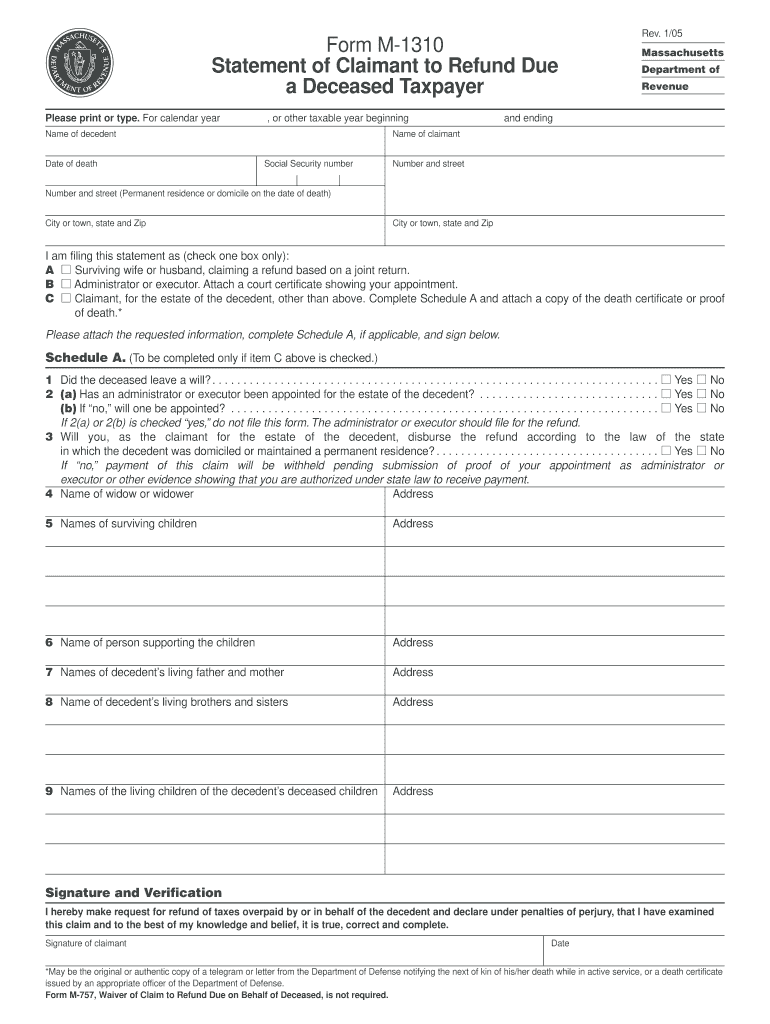
Form M-1310 Statement of Claimant to Refund Due a Deceased Taxpayer Please print or type. For calendar year or other taxable year beginning Name of decedent Date of death Rev. 1/05 Massachusetts Department of Revenue and ending Name of claimant Social Security number Number and street City or town state and Zip I am filing this statement as check one box only A Surviving wife or husband claiming a refund based on a joint return. B Administrator or executor. Attach a court certificate showing you.
Loading

Open form follow the instructions

Easily sign the form with your finger

Send filled & signed form or save
How to fill out the MA DoR M-1310 online
Filling out the MA DoR M-1310 form is an essential step for individuals seeking a tax refund for a deceased taxpayer. This guide provides clear, step-by-step instructions on how to complete the form accurately and efficiently online.
Follow the steps to fill out the MA DoR M-1310 form online.
- Click ‘Get Form’ button to access the MA DoR M-1310 form and open it for editing.
- Begin filling out the form by entering the name of the decedent and the date of death in the designated fields. Ensure this information is accurate as it is crucial for the claim.
- Provide your full name as the claimant and include your social security number. This helps to identify you as the person submitting the request for a refund.
- Specify your permanent address, including the number and street, city or town, state, and zip code. This information confirms your residence at the time of the decedent’s passing.
- Indicate your relationship to the decedent by selecting one option from the provided boxes. Choose from surviving spouse, administrator or executor, or claimant for the estate.
- If you selected option C, complete Schedule A, which includes questions about the decedent’s will, appointment of an administrator or executor, and disbursement of the refund. Respond accurately to ensure compliance with appropriate laws.
- Fill in the names and addresses of the decedent’s surviving children, spouse, parents, siblings, and any other relevant relatives as prompted on the form.
- Read the section concerning the signature and verification carefully. After ensuring all the information provided is accurate, sign the form, date it, and submit it according to the specified instructions.
- Once you have completed the form and verified all entries, you can save your changes, download a copy for your records, and print or share the completed form as needed.
Begin the process of filing documents online to ensure timely refunds and accurate processing.
Experience a faster way to fill out and sign forms on the web. Access the most extensive library of templates available.
Related content
Form M-1310. Statement of Person Claiming Refund Due a Deceased Taxpayer. Rev. 8/19...
Also, enclose Form M-1310,. Statement of Claimant to Refund Due on Behalf of Deceased...
PoE: 130 mA (dispositivo Classe 2), 12 V, c.c.: 430 mA. Temperatura operacional ambiente:...
Get answers to your most pressing questions about US Legal Forms API.
How to file a final tax return for a deceased person?
Filing a final tax return for a deceased person involves using Form 1040 and indicating the taxpayer's date of death. You will need to gather all relevant income documentation and report it within the appropriate tax year. If you're uncertain about the process, using platforms like uslegalforms can provide you with resources to simplify this task. Be mindful of the deadlines and the information needed, including the MA DoR M-1310 guidelines.
How to avoid inheritance tax in Massachusetts?
To avoid inheritance tax in Massachusetts, consider establishing trusts or making gifts while you are still alive. Additionally, keeping the estate value below the $1 million threshold is a crucial strategy. Additionally, it's wise to seek legal advice to tailor a plan that suits your financial situation. Understanding the MA DoR M-1310 guidelines can aid in your planning process.
What should be included in Form 1310?
When completing Form 1310, include information about the deceased, the reason for filing, and the beneficiaries of the estate. You'll need to provide necessary identification, proof of the relationship to the decedent, and details about the assets. Make sure all information aligns with MA DoR M-1310 requirements to avoid issues. Using ulegalforms can help ensure you include all necessary details.
Can Form M 1310 be filed electronically?
Yes, Form M 1310 can be filed electronically through the Massachusetts Department of Revenue's online system. This process simplifies your filing experience, allowing you to submit your documents quickly and efficiently. Always ensure you have the necessary information ready to complete the form correctly. Referencing the MA DoR M-1310 can guide you through the steps.
How much can you inherit without paying taxes in Massachusetts?
In Massachusetts, you can inherit up to $1 million without owing any inheritance tax. This threshold applies to the value of the estate, which means that amounts above this limit may be taxed. It's important to keep records and consult with a tax professional to understand any specific implications for your situation. Knowing the MA DoR M-1310 regulations can also help clarify your responsibilities.
What is the new inheritance tax in Massachusetts?
Massachusetts does not impose a separate inheritance tax. Instead, it has an estate tax applicable to estates valued over $1 million. When dealing with such matters, understanding the MA DoR M-1310 may be essential, and resources from uslegalforms can assist you in navigating your responsibilities regarding inheritance and estate matters.
How much should I withhold for Massachusetts taxes?
The amount you should withhold for Massachusetts taxes depends on your income level and other financial considerations. When you fill out the MA DoR M-1310, it is important to accurately assess your total earnings. Tools and calculators on uslegalforms can help you determine the right withholding amount, ensuring you meet your tax responsibilities comfortably.
What does MA withholding mean?
MA withholding represents the state tax amount withheld from your earnings, aimed at fulfilling your tax responsibilities. When completing your MA DoR M-1310, you will indicate your withholding preferences to ensure compliance. Understanding this process helps you manage your finances more effectively while planning for tax season.
How much can you inherit in Massachusetts without paying taxes?
In Massachusetts, you can inherit up to $40,000 without incurring state inheritance taxes. This exemption applies to individuals and is pertinent when filling out the MA DoR M-1310 form. For more detailed guidance on navigating these financial matters, consider utilizing the resources available on uslegalforms.
What does withholding from your paycheck mean?
Withholding from your paycheck means that a portion of your earnings is deducted to cover your tax obligations. In the context of the MA DoR M-1310, this affects your state tax payments. By properly managing this withholding, you can avoid underpayment penalties and ensure you stay compliant with Massachusetts tax laws.
Use professional pre-built templates to fill in and sign documents online faster. Get access to thousands of forms.
If you believe that this page should be taken down, please follow our DMCA take down process here.
This form is available in several versions. Select the version you need from the drop-down list below.