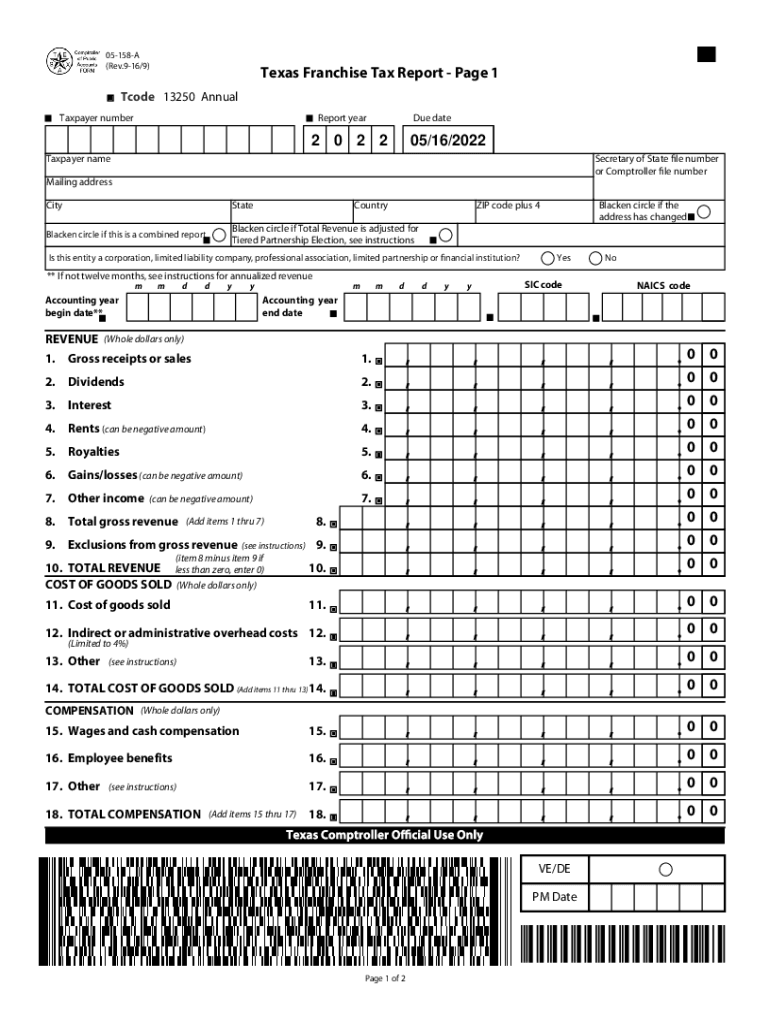
RESET FORM 05-158-A (Rev.9-16/9) PRINT FORM Texas Franchise Tax Report Page 1 FILING REQUIREMENTS Code 13250 Annual Taxpayer number Report year Due date 2 0 2 2 05/16/2023 Taxpayer name Secretary.
Loading

Open form follow the instructions

Easily sign the form with your finger

Send filled & signed form or save
How to fill out the TX Comptroller 05-158-A online
The TX Comptroller 05-158-A is a crucial form for reporting franchise taxes in Texas. This guide provides detailed, step-by-step instructions to assist users in accurately completing the form online, ensuring compliance and correctness.
Follow the steps to fill out the TX Comptroller 05-158-A
- Click ‘Get Form’ button to obtain the form and open it in the editor.
- Enter the taxpayer number, report year, and due date. Ensure that the report year matches the tax period for which you are filing.
- Fill in the taxpayer name and the Secretary of State or Comptroller file number. This information is essential for proper identification.
- Provide the mailing address, city, state, country, and ZIP code plus four. Double-check these details for accuracy and completeness.
- If applicable, blacken the circle indicating whether this is a combined report or if the address has changed since the last filing.
- Specify the entity type by indicating whether it is a corporation, limited liability company, or other specified types.
- For revenue sections, enter the gross receipts or sales, dividends, interest, rents, royalties, gains/losses, and other income. Only whole dollar amounts are to be recorded.
- Calculate total gross revenue by adding items related to income from steps 7. Make sure to also include any exclusions from gross revenue.
- Proceed to fill out the cost of goods sold, entering data in items 11 through 14, ensuring to add as necessary to obtain the total.
- Complete the compensation section by reporting wages and cash compensation, employee benefits, and any other forms of compensation.
- Continue to the margins section and calculate the taxable margin based on the instructions provided.
- Finally, review all entries, save changes, and prepare to download, print, or share your completed form as required.
Complete your TX Comptroller 05-158-A form online to ensure timely and accurate filing.
Experience a faster way to fill out and sign forms on the web. Access the most extensive library of templates available.
Related content
If you are unable to file using Webfile, use our downloadable .PDF reports, designed to...
15PB-189 CC Catalog Front Cover Flat2; 2015-2016 Catalog_AC_only_web; 4.8.15...
Get answers to your most pressing questions about US Legal Forms API.
What is a passive entity tax?
To qualify as a passive entity, the entity must be a partnership or trust, other than a business trust, for the entire accounting period on which the tax is based. The entity may not qualify as passive for the accounting period during which the conversion occurs even if it meets the 90 percent income test.
What is a passive entity?
Passive income includes, for example, dividends, royalties, interest, foreign currency, rental income or property gains (the precise legal definition is in the FATCA and CRS legislation). An Active Entity may broadly be described as one where less than 50% of the entity's gross income and assets are passive.
Is this the reporting entity of a combined group?
Combined Reporting Taxable entities that are part of an affiliated group engaged in a unitary business must file a combined group report in lieu of individual reports. The combined group is a single taxable entity for purposes of calculating franchise tax due and completing the required tax reports.
What is the tax rate for a small business in Texas?
As with all businesses, the no-tax-due threshold and E-Z Computation rules apply to corporations. At 1%, the tax rate on Texas corporations ranks very low nationally, making the state a popular place for businesses of all sizes.
Does an LLC pay state taxes in Texas?
State Business Tax By default, LLCs themselves do not pay federal income taxes, only their members do. Texas, however, imposes a state franchise tax on most LLCs. ... In some cases, the owners of an LLC choose to have their business treated like a corporation for tax purposes.
What taxes does an LLC pay?
The IRS treats one-member LLCs as sole proprietorships for tax purposes. This means that the LLC itself does not pay taxes and does not have to file a return with the IRS. As the sole owner of your LLC, you must report all profits (or losses) of the LLC on Schedule C and submit it with your 1040 tax return.
What taxes does an LLC pay in Texas?
All Texas LLC business members or managers who take profits out of the LLC will need to pay self-employment tax. This tax is also known as FICA, Social Security or Medicare tax. It applies to all the earnings you withdraw from your Texas business. The current self-employment tax rate is 15.3 percent.
What is no tax due threshold in Texas?
Select Yes when the entity's total annualized revenue is less than or equal to the no tax due threshold. The no tax due threshold is as follows: $1,110,000 for reports due in 2016-2017. $1,080,000 for reports due in 2014-2015.
Do I have to pay franchise tax in Texas?
The amount of franchise tax due depends on a business' revenue. Companies whose annual revenue falls below a certain threshold are not required to pay franchise tax. However, all businesses in Texas must file a franchise tax report, regardless of whether they are actually required to pay the tax.
What is the no tax due threshold for franchise tax in Texas?
Even if your business does not owe taxes, it is required to file a Franchise Tax Report each year. The no-tax-due threshold for 2017 is $1,110,000 and increases in 2018 to $1,130,000.
Use professional pre-built templates to fill in and sign documents online faster. Get access to thousands of forms.
If you believe that this page should be taken down, please follow our DMCA take down process here.