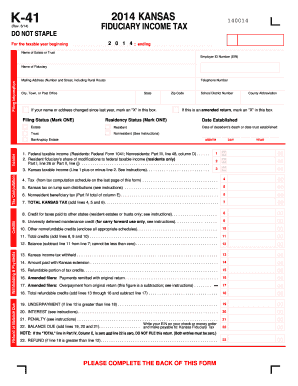
Trust Employer ID Number (EIN) Filing Information Name of Fiduciary Mailing Address (Number and Street, including Rural Route) Telephone Number City, Town, or Post Office State If your name or address changed since last year, mark an "X" in this box. Filing Status (Mark ONE) Residency Status (Mark ONE) Income Tax Computation Credits School District Number County Abbreviation If this is an amended return, mark an "X" in this box. Date Established Date of decedent's death or da.
Open form follow the instructions
Easily sign the form with your finger
Send filled & signed form or save
How to fill out the KS DoR K-41 online
Filling out the KS DoR K-41 form is an essential task for estates and trusts to report fiduciary income tax in Kansas. This guide offers a clear step-by-step process to assist users in completing the form accurately and efficiently online.
Follow the steps to complete the KS DoR K-41 form online.
- Click the ‘Get Form’ button to obtain the KS DoR K-41 form and open it in your preferred online document editor.
- Fill in the 'Name of Estate or Trust' field with the legal name of the estate or trust.
- Enter the 'Employer ID Number (EIN)' in the designated box to ensure proper identification.
- Provide the 'Name of Fiduciary' responsible for the estate or trust.
- Complete the 'Mailing Address' section with the full number and street name, including any rural route information.
- Input the 'Telephone Number,' 'City, Town, or Post Office,' and 'State' in the respective fields.
- If your name or address has changed since the last filing, mark an 'X' in the designated box.
- Select your 'Filing Status' by marking one option that best describes your situation.
- Indicate your 'Residency Status' by marking the appropriate box.
- For reporting income, enter the 'Federal taxable income' as per your records, referencing the appropriate federal form for residents or nonresidents.
- Add any resident fiduciary's share of modifications to federal taxable income, if applicable.
- Calculate your 'Kansas taxable income' by adding or subtracting any modifications from your federal taxable income.
- Compute the tax based on the tax computation schedule provided at the end of the form.
- If you are submitting an amended return, check the appropriate box.
- Review all entries for accuracy before proceeding to the next sections regarding credits, withholding, and payments.
- Once all sections are completed, you can save your changes, download, print, or share the form as necessary.
Take control of your fiduciary income tax filings by completing the KS DoR K-41 form online today.
Experience a faster way to fill out and sign forms on the web. Access the most extensive library of templates available.
Related content
Kansas income tax withheld. 13. Kansas estimated tax paid. 14. Amount paid with Kansas...
Request For Copy Of Kansas Tax Records (DO-41) · Sales and Use Tax Refund ... Sales and...
Wrong fuel mix (too much engine oil in the gasoline), a dirty air filter and unfavorable...
Get answers to your most pressing questions about US Legal Forms API.
What are the benefits of an LLC in Kansas?
Forming an LLC in Kansas offers several advantages, such as limited liability protection and pass-through taxation. This allows you to protect your personal assets while enjoying the tax benefits associated with an LLC. Additionally, filing the KS DoR K-41 can help you navigate your tax responsibilities effortlessly. Using platforms like uslegalforms can simplify the process and ensure you maximize the benefits of your LLC.
Does Kansas have an e-file form?
Yes, Kansas offers e-file options for various tax forms, including personal income tax. The KS DoR K-41 form is one of those that can often be filed electronically, making your filing process more efficient. Utilizing e-filing can help reduce errors and expedite your refund if applicable. Remember to check for the latest guidelines on the Kansas state website.
Can Kansas amended returns be filed electronically?
Yes, Kansas allows taxpayers to file amended returns electronically. This streamlined process makes it easier for you to correct any mistakes on your original return. As part of this process, you may need to refer to the KS DoR K-41 form for accurate reporting. Using e-filing can save you time and effort while ensuring compliance.
How are LLCs taxed in Kansas?
In Kansas, LLCs are typically taxed as pass-through entities. This means that the profits and losses of the LLC pass through to the owners' personal tax returns. Additionally, the KS DoR K-41 form is often used for reporting income and deductions related to LLCs in the state. It's advisable to consult a tax professional to ensure you meet all your filing obligations.
Does Kansas require nonresident withholding?
Yes, Kansas does require nonresident withholding for individuals earning income from Kansas sources. This rule aims to ensure proper tax collection from individuals who may not file a Kansas tax return otherwise. Familiarizing yourself with the KS DoR K-41 form can help clarify your obligations in these situations.
What makes you exempt from Kansas withholding?
You may qualify for exemption from Kansas withholding if you expect to owe less than $500 in Kansas income tax. Additionally, you must have neither a tax liability from the previous year nor expect to have one for the current year. The KS DoR K-41 form can help you determine your eligibility for this exemption.
What is the standard deduction for Kansas income tax?
The standard deduction for Kansas income tax varies based on filing status. For single filers, the amount is $3,000, while married filers can claim $6,000. By utilizing the KS DoR K-41 form, you can ensure that you're maximizing deductions and minimizing your taxable income effectively.
What is the difference between a resident and a nonresident in Kansas?
In Kansas, a resident is someone who has established a permanent home in the state, while a nonresident does not. Residents are taxed on their entire income, while nonresidents are only taxed on income earned within the state. Understanding this distinction is crucial for accurate reporting on the KS DoR K-41 form.
Which states require nonresident withholding?
Nonresident withholding is required in several states, particularly where individuals earn income but are not residents. States like California and New York enforce nonresident withholding on income derived within their borders. If you engage in business or earn income in Kansas, be sure to check the KS DoR K-41 guidance for compliance.
What states have mandatory withholding?
Several states require employers to withhold state income taxes from employee wages. States like California, New York, and New Jersey have mandatory withholding policies. If you're navigating multi-state employment issues, the KS DoR K-41 form can guide your withholding obligations in Kansas.
Use professional pre-built templates to fill in and sign documents online faster. Get access to thousands of forms.
If you believe that this page should be taken down, please follow our DMCA take down process here.
This form is available in several versions. Select the version you need from the drop-down list below.