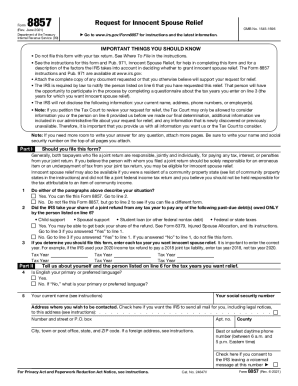
Form Rev. January 2014 Department of the Treasury Internal Revenue Service 99 Request for Innocent Spouse Relief OMB No. 1545-1596 Information about Form 8857 and its separate instructions is at www.irs.gov/form8857. Cat. No. 24647V Daytime phone number between 6 a.m. and 5 p.m. Eastern Time Form 8857 Rev. 1-2014 Page 2 Note. Do either of the paragraphs above describe your situation Yes. You should file this Form 8857. Go to question 2. No. Go to question 3 if you answered Yes to question 1. If you answered No to question 1 do not file this form. If you determine you should file this form enter each tax year you want innocent spouse relief. It is important to enter the correct year. Part I Should you file this form Generally both you and your spouse are responsible jointly and individually for paying any tax interest or penalties from your joint return. If you believe your current or former spouse should be solely responsible for an erroneous item or an underpayment of tax from your jo....

How it works
  • Open form

    Open form follow the instructions

  • Easily sign form

    Easily sign the form with your finger

  • Share form

    Send filled & signed form or save

How to fill out the IRS 8857 online

The IRS Form 8857 is a request for innocent spouse relief, allowing individuals to seek relief from joint liabilities incurred during a marriage. This guide provides step-by-step instructions on how to effectively complete the form online, ensuring clarity and accuracy in your application.

Follow the steps to successfully complete the IRS 8857 online.

  1. Press the ‘Get Form’ button to access the 8857 form and open it in your chosen format.
  2. Read the instructions provided with the form to understand your eligibility for innocent spouse relief. In Part I, determine whether the criteria apply to your situation and proceed accordingly.
  3. In line 1, indicate whether you believe you qualify for the relief based on your joint tax obligations. If yes, continue to line 2.
  4. Enter the specific tax years for which you seek relief in the designated area under Part I.
  5. Complete Part II by providing personal information. This includes your current name, social security number, contact information, and language preferences.
  6. Provide details about your spouse or former spouse in the corresponding fields, including their social security number if known, and current address.
  7. In Part III, answer questions regarding your education, mental or physical health issues, and your role in financial decisions related to the joint tax return.
  8. Detail any history of domestic violence or abuse in Part V, if applicable. This is optional but can support your claim.
  9. Conclude the form by reviewing all entries for accuracy. Ensure you have attached any necessary documents that support your request.
  10. Save your changes, download a copy for your records, and prepare to submit the form according to the filing instructions provided.

Complete your IRS 8857 form online today for prompt processing of your innocent spouse relief request.

Get form

Experience a faster way to fill out and sign forms on the web. Access the most extensive library of templates available.

Related content

Instructions for Form 8857 (01/2014) | Internal...

Sep 11, 2017 - To request relief, you must file Form 8857. The IRS will use the...

Learn more
26 CFR 1.6015-5 - Time and manner for requesting...

... equitable relief under § 1.6015-4, a requesting spouse must file Form 8857, ... The...

Learn more
Publication 594 (Rev. 03 2017) P594...

The IRS Collection Process Publication 594 This publication provides a general ...... You...

Learn more
Questions & Answers

Get answers to your most pressing questions about US Legal Forms API.

Contact support

What is the difference between injured spouse and innocent spouse?

In most cases, innocent spouse relief is limited to taxpayers who are no longer married. In contrast, injured spouse relief applies to taxpayers who are married. ... An allocation is made as if you and your spouse each filed a separate tax return instead of a joint tax return.

Please see the IRS Innocent Spouse Q & A. An excerpt from this is below; Balance Due Generally, you must file your request within the time period the IRS has to collect the tax. Generally, the IRS has 10 years from the date the tax liability was assessed to collect the tax.

The IRS can garnish your husband's wages, which can reduce your total household income. If you file jointly in the future, the IRS may withhold your refund to pay the taxes your spouse owes. If you did file jointly, though, both of your wages can be garnished.

In some of these states, the law allows the IRS to collect past due taxes from either spouse, regardless of who owes them or who filed and signed the return. ... The IRS can take your refund to satisfy your husband's debt and it can even garnish your own personal wages to pay it.

If the IRS liability is a JOINT liability then YES, the IRS may levy both your and your spouse's wages, assets, and/or accounts. When it comes to wages, IRS guidelines suggest that only the spouse with the higher income should be levied (a wage levy is the IRS term for a wage garnishment).

The innocent spouse rule allows a taxpayer to avoid a tax obligation arising from errors made by a spouse on a joint return. Most commonly, the error involves unreported income or an inflated deduction. ... The taxpayer must apply for relief within two years of the IRS initiating collection.

To qualify for an injured spouse claim, you must meet all three following conditions: You are not required to pay the past-due amount. This means that the debt is one which your spouse incurred before you got married or that the debt is one for which only your spouse is liable.

When a Form 8857, Request for Innocent Spouse Relief, is filed with the IRS, it may take up to 6 months before a determination is made. During the processing time, the Service is requesting your tax information and contacting the non-requesting spouse. By law, the IRS must contact your spouse or former spouse.

Innocent Spouse Relief. You must meet all of the following conditions to qualify for innocent spouse relief: You filed a joint return that has an understatement of tax that's solely attributable to your spouse's erroneous item. An erroneous item includes income received by your spouse but omitted from the joint return.

Form to File To seek innocent spouse relief, separation of liability relief, or equitable relief, you should submit to the IRS a completed Form 8857, Request for Innocent Spouse Relief (PDF) or a written statement containing the same information required on Form 8857, which you sign under penalties of perjury.

Get This Form Now!

Use professional pre-built templates to fill in and sign documents online faster. Get access to thousands of forms.

If you believe that this page should be taken down, please follow our DMCA take down process here.

Get IRS 8857