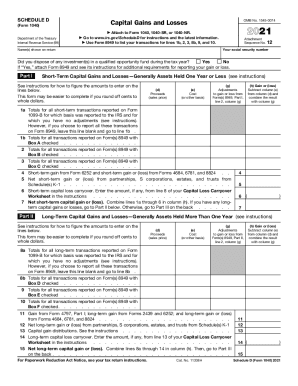
SCHEDULE DCapital Gains and Losses(Form 1040) Department of the Treasury Internal Revenue Service (99)OMB No. 154500742021 Attach to Form 1040, 1040SR, or 1040NR. Go to www.irs.gov/ScheduleD for instructions.
Loading
Open form follow the instructions
Easily sign the form with your finger
Send filled & signed form or save
How to fill out the IRS 1040 - Schedule D online
Filling out the IRS 1040 - Schedule D is essential for declaring your capital gains and losses. This guide will help you navigate the form online, ensuring you accurately report your financial information.
Follow the steps to successfully complete Schedule D online.
- Click ‘Get Form’ button to obtain the form and open it in your editor.
- Enter your social security number in the designated field at the top of the form. Ensure that it matches the name(s) shown on your return.
- Indicate whether you disposed of any investment(s) in a qualified opportunity fund during the tax year by checking 'Yes' or 'No'. If 'Yes,' attach Form 8949 and follow its instructions regarding additional reporting requirements.
- Section I: Report short-term capital gains and losses. Round off cents to whole dollars for convenience. Enter the proceeds (sales price), cost (or other basis), and any adjustments to gain or loss from Form 8949 for each transaction.
- Complete lines 1a through 7 in Part I. Use the totals for short-term transactions as indicated, ensuring to consider any adjustments on Form 8949. If you have long-term capital gains or losses, proceed to Part II.
- Section II: Document long-term capital gains and losses. Similar to Part I, enter the necessary amounts for proceeds, cost, and adjustments for each transaction.
- Fill in lines 8a through 15 in Part II, ensuring correct combinations as instructed. After this, follow through to Part III to summarize your total gains or losses.
- In Part III, combine the totals from line 7 and line 15. Enter this amount in line 16.
- If line 16 shows a gain, transfer that amount to Form 1040, lines 7 and continue to line 17. If it's a loss, skip to line 21 after completing any related instructions.
- Review your entries for accuracy. Once completed, you can save changes, download the form, print it, or share it according to your needs.
Start filling out your IRS 1040 - Schedule D online to ensure compliance and proper reporting of your capital gains and losses.
Experience a faster way to fill out and sign forms on the web. Access the most extensive library of templates available.
Related content
Information about Schedule D (Form 1040), Capital Gains and Losses, including recent...
Aug 1, 2019 - The 2018 Form 1040—while created to showcase a new, “simplified”...
Get answers to your most pressing questions about US Legal Forms API.
Do I have to report stocks on taxes?
Under U.S. tax rules, if you sell almost any type of asset for more than the cost, you have a capital gain; that profit must be reported on your tax return and the appropriate taxes paid. With investments such as stocks, you also report capital losses.
Do I need a Schedule D?
Schedule D requires taxpayers to report the sales price of their investment or ownership interest, its cost or other basis and any adjustments to the gain or loss. Taxpayers can usually get this information from Form 1099-B, which the payer must file with the IRS for reporting purposes and send a copy to the payee.
What is the Schedule D form 1040 used for?
Schedule D is a form provided by the IRS to help taxpayers computer their capital gains or losses and the corresponding taxes due. The calculations from Schedule D are combined with individual tax return form 1040, where it will affect the adjusted gross income amount.
What is a Schedule D tax form used for?
Schedule D isn't just used to report capital gains when you sell a home. It's also used to report: The sale or exchange of a capital asset not reported on another form or schedule. Gains from involuntary conversions (other than from casualty or theft) of capital assets not held for business or profit.
Do I need to file Schedule D?
Schedule D requires taxpayers to report the sales price of their investment or ownership interest, its cost or other basis and any adjustments to the gain or loss. Taxpayers can usually get this information from Form 1099-B, which the payer must file with the IRS for reporting purposes and send a copy to the payee.
Do I have to file Form 8949 with Schedule D?
Any year that you have to report a capital asset transaction, you'll need to prepare Form 8949 before filling out Schedule D unless an exception applies. Form 8949 requires the details of each capital asset transaction.
Where do I enter capital gains on Form 1040?
Capital gains and deductible capital losses are reported on Form 1040, Schedule D, Capital Gains and Losses, and then transferred to line 13 of Form 1040, U.S. Individual Income Tax Return.
Do I need to fill out a Schedule D?
Schedule D requires taxpayers to report the sales price of their investment or ownership interest, its cost or other basis and any adjustments to the gain or loss. Taxpayers can usually get this information from Form 1099-B, which the payer must file with the IRS for reporting purposes and send a copy to the payee.
How do I fill out a Schedule D form 1040?
Fill out Form 1040. Put your totals from Schedule D on line 13 of form 1040. Attach Schedule D and Form 8949 to your Form 1040 so the IRS can verify your figures. Your long-term gains or losses qualify you for a 15 percent tax rate.
Is Schedule D required if Form 8949 is Used?
Schedule D: Capital Gains and Losses of Form 1040 is used to report most capital gain (or loss) transactions. But before an individual can enter the net gain or loss on Schedule D, Form 8949 must be completed.
Use professional pre-built templates to fill in and sign documents online faster. Get access to thousands of forms.
If you believe that this page should be taken down, please follow our DMCA take down process here.