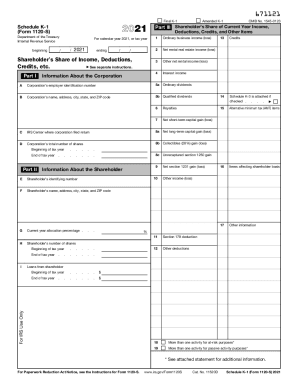
6711212021Schedule K1 (Form 1120S) Department of the Treasury Internal Revenue Service //beginningPart III Shareholders Share of Current Year Income, Deductions, Credits, and Other Items1Ordinary.

How it works
  • Open form

    Open form follow the instructions

  • Easily sign form

    Easily sign the form with your finger

  • Share form

    Send filled & signed form or save

How to fill out the IRS 1120S - Schedule K-1 online

Filling out the IRS 1120S - Schedule K-1 is an important task for shareholders of an S Corporation. This form reports your share of the corporation's income, deductions, and credits for the tax year, enabling you to accurately file your personal tax return.

Follow the steps to complete your IRS 1120S - Schedule K-1 online.

  1. Click 'Get Form' button to access the IRS 1120S - Schedule K-1 and open it in your browser or preferred editing tool.
  2. Enter the corporation’s employer identification number in the designated field. This number is essential for identifying the business entity that you are a shareholder in.
  3. Provide the corporation's name, address, city, state, and ZIP code. Accurate information is critical for tax identification purposes.
  4. Fill in your identifying number as a shareholder, along with your name, address, and other personal information as requested in Part II.
  5. Review Part III to report your share of the corporation’s income, deductions, credits, and more. Carefully enter figures such as ordinary business income, rental income, and dividends.
  6. If applicable, check the box related to Schedule K-3 to indicate any additional reporting information required for your tax situation.
  7. Once all entries are completed and verified for accuracy, you can save changes to the form. Consider downloading or printing a copy for your records before submitting.
  8. Share the completed Schedule K-1 with your accountant or include it with your personal tax return to ensure proper reporting.

Complete your IRS 1120S - Schedule K-1 online and stay organized for tax season!

Get form

Experience a faster way to fill out and sign forms on the web. Access the most extensive library of templates available.

Related content

About Schedule K-1 (Form 1120-S), Shareholder's...

The S corporation files a copy of schedule k-1 (Form 1120-S) with the IRS to report your...

Learn more
Applying for Financial Aid - Amherst College

Sep 18, 2019 - You will report your 2018 federal tax information on the 2020-21 FAFSA....

Learn more
Publication 4163 (Rev. 12 2017) P4163...

Publication 4163 Modernized e-File (MeF) Information for Authorized IRS e-File Providers...

Learn more
Questions & Answers

Get answers to your most pressing questions about US Legal Forms API.

Contact support

Is S Corp income passive or Nonpassive?

If a shareholder materially participates in the operations of an S corporation, the passthrough of nonseparately stated (ordinary) income or loss is nonpassive. The income or loss passed through is passive if the shareholder does not materially participate.

Schedule K-1 The passive income is also included with the S Corporation's nonpassive income. If you are an S Corporation shareholder, request a breakdown of ordinary income so you know how much of the income you must report as passive and how much you must report as ordinary.

K-1 Losses If your K-1 shows a net loss, you report it on the appropriate tax schedule, for example Schedule E for a partnership. Then you write in the loss on your Form 1040 and deduct it from any other taxable income. ... Instead, if you have a net operating loss, you can deduct it from past or future taxable income.

Use Schedule K-1 to report a beneficiary's share of the estate's or trust's income, credits, deductions, etc. on your Form 1040, U.S. Individual Income Tax Return. ... Don't file it with your tax return, unless backup withholding was reported in box 13, code B.

As long as you have the correct information, you can put it on your tax form without having the statement in hand. The one exception is the 1099-R, which tracks distributions from retirement plans and insurance contracts. You'll need to send that in with your tax return if income tax was withheld.

Yes you can file the 2016 return without the Schedule K-1 and then amend the 2016 return after receipt of the K-1.

How is K1 Income Taxed? ... Partnerships, S Corporations, estates and trusts provide K-1 forms to partners and shareholders for filing their individual tax returns. Income and tax liabilities are passed through the corporation or entity to the taxpayer. K-1 income or loss is passed through to the individual tax return.

The partnership does file an information-only tax return - Form 1065. An S corporation pays tax on income and files a corporate return on Form 1120-S. ... A single-member LLC is taxed as a sole proprietorship and the owner doesn't receive a Schedule K-1.

S Corporation K1: Everything You Need to Know. The S corporation K-1 form, also known as a Schedule K-1, is used to report the amount of profit passed through to each party in business entities such as LLCs and S corporations. It shows income, dividend receipts, and losses.

Similar to a partnership, S corporations must file an annual tax return on Form 1120S.The S corporation provides Schedule K-1s that reports each shareholder's share of income, losses, deductions and credits. The shareholders use the information on the K-1 to report the same thing on their separate tax returns.

Get This Form Now!

Use professional pre-built templates to fill in and sign documents online faster. Get access to thousands of forms.

If you believe that this page should be taken down, please follow our DMCA take down process here.

Get IRS 1120S - Schedule K-1