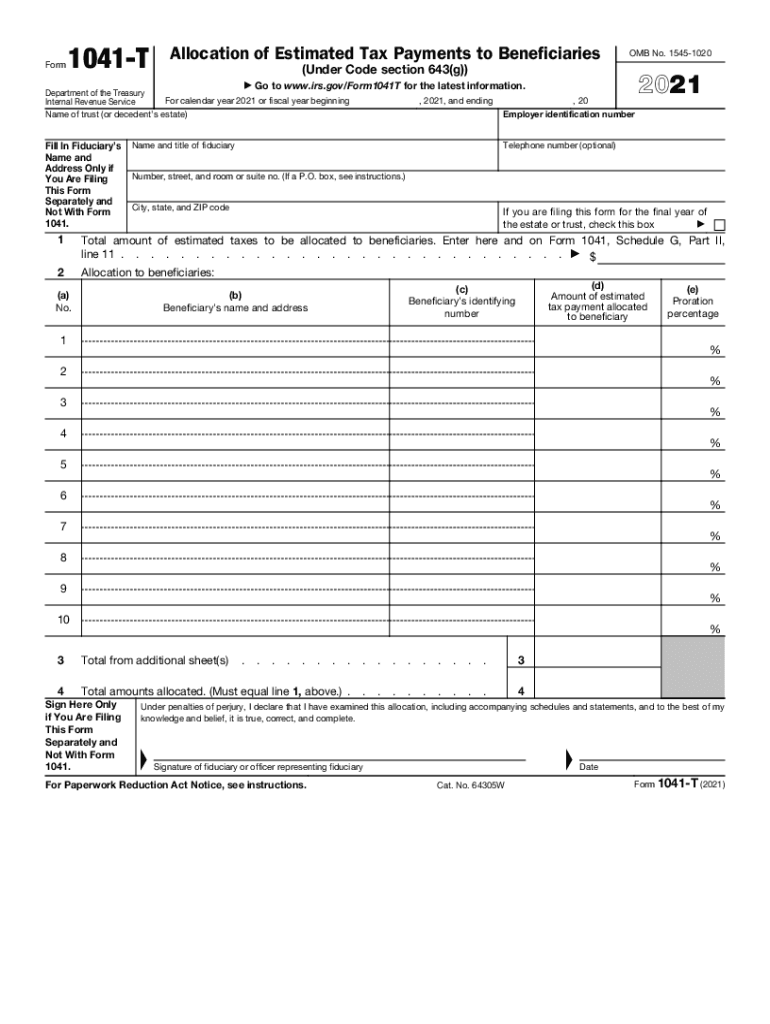
Form1041TAllocation of Estimated Tax Payments to Beneficiaries (Under Code section 643(g))2021Go to www.irs.gov/Form1041T for the latest information. Department of the Treasury For calendar year 2021.
Loading

Open form follow the instructions

Easily sign the form with your finger

Send filled & signed form or save
How to fill out the IRS 1041-T online
Filing the IRS 1041-T form is essential for fiduciaries managing trusts or decedent's estates that wish to allocate estimated tax payments to beneficiaries. This guide provides a clear, step-by-step approach to completing the form online, ensuring you understand each component.
Follow the steps to successfully complete the IRS 1041-T form online.
- Click ‘Get Form’ button to obtain the form and open it in the editor.
- Fill in the name of the trust or decedent's estate at the top of the form. This includes entering the employer identification number as well as the fiduciary’s name, address, and optional telephone number.
- Indicate the tax year for which you are filing the 1041-T form by filling out the relevant spaces at the top.
- If this form is being filed for the final year of the estate or trust, check the corresponding box.
- Enter the total amount of estimated taxes to be allocated to beneficiaries in line 1. This amount should correspond with the figure reported on Form 1041, Schedule G, Part II, line 11.
- Below line 1, allocate the taxes to each beneficiary by filling in their name, address, TIN (taxpayer identification number), the amount allocated, and the proration percentage on the relevant columns provided.
- If there are more than ten beneficiaries, aggregate the additional beneficiaries on an attached sheet and enter the total on line 3.
- Ensure the total amounts allocated match the total from line 1 and complete line 4.
- At the bottom of the form, sign and date it if you are filing this form separately. Otherwise, do not sign here.
- After completing all necessary fields, save your changes. You can then download, print, or share the completed form as needed.
Start filling out your IRS 1041-T form online today to ensure proper tax allocation for your beneficiaries.
Experience a faster way to fill out and sign forms on the web. Access the most extensive library of templates available.
Related content
Information about Form 1041-T, Allocation of Estimated Tax Payments to Beneficiaries...
Generally, the threshold amount for the upcoming year is updated by IRS .... For estates...
Publication 4163 Modernized e-File (MeF) Information for Authorized IRS e-File Providers...
Get answers to your most pressing questions about US Legal Forms API.
How do I file a trust tax return?
In case the Trust is required to file income tax return due to taxable income being over Rs.2.5 lakhs, then ITR 5 can be filed. In case the Trust is required to file income tax return mandatorily under Sections 139(4A) or139(4B) or 139(4C) or 139(4D) or 139(4E) or139(4F) of the Income Tax Act, then ITR 7 must be filed.
What is the tax rate for an irrevocable trust?
In general, trusts are subject to the same tax rates as individuals, but trusts hit the highest tax rates at a much lower level. For 2017, the top marginal income tax rate of 39.6% impacts single taxpayers with taxable income of $418,400, and married couples with taxable income of $470,700.
Do you have to file a tax return for an irrevocable trust?
Trust Tax Implications An irrevocable trust is treated as a separate taxpayer and must file a federal income tax return on Form 1041 each year. The trustee is responsible for reporting all income the trust earns, even if the terms of the trust require beneficiaries to receive all of that income.
How do I file a 1041 for an irrevocable trust?
The legal name of the trust, the Trustee name and address must be given to the IRS. Next, the Trustee should file the Form 1041 U.S. Income Tax Return for Estates and Trusts with the IRS if the Irrevocable Trust has more than $600 in taxable income generated annually.
How do I file a tax return for a trust?
In case the Trust is required to file income tax return due to taxable income being over Rs.2.5 lakhs, then ITR 5 can be filed. In case the Trust is required to file income tax return mandatorily under Sections 139(4A) or139(4B) or 139(4C) or 139(4D) or 139(4E) or139(4F) of the Income Tax Act, then ITR 7 must be filed.
Do you have to file a 1041 if there is no income?
Not every estate is required to file Form 1041 for income earned. If the estate has no income producing assets or the annual gross income is less than $600, no return is necessary. ... The executor or personal representative of the estate must file the return.
Do I have to file taxes for a trust?
Trusts and estates must pay income taxes when they earn at least $600. IRS Form 1041 is an income tax return, the same as an individual or business would file but for a decedent's estate or living trust after his death.
Does an irrevocable trust have to file a tax return?
An irrevocable trust is treated as a separate taxpayer and must file a federal income tax return on Form 1041 each year. ... However, if the trustee has no obligation to distribute earnings to beneficiaries and accumulates income within the trust, she must pay tax on those earnings using money from the trust.
Does a trust have to file a tax return?
A: Trusts must file a Form 1041, U.S. Income Tax Return for Estates and Trusts, for each taxable year where the trust has $600 in income or the trust has a non-resident alien as a beneficiary. ... Thus, the grantor/individual would pay the total tax liability upon the filing of his return for that taxable year.
Do I need to file an estate tax return for 2018?
You must file Form 1041 (U.S. Income Tax Return for Estates and Trusts) by the 15th day of the fourth month after the tax year-end (adjusted for weekends and holidays). So for a person who died in 2018, the deadline is April 15, 2019, when the standard Dec. 31 tax year-end is chosen.
Use professional pre-built templates to fill in and sign documents online faster. Get access to thousands of forms.
If you believe that this page should be taken down, please follow our DMCA take down process here.