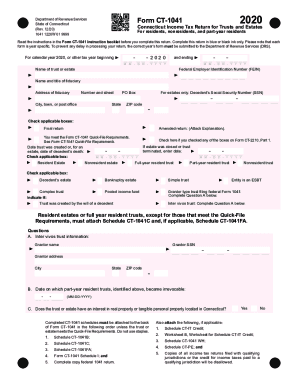
2020Form CT1041Department of Revenue Services State of Connecticut (Rev. 12/20) 1041 1220W 01 9999Connecticut Income Tax Return for Trusts and Estates For residents, nonresidents, and partyear residentsRead.

How it works
  • Open form

    Open form follow the instructions

  • Easily sign form

    Easily sign the form with your finger

  • Share form

    Send filled & signed form or save

How to fill out the CT DRS CT-1041 online

This guide provides comprehensive instructions on how to complete the Connecticut Income Tax Return for Trusts and Estates, known as Form CT-1041. Whether you are filing for a resident, nonresident, or part-year resident trust, these step-by-step instructions will help ensure a smooth and accurate online filing process.

Follow the steps to complete your CT DRS CT-1041 online

  1. Press the ‘Get Form’ button to access the CT DRS CT-1041 form in the editor.
  2. Enter the tax year for which you are filing in the designated fields at the top of the form (Month, Day, Year).
  3. Fill in the name of the trust or estate along with the Federal Employer Identification Number (FEIN).
  4. Input the name and title of the fiduciary, along with their complete address including street number, PO Box, city, state, and ZIP code.
  5. For estates, provide the date of the decedent’s death and their Social Security Number (SSN).
  6. Select the applicable checkboxes indicating whether this is the final return, if it meets Quick-File requirements, and if applicable, specify the type of estate or trust.
  7. If applicable, detail the information about the Inter vivos trust by completing the questions regarding the grantor.
  8. Attach any required schedules as instructed, ensuring they are in the specified order without using staples.
  9. Complete the computation of tax section, entering figures as directed based on the taxable income and any credits applicable.
  10. Review the declaration section, sign, and date the form as fiduciary or as an officer representing the fiduciary.
  11. After finishing all sections, you can save changes, download, print, or share the form as needed.

Complete your CT DRS CT-1041 form online today to ensure accurate and timely filing.

Get form

Experience a faster way to fill out and sign forms on the web. Access the most extensive library of templates available.

Related content

Trust and Estate forms - CT.gov

2018 Connecticut Electronic Filing Payment Voucher, 12/2018. CT-1041ES, 2018 Estimated...

Learn more
CT Income Tax | It's Your Yale

Prepare & File your State of CT Individual Income Tax Return. ... CT-1040 NR/PY...

Learn more
Manual - UserManual.wiki

... 0) The basis polynomial is then f (r, s) = a + br + cs + drs + er2 + f s2 + gr2 s +...

Learn more
Questions & Answers

Get answers to your most pressing questions about US Legal Forms API.

Contact support

Can I use TurboTax to file a 1041?

You'll need TurboTax Business to file Form 1041, as the personal versions of TurboTax do not support this form. TurboTax Business (Windows only) is available on CD or as a download. It's not available for Mac or in our online versions of TurboTax. ... Select Trust or Estate return (Form 1041) and proceed.

Which TurboTax do I need to file a return for a trust? If it's a living trust, you can use whichever TurboTax personal program suits your tax situation. There is no special tax form for living trusts; the trust's income and deductions are reported on your personal tax return.

Form 706 must generally be filed and any tax due must be paid within nine months of the decedent's date of death.

A: Trusts must file a Form 1041, U.S. Income Tax Return for Estates and Trusts, for each taxable year where the trust has $600 in income or the trust has a non-resident alien as a beneficiary. ... Thus, the grantor/individual would pay the total tax liability upon the filing of his return for that taxable year.

Not every estate is required to file Form 1041 for income earned. If the estate has no income producing assets or the annual gross income is less than $600, no return is necessary. ... The executor or personal representative of the estate must file the return.

Which Estates Must File IRS Form 1041? The executor or personal representative of an estate must file Form 1041 when a domestic estate has gross income for the tax year of $600 or more or when one or more of its beneficiaries are nonresident aliens.

IRS Form 1041, U.S. Income Tax Return for Estates and Trusts, is required if the estate generates more than $600 in annual gross income. The decedent and their estate are separate taxable entities. Before filing Form 1041, you will need to obtain a tax ID number for the estate.

The grantor must pay gift taxes whenever assets are transferred into an irrevocable trust. Revocable trusts are not subject to gift taxes, but will be included in the grantor's estate for estate tax purposes.

IRS Form 1041 is an income tax return, the same as an individual or business would file but for a decedent's estate or living trust after his death. The return reports income, capital gains, deductions, and losses, but subject to somewhat different rules than those that apply to living individuals.

In case the Trust is required to file income tax return due to taxable income being over Rs.2.5 lakhs, then ITR 5 can be filed. In case the Trust is required to file income tax return mandatorily under Sections 139(4A) or139(4B) or 139(4C) or 139(4D) or 139(4E) or139(4F) of the Income Tax Act, then ITR 7 must be filed.

Get This Form Now!

Use professional pre-built templates to fill in and sign documents online faster. Get access to thousands of forms.

If you believe that this page should be taken down, please follow our DMCA take down process here.

CT DRS CT-1041 Form

This form is available in several versions. Select the version you need from the drop-down list below.

Get CT DRS CT-1041