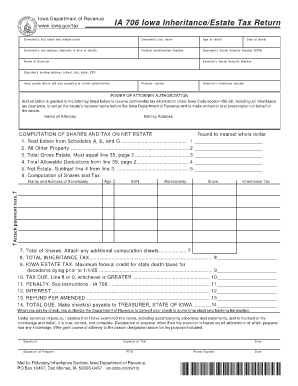
Domicile at time of death) Federal Identification Number Decedent s Social Security Number (SSN) Name of Executor Date of death Executor s Social Security Number Executor s mailing address (street, city, state, ZIP) Iowa county where will was probated or estate administered Probate number Attorney s telephone number POWER OF ATTORNEY AUTHORIZATION Authorization is granted to the attorney listed below to receive confidential tax information under Iowa Code section 450.68, includ.
Open form follow the instructions
Easily sign the form with your finger
Send filled & signed form or save
How to fill out the IA DoR 706 online
Filling out the IA DoR 706 can seem daunting, but this guide will help you navigate the process efficiently. By following these instructions, you will ensure that your form is completed accurately and submitted in a timely manner.
Follow the steps to successfully complete the IA DoR 706 online.
- Click the ‘Get Form’ button to obtain the form and open it in the editor.
- Begin by entering the decedent’s first name, middle initial, last name, age at death, and last address at the time of death. This information is essential for identifying the decedent.
- Fill in the Federal Identification Number and Social Security Number (SSN) of the decedent. Ensure accuracy in these numbers as they are crucial for federal reporting.
- Provide the name of the executor and their Social Security Number, mailing address, and the date of death of the decedent. This identifies who is responsible for managing the estate.
- Indicate the Iowa county where the will was probated or the estate was administered, along with the probate number. This information helps track the estate's legal processes.
- If applicable, complete the Power of Attorney authorization section by providing the name and mailing address of the attorney authorized to act on behalf of the estate.
- Proceed to the Computation of Shares and Tax on Net Estate section. Enter values for each line regarding real estate, other property, gross estate, allowable deductions, and net estate.
- Calculate the shares and inheritance tax for each beneficiary based on their relationship to the decedent and their respective shares.
- Finally, review all entries for accuracy before saving, downloading, printing, or sharing the completed form.
Start filling out your IA DoR 706 online today to ensure proper submission and compliance.
Experience a faster way to fill out and sign forms on the web. Access the most extensive library of templates available.
Related content
May 28, 2024 — This designation allows for the designee to receive the estate's...
by M Fernandes · 2002 · Cited by 135 — queixas de saúde e achados audiológicos de...
This MIG welding machine is factory set for welding low-carbon steel. Use a mixed gas...
Get answers to your most pressing questions about US Legal Forms API.
How to avoid Iowa inheritance tax on property?
To avoid Iowa inheritance tax on property, explore potential exemptions under the IA DoR 706 based on your relationship to the decedent. Beneficiaries may face different tax rates, so understanding these relationships is crucial. Additionally, planning ahead with estate planning tools can legally minimize tax burdens. Consulting uslegalforms can provide valuable resources to help you navigate these complexities.
How do I get a closing letter from the IRS form 706?
To obtain a closing letter from the IRS after filing form 706, first ensure the form is accurately completed and submitted. Once the IRS processes your application, they will issue a closing letter if there are no outstanding tax liabilities. This can take several months, so patience is key. For a smoother process, tools like uslegalforms can help streamline your filing.
Who signs 706 if there is no executor?
If there is no appointed executor, the personal representative or another responsible party may need to sign the form 706. Under the IA DoR 706 guidelines, you should designate someone who can act on behalf of the estate, ensuring all necessary information is accurately reported. If no one is available, it may be necessary to seek a court appointment for someone to manage these responsibilities. Don’t hesitate to use uslegalforms for assistance in this process.
How do I avoid taxes when I inherit my house?
To avoid taxes when inheriting a house, consider leveraging the step-up in basis outlined in the IA DoR 706. This legal provision allows you to inherit the house at its current market value, potentially eliminating capital gains tax when selling. Additionally, consulting with a tax professional can provide guidance on strategies to minimize your tax burden. Using platforms like uslegalforms can also facilitate the required paperwork.
Does Iowa have inheritance tax on real estate?
Yes, Iowa has an inheritance tax that may apply to real estate, depending on the heir's relationship to the deceased. Under the IA DoR 706, direct descendants often face lower rates or exemptions, while other beneficiaries may incur more significant taxes. It's important to review the specific relationship and applicable rates, as they can impact the overall inheritance tax due. To navigate this process, consider utilizing resources like uslegalforms.
Do all estates have to file form 706?
Not all estates are required to file form 706; it depends on the estate's total value. If the estate value falls below a certain threshold, you are exempt from filing. It’s advisable to consult with professionals to determine your obligations under the IA DoR 706 to ensure you are compliant.
What is the exemption amount for form 706?
As of recent tax law changes, the exemption amount for form 706 has significantly increased. It is essential to stay updated on these figures, as they directly impact estate planning. Understanding the exemption amount is crucial for navigating the IA DoR 706 requirements effectively.
Who signs form 706 if no executor?
If there is no executor, a beneficiary or an individual who has been appointed by the court can sign form 706. It's important for this person to have the necessary authority to act on behalf of the estate. This ensures compliance with IA DoR 706 and maintains the integrity of the estate management process.
Who signs form 706?
The executor or the personal representative of the estate must sign form 706. This signature verifies the accuracy of the information provided. By properly signing the form, you uphold the standards set by IA DoR 706, which is essential for a smooth estate process.
Who fills out form 706?
Typically, the executor of the estate is responsible for filling out form 706. This form is used to report the estate's value for tax purposes. It's crucial to complete it accurately to ensure compliance with IA DoR 706 guidelines, which help streamline the estate settlement process.
Use professional pre-built templates to fill in and sign documents online faster. Get access to thousands of forms.
If you believe that this page should be taken down, please follow our DMCA take down process here.
This form is available in several versions. Select the version you need from the drop-down list below.