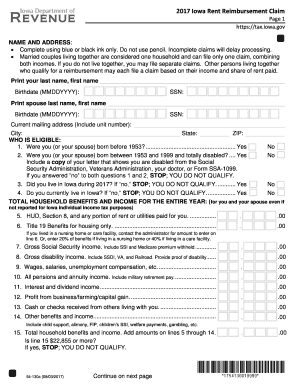
E 15 $22,855 or more? If yes, STOP; YOU DO NOT QUALIFY. , 10. All pensions and annuity income. 54-130a (08/03/2017) Continue on next page 0 .00 2017 Iowa Rent Reimbursement Claim, Page 2 RENTAL INFORMATION: Complete the Statement of Rent Paid if you lived in more than one place. 16. Did you live in a Nursing Home or Care Facility? If yes, report Title 19 benefits on line 6. Yes No 17. Rental Address. (The location where you lived must be subject to property tax. You are not eligible for.

How it works
  • Open form

    Open form follow the instructions

  • Easily sign form

    Easily sign the form with your finger

  • Share form

    Send filled & signed form or save

How to fill out the IA DoR 54-130 online

The IA DoR 54-130 is a crucial form for individuals seeking rent reimbursement in Iowa. This guide will help you navigate through the online filling process, ensuring that you complete each section accurately and efficiently.

Follow the steps to fill out the IA DoR 54-130 online:

  1. Click ‘Get Form’ button to obtain the form and open it in the editor.
  2. In the 'Name and Address' section, fill in your last name and first name using blue or black ink only. Include your birthdate and Social Security Number (SSN). If applicable, enter your spouse's last name, first name, birthdate, and SSN. Provide your current mailing address, including the unit number, city, state, and ZIP code.
  3. Determine your eligibility by answering the four questions regarding age, disability status, and residency in Iowa. If you do not qualify based on these questions, you should stop filling out the form.
  4. In the 'Total Household Benefits and Income for the Entire Year' section, report all relevant income sources, including Social Security, pension, wages, and other benefits. Complete all fields, ensuring that you report combined incomes for married couples.
  5. Provide your rental information under the 'Rental Information' section. Include the rental address, dates you rented in 2017, and total Iowa rent paid. Remember that the location must be subject to property tax.
  6. If you lived in more than one location, complete additional statements for each rental address. Calculate the total rent paid in 2017 and enter this amount.
  7. Complete the optional calculations for reimbursable rent and estimated reimbursement based on your reported income and rent paid. Make sure to multiply and apply the correct rates based on your household income.
  8. For direct deposit, fill in the routing and account numbers and specify the type of bank account.
  9. Read and sign the declaration statement. Include your phone number and that of your preparer, if applicable. Sign and date the form.
  10. After ensuring all fields are complete and accurate, save changes, download, print, or share the form as needed.

Submit your IA DoR 54-130 form online today to ensure timely processing of your rent reimbursement claim.

Get form

Experience a faster way to fill out and sign forms on the web. Access the most extensive library of templates available.

Related content

Iowa Administrative Code Supplement

Dec 24, 1980 — Pursuant to section 17 A.6 of the Iowa Code, the Iowa Administrative Code...

Learn more
Catalogue and Bibliography of Emission-Line Stars...

by WP Bidelman · 1954 · Cited by 306 — On spectrograms taken at Mount Wilson by Joy...

Learn more
Questions & Answers

Get answers to your most pressing questions about US Legal Forms API.

Contact support

Is Iowa a high tax state?

Iowa is often considered a high tax state when you compare it to national averages. Residents experience various tax obligations, including income tax, property tax, and sales tax, as discussed in the IA DoR 54-130. Despite the higher tax burden, many residents find the quality of services and public programs justifiable. For further insights on Iowa taxes, explore tools offered by uslegalforms, which can help clarify your tax situation.

The Iowa state income tax rate varies based on income level; it ranges from 0.33% to 8.53%. This structure reflects the progressive nature of the tax system, which the IA DoR 54-130 outlines clearly. Being aware of the tax brackets can help you navigate your finances effectively. For comprehensive resources on Iowa tax rates, consider checking uslegalforms for accurate tax-related information.

Filling out your tax withholding form involves some key steps. Begin by reviewing the IA DoR 54-130 to understand your exemptions and filing status better. Include all relevant income details, and make sure to double-check your entries for accuracy. If you're unsure, UsLegalForms offers helpful resources and templates to simplify this process.

When asked if you are exempt from withholding, reflect on your current tax situation. If you consistently owe no taxes due to low income or specific deductions, you can answer 'yes.' However, correctly completing the IA DoR 54-130 is crucial to support your claim. Ensure you provide accurate information to avoid any misconceptions or issues.

Filling out a withholding exemption form is straightforward when you know what to include. Start by gathering your personal information and financial details. Use the IA DoR 54-130 form to accurately report your exemptions, income, and filing status. If you find the process challenging, platforms like UsLegalForms can guide you with easy templates and instructions.

The number of exemptions you should withhold depends on your unique financial situation. Using the IA DoR 54-130 form, evaluate your income, expenses, and other tax considerations. Be mindful that claiming too many exemptions can result in owing taxes at the end of the year. It's often wise to consult a tax professional to determine the right number for you.

In Iowa, various individuals may be exempt from state taxes based on their income, age, or other qualifying factors. For instance, seniors earning below a certain limit could find themselves exempt. Understanding the specifics outlined in the IA DoR 54-130 helps you identify if you qualify for any exemptions, allowing you to navigate your state tax responsibilities effectively.

Many individuals are exempt from filing a state tax return in Iowa, particularly those with income that falls below the required threshold. Additionally, certain groups, like specific seniors or military personnel, may also find exemptions. Referencing the IA DoR 54-130 can help clarify these situations to avoid unnecessary filing.

You must file an Iowa income tax return if you meet specified income thresholds and do not qualify for exemptions. This requirement generally includes residents earning taxable income over the limit set for the year. Following the IA DoR 54-130 updates ensures that you meet your state obligations while optimizing any potential deductions.

The IA 1040 form is the primary income tax return form used by residents of Iowa to report their income and calculate their state tax liability. It is a crucial document for anyone who needs to file an Iowa income tax return, as outlined in the IA DoR 54-130. Completing the correct version of the IA 1040 ensures accurate reporting and compliance with state tax regulations.

Get This Form Now!

Use professional pre-built templates to fill in and sign documents online faster. Get access to thousands of forms.

If you believe that this page should be taken down, please follow our DMCA take down process here.

IA DoR 54-130 Form

This form is available in several versions. Select the version you need from the drop-down list below.

Get IA DoR 54-130