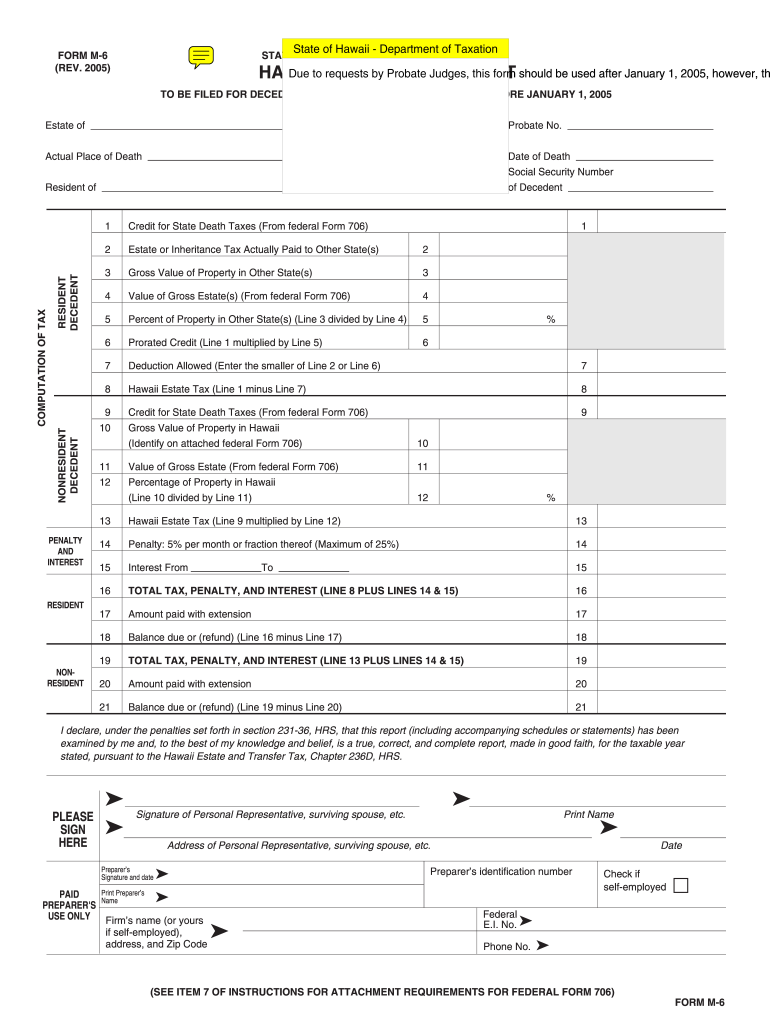
Ate No. Actual Place of Death Date of Death Social Security Number Resident of of Decedent 2 3 Gross Value of Property in Other State(s) 3 4 Value of Gross Estate(s) (From federal Form 706) 4 5 Percent of Property in Other State(s) (Line 3 divided by Line 4) 5 Prorated Credit (Line 1 multiplied by Line 5) 6 7 Deduction Allowed (Enter the smaller of Line 2 or Line 6) 7 8 RESIDENT DECEDENT Estate or Inheritance Tax Actually Paid to Other State(s) 6 NONRESIDENT DECEDENT Cre.
Loading

Open form follow the instructions

Easily sign the form with your finger

Send filled & signed form or save
How to fill out the HI DoT M-6 online
Navigating the HI DoT M-6 form can be challenging, but with the right guidance, you can complete it efficiently. This comprehensive guide will walk you through each section and field of the form to ensure accuracy and compliance.
Follow the steps to complete the form effectively.
- Press the ‘Get Form’ button to access the HI DoT M-6 form online and open it in your preferred editor.
- Begin by entering the name of the estate in the designated field, alongside the probate number, actual place of death, and date of death. Ensure that you also include the social security number of the decedent.
- Indicate whether the decedent was a resident or nonresident and provide the respective details about their property. This includes the gross value of property located in other states.
- Fill in the section about the value of the gross estate, which should be obtained from the federal Form 706. This value is crucial for tax calculations.
- Calculate the percent of property in other states by dividing the gross value of property in other states by the value of gross estate.
- Compute the prorated credit by multiplying the value on line 1 by the value calculated in the previous step.
- Enter the allowed deduction, which will be the smaller amount from line 2 or line 6.
- Discuss the computation of tax by entering the final figures derived from previous lines and adjustments for penalties and interest if applicable.
- Complete the declaration section where the personal representative or responsible individual must sign and provide their printed name, address, and preparer information if applicable.
- Finally, review all entries for accuracy. You can save changes, download, print, or share the completed form as required.
Ensure you complete the necessary documents online for a smooth filing process.
Experience a faster way to fill out and sign forms on the web. Access the most extensive library of templates available.
Related content
Oct 22, 2019 — Anyone applying for a REAL ID compliant Hawaii driver's license or...
Scratch is a free programming language and online community where you can create your own...
The NXAMP Amplified Digital TDcontroller provides driver protection and system...
Get answers to your most pressing questions about US Legal Forms API.
Is the Hawaii estate tax exemption portable?
Yes, the Hawaii estate tax exemption is portable, meaning that a surviving spouse can inherit the unused portion of the exemption from their deceased partner. This feature, part of the HI DoT M-6 regulation, can significantly enhance the tax exemptions available to the surviving spouse. Proper estate planning can ensure that you take full advantage of this benefit.
What is the estate tax exemption in Hawaii 2025?
As of 2025, the estate tax exemption in Hawaii is expected to be around $5.49 million, but this can change based on legislative decisions. It's essential to stay updated on any developments regarding HI DoT M-6, as these changes can impact estate planning strategies. Regularly checking with legal platforms like uslegalforms can provide current information to ensure you are well-prepared.
Do you have to file an estate tax return for portability?
Yes, to elect for portability, you must file an estate tax return, even if no tax is owed. This requirement is crucial to ensure that the exemption is preserved for the surviving spouse. By filing the return and properly completing the forms related to HI DoT M-6, you can secure the benefits of portability.
How to avoid Hawaii estate tax?
To avoid Hawaii estate tax, individuals can take advantage of several strategies, including gifting assets before death and utilizing the HI DoT M-6 estate tax exemption. It is also beneficial to create trusts or consider other estate planning tools. Consulting with a knowledgeable estate planner can provide tailored strategies that fit specific financial situations.
When did estate tax exemption become portable?
Estate tax exemption became portable in 2010, after the introduction of the Tax Relief, Unemployment Insurance Reauthorization, and Job Creation Act. However, it was not until the American Taxpayer Relief Act of 2012 that portability was made permanent, including for states like Hawaii under the HI DoT M-6. Understanding these changes can help individuals make informed decisions about estate planning.
What is an example of portability for estate tax exemption?
Portability for estate tax exemption, particularly in the context of HI DoT M-6, allows a surviving spouse to utilize any unused exemption amount from their deceased partner. For instance, if one spouse passes away and their estate does not exceed the exemption limit, the survivor can carry over that unused portion. This flexibility can maximize tax benefits, reducing the overall tax burden on the surviving spouse's estate.
Do I have to file Hawaii state taxes?
If you earn income in Hawaii, then you will likely need to file Hawaii state taxes. This includes income from wages, business profits, and investments. However, some residents may qualify for exemptions depending on their specific income situation. Always examine your personal circumstances, and resources like uslegalforms can assist in determining your filing requirements.
What documents do I need to get my Hawaii state ID?
To secure a Hawaii state ID, you must present several key documents: proof of identity, proof of Hawaii residency, and your Social Security number. Submitting acceptable documents like a birth certificate and utility bill is crucial, so ensure they meet the HI DoT M-6 criteria for a successful application.
What ID is needed for Hawaii?
To legally travel and identify yourself in Hawaii, you need either a driver’s license or a state ID issued by the Hawaii Department of Transportation. This ID must meet the standards set by the HI DoT M-6. Ensuring your identification is compliant will facilitate smoother travel and verification.
Can you get an ID at the local post office?
No, you cannot obtain a Hawaii state ID at the local post office. State IDs must be issued by the Hawaii Department of Transportation, following the guidelines outlined in the HI DoT M-6. It’s best to visit a designated office to ensure you get the proper identification.
Use professional pre-built templates to fill in and sign documents online faster. Get access to thousands of forms.
If you believe that this page should be taken down, please follow our DMCA take down process here.
This form is available in several versions. Select the version you need from the drop-down list below.