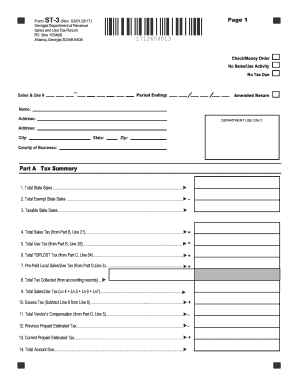
Ergy to manufacturers and all other tax exempt sales). Multiply this amount by the rate indicated on the Part B Sales Tax Distribution Table and record the Sales Tax Amount for the State. Record ONLY total sales sourced to the State of Georgia of energy sold to manufacturers. Multiply this amount by the rate indicated on the Part B Sales Tax Distribution Table and record the Sales Tax Amount. Record taxable non-motor vehicle sales for the City of Atlanta (Total sales sourced to the City of Atlan.
Open form follow the instructions
Easily sign the form with your finger
Send filled & signed form or save
How to fill out the GA DoR ST-3 online
Filling out the GA DoR ST-3 online can be a straightforward process when you follow the appropriate steps. This guide provides detailed instructions for each section of the form, making it easier for users with various levels of experience.
Follow the steps to effectively complete the GA DoR ST-3 online.
- Click ‘Get Form’ button to obtain the ST-3 form and access it for completion.
- Begin by entering your Sales and Use Tax Number (STN), along with your name and registered address in the designated fields.
- Fill in the 'Period Ending' field with the appropriate date (mm/dd/yy) indicating the end of your reporting period.
- Check the 'Amended Return' box if you are making adjustments to a previously filed return for the same period.
- If there were no taxable sales during the reporting period, check the 'No Tax Due' box. If there was no sales/use tax activity at all, complete and submit the payment voucher only.
- Proceed to Part A - Tax Summary. Record your Total State Sales on Line 1 including all applicable leases and rentals.
- On Line 2, enter the Total Exempt State Sales, including any leases and rentals that are exempt from state sales tax.
- Calculate Taxable State Sales by subtracting the exempt sales (Line 2) from the total sales (Line 1) and record this in Line 3.
- Complete the relevant sections in Part B regarding sales tax collection and subsequent calculations as instructed.
- Follow through Part C concerning TSPLOST sales and use tax if applicable, recording the necessary data in the respective fields.
- Lastly, complete Part D for Vendor’s Compensation and Part E for any bad debt reporting, recording the details as needed.
- Review all entries for accuracy, and upon completion, save your changes. You may then download, print, or share the completed form as required.
Take the next step in filing your documents online to ensure timely compliance!
Experience a faster way to fill out and sign forms on the web. Access the most extensive library of templates available.
Related content
ST-3 Sales and Use Tax Return Effective for Sales from April 1, 2018 through September 30...
Jul 3, 2019 — Institutional sales that are subject to state of Georgia sales tax must be...
Você pode utilizar o controle remoto fornecido. RM-AAU058 para operar o receiver e para...
Get answers to your most pressing questions about US Legal Forms API.
What is the reason code for use tax in Georgia?
The reason code for use tax in Georgia typically relates to items purchased without sales tax that are used within the state. When completing tax forms such as the GA DoR ST-3, individuals should specify the reason for the exemption to ensure compliance. Understanding these codes can help you accurately report your tax obligations and avoid penalties.
Do my property taxes go down when I turn 65 in Georgia?
Yes, in Georgia, you may experience a decrease in property taxes when you turn 65 if you qualify for the senior homestead exemption. This exemption significantly reduces the taxable value of your property. To take full advantage of this benefit, make sure to complete the necessary paperwork and stay updated on eligibility requirements.
At what age do you stop paying state taxes in Georgia?
You do not entirely stop paying state taxes in Georgia based on age alone. However, seniors aged 65 and older might experience reductions in property taxes through exemptions. It is important to stay informed about the specific exemptions available to you, as they can significantly alleviate your tax burden.
At what age are you exempt from Georgia state taxes?
While there is no definitive age at which all taxes are exempt in Georgia, seniors may begin to enjoy tax breaks when they turn 65. At this age, they can apply for different exemptions, including property taxes. Therefore, staying informed about tax benefits can help you manage your financial responsibilities effectively.
Who qualifies for sales tax exemption in Georgia?
Various groups in Georgia qualify for sales tax exemption, including non-profit organizations, government entities, and certain purchases made by individuals holding a valid GA DoR ST-3. Additionally, specific purchases such as those related to food, organization supplies, and medical equipment may also be exempt. Understanding the eligibility requirements is essential to benefit from these exemptions.
What is the tax break for seniors in Georgia?
In Georgia, seniors may receive a significant tax break through the homestead exemption when they reach 65 years old. This exemption reduces the taxable value of their property, leading to lower property taxes. Additionally, seniors may also qualify for other tax benefits that enhance their financial situation, making it easier to manage their expenses.
What is a Georgia Schedule 3 form?
The Georgia Schedule 3 form, also known as GA DoR ST-3, is essential for individuals seeking to claim certain sales tax exemptions in Georgia. This form helps you establish your eligibility for tax exemptions on specific purchases. It is crucial to complete this form accurately to avoid any future complications regarding your sales tax responsibilities.
What is the format for Georgia withholding ID?
The Georgia withholding ID is typically a ten-digit number that identifies your business for state withholding tax purposes. This ID is crucial when submitting payroll and tax forms, ensuring all reports are correctly linked to your business. Make sure to keep your Georgia withholding ID handy when completing the GA DoR ST-3 for any tax exemptions or transactions. Properly using this ID can streamline your reporting and reduce errors.
Does Georgia have 7% sales tax?
Yes, Georgia has a state sales tax rate of 4%, but local governments can impose additional taxes, resulting in an effective tax rate of up to 8% in some areas. Understanding this structure helps you navigate your sales tax obligations accurately. Keep in mind that specific goods and services may have different rates or exemptions. Always check local regulations to ensure compliance.
How is Georgia state tax calculated?
Georgia state tax is calculated based on your taxable income, which includes wages, interest, dividends, and capital gains. The state utilizes a progressive tax system, meaning higher income levels are taxed at higher rates. Additionally, certain deductions may apply, which can reduce your overall taxable income. Understanding how these factors work together can simplify the process, especially when filing using the GA DoR ST-3.
Use professional pre-built templates to fill in and sign documents online faster. Get access to thousands of forms.
If you believe that this page should be taken down, please follow our DMCA take down process here.
This form is available in several versions. Select the version you need from the drop-down list below.