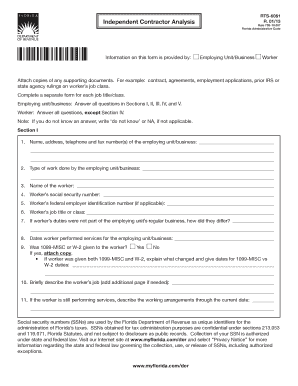
Ng documents. For example: contract, agreements, employment applications, prior IRS or state agency rulings on worker s job class. Complete a separate form for each job title/class. Employing unit/business: Answer all questions in Sections I, II, III, IV, and V. Worker: Answer all questions, except Section IV. Note: If you do not know an answer, write do not know or NA, if not applicable. Section I 1. Name, address, telephone and fax number(s) of the employing unit/business:.
Open form follow the instructions
Easily sign the form with your finger
Send filled & signed form or save
How to fill out the FL RTS-6061 online
The FL RTS-6061 form is essential for documenting the nature of work performed by independent contractors in Florida. This guide will provide you with clear, step-by-step instructions on how to accurately complete the form online.
Follow the steps to effectively complete the FL RTS-6061.
- Press the ‘Get Form’ button to access the FL RTS-6061 form and open it in your preferred editor.
- Begin by completing Section I. Fill out details pertaining to the employing unit/business, including the name, address, and contact information, as well as the type of work done.
- In Section II, answer all questions about the nature of the worker's relationship with the employing unit, including aspects like the use of equipment, training, and supervision.
- Section III is specifically for salespersons; answer the relevant questions regarding their sales activities and obligations.
- Section IV is to be filled out by the employing unit. Complete the reemployment tax account number and federal employer identification number, along with any necessary explanations about the classification of workers.
- Finally, Section V requires signatures from both the employing unit representative and the worker. Ensure all details are filled accurately. With all sections completed, save changes, and then download, print, or share the form as needed.
Take the next step in your documentation process by completing the FL RTS-6061 online today.
Experience a faster way to fill out and sign forms on the web. Access the most extensive library of templates available.
Related content
the RTS-6061 were in error with respect to drivers but did not make the same argument...
An employing unit must, if requested by DEO or DOR, complete Form RTS-6061, Independent...
Each. instrument has a serial number on a panel insert, tag, or stamped on the chassis...
Get answers to your most pressing questions about US Legal Forms API.
How to classify contractor vs employee?
Classifying contractors and employees in relation to FL RTS-6061 requires careful consideration of various factors. It's important to assess aspects such as control, financial arrangements, and the nature of your relationship with the employer. Utilizing resources like US Legal Forms can help clarify these classifications and ensure compliance with FL RTS-6061.
How do you determine if you are a contractor or employee?
To determine if you are a contractor or employee in accordance with FL RTS-6061, evaluate the degree of control exercised over your work. If your employer sets your hours and how the work is performed, you are likely an employee. Conversely, if you can make decisions about your work processes and schedule, you are more likely a contractor.
What classifies someone as a contractor?
Under FL RTS-6061, a contractor is classified as an individual who offers their services to clients without being an employee. They usually sign a contract based on agreed terms, retain control over how they complete tasks, and handle their own taxes. This clear understanding of the contractor classification plays a vital role in ensuring compliance with FL RTS-6061.
Do I have to report independent contractor income?
Yes, under FL RTS-6061, you must report any income earned as an independent contractor. The IRS requires that you report all income on your tax return, regardless of whether or not you receive a 1099 form. Failure to report this income can lead to penalties, so it is crucial to keep detailed records.
How do you classify an employee vs. a contractor?
To classify someone as an employee or contractor under FL RTS-6061, you should consider the level of control the employer has over the worker. If the employer directs how the work gets done and provides the tools and training, the worker is likely an employee. On the other hand, contractors typically have more independence and flexibility, which is essential to recognize when adhering to FL RTS-6061 regulations.
What category does contractor fall under?
In the context of FL RTS-6061, contractors generally fall under the category of independent workers who offer services to clients or businesses. Unlike employees, they operate on a contractual basis, often managing their own taxes and benefits. This distinction highlights the importance of understanding your obligations under regulations like FL RTS-6061.
What is the rts 6061 form for?
The RTS 6061 form is used to declare the classification of workers as independent contractors or employees. This form helps businesses comply with state regulations and avoid penalties for misclassification. It is an essential component of understanding your rights and responsibilities when working under FL RTS-6061, simplifying the process for both employers and contractors.
What is rts 6061?
RTS 6061 refers to a specific Florida form related to employment classification and independent contractor declarations. It plays a vital role in clarifying the relationships between businesses and their workers. Understanding what FL RTS-6061 entails can significantly impact how contracts and employment agreements are structured in Florida.
What is the new Florida independent contractor law?
The new Florida independent contractor law clarifies the classification of workers within the state, aiming to protect independent contractors and ensure fair treatment. This law ensures that workers maintain their independence while also addressing issues that may arise with misclassification. Understanding these details is crucial for anyone impacted by FL RTS-6061.
What is the difference between self-employed and independent contractor?
Self-employed individuals run their own businesses and manage their own clients. In contrast, independent contractors typically work on a contract basis for clients but do not own a business entity. Both often have more flexibility than traditional employees, but distinguishing between the two is important for tax and legal purposes, especially in the context of FL RTS-6061.
Use professional pre-built templates to fill in and sign documents online faster. Get access to thousands of forms.
If you believe that this page should be taken down, please follow our DMCA take down process here.
This form is available in several versions. Select the version you need from the drop-down list below.