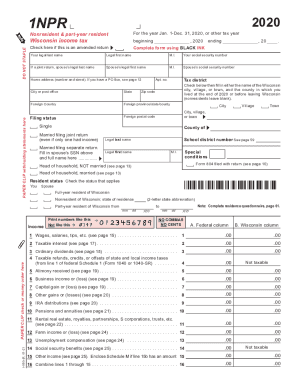
4 5 Add lines 1 through 4. 5 6 Wisconsin standard deduction from Form 1NPR line 35c. 6 7 Subtract line 6 from line 5. 45 Page 3 Name s shown on Form 1NPR 4 6 Fill in amount from line 45. 46 47 Armed forces member credit. Full-year Wisconsin residents only. 47 4 8 Working families tax credit. Full-year Wisconsin residents only. Fill in here and on line 40 of Form 1NPR. 9 Schedule 2 Married Couple Credit May be claimed only when both spouses have earned income taxable by Wisconsin. Do not include deferred compensation even though reported on a W 2 or taxable scholarships or fellowships not reported on a W 2. 1NPR For the year Jan* 1-Dec* 31 2018 or other tax year Nonresident part-year resident DO NOT STAPLE Wisconsin income tax beginning Check here if this is an amended return Your social security number If a joint return spouse s legal last name Spouse s legal first name M. I. Spouse s social security number Home address number and street. If you have a PO Box see page 12 PAPER CLIP wit....
Open form follow the instructions
Easily sign the form with your finger
Send filled & signed form or save
How to fill out the WI DoR 1NPR online
The Wisconsin Department of Revenue Form 1NPR is essential for nonresident and part-year resident taxpayers who need to report their income and calculate the correct tax liability. This guide provides a clear and supportive step-by-step approach to filling out the form online, ensuring that you can complete this process efficiently and accurately.
Follow the steps to complete the WI DoR 1NPR form online.
- Press the ‘Get Form’ button to obtain the WI DoR 1NPR form and open it in your preferred online editor.
- Begin filling out the form by providing your legal name, including your first name, middle initial, and last name, as well as your social security number in the designated fields.
- If applicable, input your spouse's legal name and social security number if you are filing jointly.
- Fill in your home address, including any apartment number, and the tax district where you resided at the end of the tax year.
- Indicate your filing status by checking the appropriate box, selecting from options such as single, married filing jointly, or head of household.
- Complete the income section by entering the applicable amounts for wages, taxable interest, dividends, and other income in both the federal and Wisconsin columns.
- Provide any applicable adjustments to income, noting specific adjustments as detailed in the guidelines, and total these amounts.
- Calculate your adjusted gross income followed by subtracting the deductions to find your taxable income.
- Complete the tax computation section based on your taxable income, checking for any additional credits or deductions for which you may qualify.
- Upon finalizing the form, ensure you review all entered information for accuracy and completeness.
- Finally, save your changes, download the completed form, or print it for submission as directed.
Complete your WI DoR 1NPR form online today to ensure accurate tax reporting!
Experience a faster way to fill out and sign forms on the web. Access the most extensive library of templates available.
Related content
Wisconsin Department of Revenue: 2018 Individual Income Tax Forms. ... Form 1NPR...
Some 2017 forms on this page have not yet been updated for 2018 by ... Wisconsin...
Jan 11, 2019 - New for 2018: You must have at least some earned income in 2018 OR be...
Get answers to your most pressing questions about US Legal Forms API.
Do I have to file Wisconsin state taxes?
You are required to file a Wisconsin income tax return if your Wisconsin gross income is $2,000 or more. Gross income means income before deducting expenses. While net income reported to you may be less than $2,000, gross income may be over that amount, requiring that a Wisconsin income tax return be filed.
What is Wisconsin's state income tax?
Wisconsin individual income tax rates vary from 4.00% to 7.65%, depending upon marital status and income. Note: Nonresidents and part-year residents must prorate the tax based on the ratio of their Wisconsin income to their federal adjusted gross income. See the Wisconsin Form 1NPR for further details.
Does Wisconsin tax out of state income?
Yes. All income received by a Wisconsin resident is reportable to Wisconsin regardless of where it is earned. Wisconsin allows a credit for the net income tax you pay to other states on income that is taxed by both Wisconsin and the other state. ... Attach a copy of the other state's income tax return.
What percent of paycheck goes to taxes in Wisconsin?
Overview of Wisconsin Taxes The tax rates, which range from 4% to 7.65%, are dependent on income level and filing status.
When can I file Wisconsin taxes?
The Internal Revenue Service and the Wisconsin Department of Revenue will accept electronically filed income tax returns for tax year 2018 on January 28, 2019. The department's free Wisconsin e-file application is available for use on or after January 28, 2019.
Who must file a Wisconsin income tax return?
If you are a nonresident or part-year resident of Wisconsin and your Wisconsin gross income (or the combined gross income of you and your spouse) is $2,000 or more, you must file a Form 1NPR, Nonresident and Part-Year Resident Income Tax Return.
How much do you have to make in Wisconsin to file taxes?
You are required to file a Wisconsin income tax return if your Wisconsin gross income is $2,000 or more. Gross income means income before deducting expenses. While net income reported to you may be less than $2,000, gross income may be over that amount, requiring that a Wisconsin income tax return be filed.
How do I file a tax extension in Wisconsin?
To obtain an extension only for Wisconsin, you must attach a statement to your Wisconsin income tax return indicating you wish to take the federal Form 4868 extension provision or attach a copy of the federal Form 4868, Application for Automatic Extension of Time to File U.S. Individual Income Tax Return, with only the ...
Can I claim rent on my taxes in Wisconsin?
You can claim the renter's credit if you paid rent during 2017 for living quarters that you used as your primary residence. The Renter's Credit is a maximum of $300, and it's based on the amount of rent paid.
Who has to file a Wisconsin tax return?
If you are a nonresident or part-year resident of Wisconsin and your Wisconsin gross income (or the combined gross income of you and your spouse) is $2,000 or more, you must file a Form 1NPR, Nonresident and Part-Year Resident Income Tax Return.
Use professional pre-built templates to fill in and sign documents online faster. Get access to thousands of forms.
If you believe that this page should be taken down, please follow our DMCA take down process here.