F3c. * F4. Was the transferee a tenant prior to this transfer?. . . . . . . . . . . . . . . . . . . . . . . . . . . . . . . . F4. c Yes* F5. Financing. . . . . . . . . . . . . . . . . . . . . . . . F5. c Conventional/Bank* c Owner Financing* c No* c Other* F5c. If Line F5 is Other, enter description . . . . . . . . . . . . . . F5c.
Open form follow the instructions
Easily sign the form with your finger
Send filled & signed form or save
How to use or fill out the VT DoT PTT-172 (formerly PT-172) online
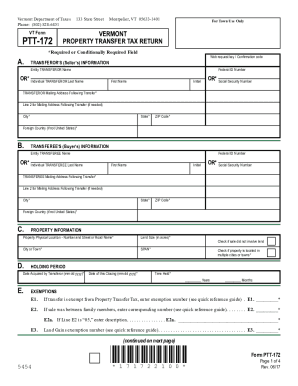
Filling out the VT DoT PTT-172 form online is a crucial step in the property transfer process in Vermont. This guide outlines clear steps to assist you in accurately completing this important document with ease.
Follow the steps to successfully complete the form.
- Click ‘Get Form’ button to obtain the form and open it for editing.
- Begin by entering the web request key or confirmation code if required. This field may verify your submission.
- Provide the transferor's (seller's) information, including their name, federal ID number or social security number, and mailing address following transfer. Ensure each line of the address is filled out completely, including city, state, and ZIP code.
- Next, fill in the transferee's (buyer's) information with the same level of detail as the transferor, including name, federal ID number or social security number, and mailing address.
- In the property information section, specify the physical location of the property, land size in acres, city or town, and the SPAN (School Property Account Number). Each of these details is essential for property identification.
- Indicate whether the sale did not involve land or if the property is located in multiple cities or towns by checking the respective boxes.
- Fill in the holding period by providing the date acquired by the transferor and the date of this closing. Include the time held in years and months.
- If applicable, enter any exemptions for property transfer tax, along with exemption numbers and required descriptions.
- Provide detailed transfer information regarding how the transferor acquired the property, the interest conveyed in this transfer, and the type of building construction at the time of transfer. Respond to related sub-questions as necessary.
- Indicate if the transferee was a tenant prior to the transfer and provide information regarding financing options.
- Complete the certification for real estate withholding, confirming if the Vermont income tax has been withheld from the purchase price.
- Calculate the tax due based on the provided values and specific tax rates. Complete all calculations related to the special principal residence rate and general rate property.
- Finally, review the completed form for accuracy. You can save changes, download the form for your records, print it, or share it as needed.
Complete your documents online today for a hassle-free submission process.
Experience a faster way to fill out and sign forms on the web. Access the most extensive library of templates available.
Related content
State of Vermont Logo. myVTax Banner ... Vermont Department of Taxes | Accessibility...
Read chapter LIABILITY OF STATE DEPARTMENTS OF TRANSPORTATION FOR DESIGN ERRORS: TRB's...
Dec 11, 2014 - Vermont Castings Dv580 Dv360 Operation Manual ManualsLib Makes It Easy To...
Get answers to your most pressing questions about US Legal Forms API.
Is there a tax credit for buying a house in 2019?
According to the IRS: The Tax Cuts and Jobs Act of 2017, enacted Dec. 22, suspends from 2018 until 2026 the deduction for interest paid on home equity loans and lines of credit, unless they are used to buy, build or substantially improve the taxpayer's home that secures the loan.
What part of closing costs are tax deductible?
The only settlement or closing costs you can deduct on your tax return for the year the home was purchased or built are Mortgage Interest and certain Real Estate (property) taxes. These can be deducted in the year you buy your home if you itemize your deductions.
Are closing costs tax deductible 2018?
You closing costs are not tax deductible if they are fees for services, like title insurance and appraisals. You can deduct these items considered mortgage interest: Mortgage insurance premiums for contracts issued from 2013 to 2018 but paid in the tax year. Points since they're considered prepaid interest.
Are closing costs tax deductible 2019?
In general, the only settlement or closing costs you can deduct are home mortgage interest and certain real estate taxes. You deduct them in the year you buy your home if you itemize your deductions. ... "Basis" is the value of your home for the purposes of calculating future capital gains taxes.
What closing costs are tax deductible 2019?
As per IRS publication 530, homebuyers may deduct certain closing costs when they file federal tax returns. These include the points, or loan origination fees, you paid, as well as property taxes and mortgage interest.
How much of your property taxes are tax deductible?
You can deduct annual real estate taxes based on the assessed value of your property by your city or state. Beginning in 2018, the total amount of state and local taxes, including property taxes, that you can deduct is limited to $10,000 per year.
Can I deduct property taxes for 2018?
The bottom line is that yes, property taxes are still deductible in 2018 and beyond. However, the Tax Cuts and Jobs Act has severely limited the deduction, especially for taxpayers in states where they're likely to need the deduction most.
What is the maximum mortgage interest deduction for 2019?
Interest expense: Homeowners can deduct interest expenses on up to $750,000 of mortgage debt from their income taxes, though when they itemize these deductions, they forgo the standard deduction of $12,000 for individuals or married couples filing individually, $18,000 for head of household & $24,000 for married filing ...
Is mortgage interest tax deductible in 2019?
The Mortgage Interest Deduction allows homeowners to reduce their taxable income by the amount of interest paid on a qualified residence loan. The law regarding the Mortgage Interest Deduction has been revised by the Tax Cuts and Jobs Act, and the changes will take effect beginning with returns filed in 2019.
Are property taxes deductible in 2019?
To claim a property tax deduction, the Internal Revenue Service requires that you actually make the payment during the same year you report the deduction. When filing your 2018 tax return in 2019, for example, you can only deduct the property taxes you paid on or between January 1, 2018 and December 31, 2018.
Use professional pre-built templates to fill in and sign documents online faster. Get access to thousands of forms.
If you believe that this page should be taken down, please follow our DMCA take down process here.
This form is available in several versions. Select the version you need from the drop-down list below.