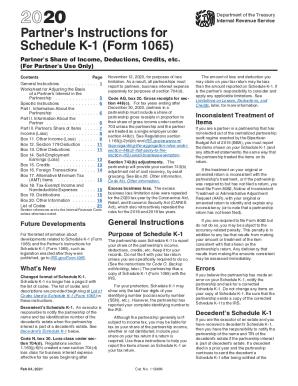
2020Department of the Treasury Internal Revenue ServicePartner's Instructions for Schedule K1 (Form 1065) Partner's Share of Income, Deductions, Credits, etc. (For Partner's Use Only) ContentsGeneral.

How it works
  • Open form

    Open form follow the instructions

  • Easily sign form

    Easily sign the form with your finger

  • Share form

    Send filled & signed form or save

How to fill out the IRS Instruction 1065 - Schedule K-1 online

Completing the IRS Instruction 1065 - Schedule K-1 online can seem daunting, but with this step-by-step guide, users with varied levels of experience can navigate the process confidently. This guide will provide clear and concise directions to help individuals accurately fill out this important tax document.

Follow the steps to complete Schedule K-1 efficiently.

  1. Click 'Get Form' button to obtain the form and open it in your document editor.
  2. In Part I, fill in the information about the partnership. Ensure you include the partnership's name, address, and Employer Identification Number (EIN).
  3. Proceed to Part II, which requires filling in details about the partner including name, address, and identification number (SSN or ITIN). Check the applicable boxes if the partner is a disregarded entity.
  4. In Part III, report the partner's share of income, deductions, credits, and other items from the partnership. Fill out specific boxes based on the information provided by the partnership.
  5. Follow the detailed instructions for each box regarding income and deductions. For example, report ordinary business income in box 1 and net rental income in box 2.
  6. For deductions and credits, refer to the corresponding codes and explanations in the instructions to ensure accurate reporting. Include any necessary statements as indicated.
  7. Once you have completed all relevant sections, review the information for accuracy. Make sure all necessary boxes are checked as required.
  8. At the end of the process, you may save changes, download, print, or share the completed Schedule K-1 form as needed.

Start your online completion of the IRS Instruction 1065 - Schedule K-1 today!

Get form

Experience a faster way to fill out and sign forms on the web. Access the most extensive library of templates available.

Related content

Partner's Instructions for Schedule K-1 (Form...

Jan 18, 2019 - Partner's Instructions for Schedule K-1 (Form 1065) (2018) .... sure that...

Learn more
Questions and Answers on the Net Investment Income...

1, 2013. The NIIT affects income tax returns of individuals, estates and trusts, ... from...

Learn more
Publication 4163 (Rev. 12 2017) P4163...

Publication 4163 Modernized e-File (MeF) Information for Authorized IRS e-File ... for...

Learn more
Questions & Answers

Get answers to your most pressing questions about US Legal Forms API.

Contact support

What is a Schedule 2 tax form?

Schedule 2 Use this if you need to report additional taxes owned such as the alternative minimum tax or taxes on other forms of income such as a child's unearned income from investments. ... That can include self-employment tax, uncollected Social Security taxes and additional taxes on IRA withdrawals.

But the revised Form 1040 took information from the old 1040 and moved it to a series of new forms, called schedules. On Schedule 1, you'll report types of income that aren't listed on the 1040, such as capital gains, unemployment payments and gambling winnings. On the 1040, you can only enter common types of income.

Schedule 1, Additional Taxes and Adjustments to Income Taxpayers use this schedule to report income or adjustments to income that can't be entered directly on Form 1040. ... This also includes the student loan interest deduction, self-employment tax, or educator expenses.

Owners of pass-through entities must file the Schedule K-1 tax form along with their personal tax return to report their share of business profits, losses, deductions, and credits. ... The IRS won't accept your personal tax return if your Schedule K-1 isn't included along with it.

Partners and shareholders use Schedule K-1 to complete their annual tax filing, typically due on March 15 or April 15 (unless they file for an extension).

K-1s are provided to the IRS with the partnership's tax return and also to each partner so that they can add the information to their own tax returns. For example, if a business earns $100,000 of taxable income and has four equal partners, each partner should receive a K-1 with $25,000 of income on it.

Open your return in TurboTax. ... In your TurboTax program, search for K-1 and select the "Jump to" link in the search results. This will take you to the Schedules K-1 or Q screen. Answer Yes and follow the prompts.

Guaranteed payments are also found on Schedules K-1 and K of the partnership return. The individual partner should report guaranteed payments on Schedule E of the IRS Form 1040 as typical income, along with the distributive share of the partnership's other ordinary income.

How is K1 Income Taxed? ... Partnerships, S Corporations, estates and trusts provide K-1 forms to partners and shareholders for filing their individual tax returns. Income and tax liabilities are passed through the corporation or entity to the taxpayer. K-1 income or loss is passed through to the individual tax return.

Enter any interest income on the K-1 form line 1 on line 8a of the 1040 form. Ordinary dividends on line 2a of the form are entered on line 9a on the 1040 form. Amounts on line 2b of the K-1 form are entered on line 9b on the 1040.

Get This Form Now!

Use professional pre-built templates to fill in and sign documents online faster. Get access to thousands of forms.

If you believe that this page should be taken down, please follow our DMCA take down process here.

IRS Instruction 1065 - Schedule K-1 Form

This form is available in several versions. Select the version you need from the drop-down list below.

Get IRS Instruction 1065 - Schedule K-1