Loading
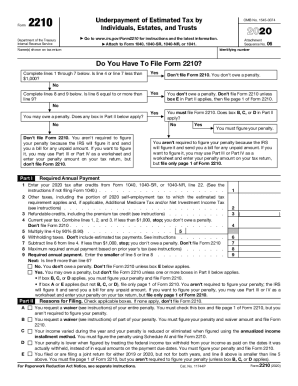
Get Irs 2210 2020
This website is not affiliated with IRS
How it works
-

Open form follow the instructions
-

Easily sign the form with your finger
-

Send filled & signed form or save
How to fill out the IRS 2210 online
Filling out the IRS 2210 form is an essential process for individuals, estates, and trusts who may have underpaid their estimated taxes. This guide provides clear, step-by-step instructions to assist you in accurately completing the form online.
Follow the steps to effectively complete the IRS 2210.
- Click ‘Get Form’ button to obtain the form and open it in the editor.
- Begin by reviewing the top section and ensure that you attach Form 2210 to your tax return (Form 1040, 1040-SR, 1040-NR, or 1041).
- In the 'Do You Have To File Form 2210?' section, complete lines 1 through 7 to determine if you need to file the form based on your estimated tax payments.
- If applicable, move to Part I and calculate your required annual payment using the information from your tax return. Fill in the tax after credits in line 1, other taxes in line 2, and refundable credits in line 3.
- Add lines 1 through 3 for your current year tax in line 4. If this amount is less than $1,000, you may stop here as you do not owe a penalty.
- If necessary, calculate your maximum required annual payment based on last year’s tax in line 8 and determine your required annual payment in line 9, which is the smaller amount compared to line 5.
- Proceed to Part II to check any boxes that apply to your reason for filing under penalty situations and ensure you understand your obligations.
- If you must calculate a penalty, complete Parts III or IV as needed to determine the exact amount based on your underpayment.
- Once completely filled out, review your entries for accuracy and ensure that you save your changes. You can then download, print, or share the form as required.
Take action now and start competing your IRS 2210 form online.
Get form
Experience a faster way to fill out and sign forms on the web. Access the most extensive library of templates available.
Estimated tax is the method used to pay tax on income that is not subject to withholding. This includes income from self-employment, interest, dividends, alimony, rent, gains from the sale of assets, prizes and awards.
Get This Form Now!
Use professional pre-built templates to fill in and sign documents online faster. Get access to thousands of forms.