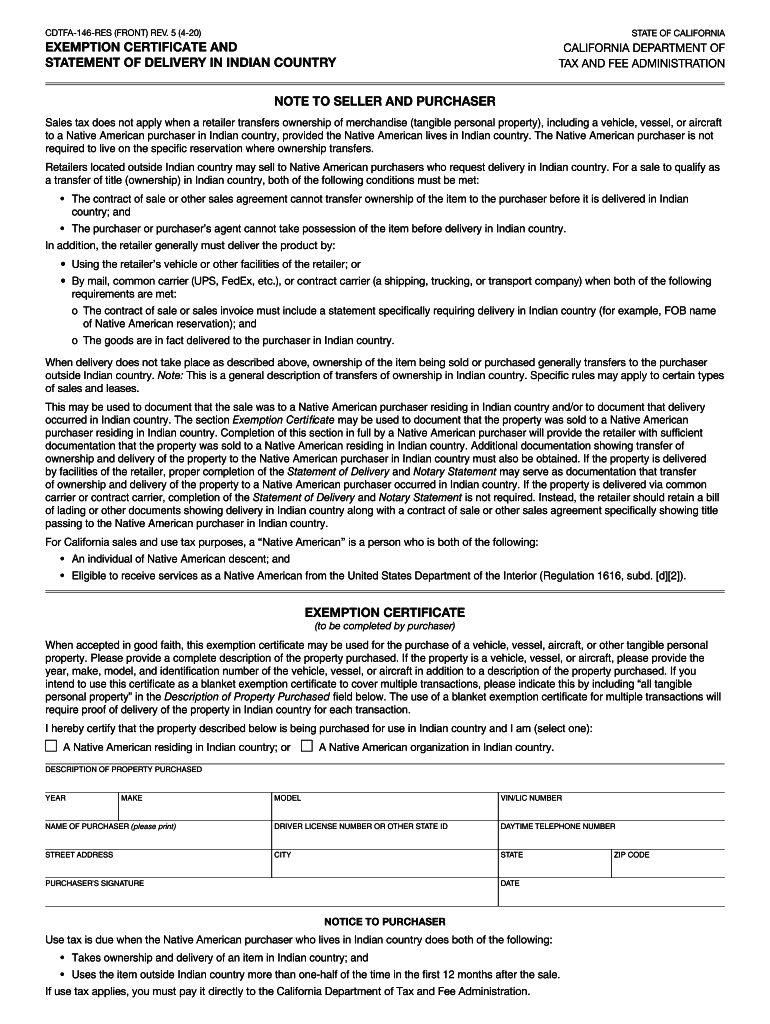
CDTFA146RES (FRONT) REV. 5 (420)STATE OF CALIFORNIAEXEMPTION CERTIFICATE AND STATEMENT OF DELIVERY IN INDIAN COUNTRYCALIFORNIA DEPARTMENT OF TAX AND FEE ADMINISTRATIONNOTE TO SELLER AND PURCHASER Sales.
Loading

Open form follow the instructions

Easily sign the form with your finger

Send filled & signed form or save
How to fill out the CA CDTFA-146-RES (Formerly BOE-146-RES) online
This guide provides detailed instructions for completing the CA CDTFA-146-RES form online. Designed for users at all experience levels, these steps will ensure you accurately fill out the form to document sales tax exemptions for Native American purchasers in Indian country.
Follow the steps to fill out the CA CDTFA-146-RES form online confidently.
- Click the ‘Get Form’ button to download the CA CDTFA-146-RES form and open it in your preferred editor.
- Begin by completing the 'Exemption Certificate' section. Indicate whether you are a Native American residing in Indian country or a Native American organization.
- Provide a complete description of the property being purchased in the 'Description of Property Purchased' field, including year, make, model, and identification number if applicable.
- Fill in your personal details, including your name, driver license number or other state ID, daytime telephone number, street address, city, state, and ZIP code.
- Sign and date the form where indicated to certify that the information is accurate.
- For the 'Statement of Delivery' section, the seller must complete the relevant fields, including details of the merchandise and delivery information.
- If applicable, complete the 'Notary Statement' section to have the document notarized, confirming the identity of the signer.
- Review the form for accuracy, then save your changes. You may choose to download, print, or share the completed form.
Complete your documents online today to ensure compliance and accuracy.
Experience a faster way to fill out and sign forms on the web. Access the most extensive library of templates available.
Related content
Pursuant to 2017 legislation, the duty of hearing and deciding administrative appeals for...
CDTFA-146-RES, Exemption Certificate and Statement of Delivery in Indian Country;...
State Board of Equalization, 146 Cal. ... The ordinance, resolution, or board order may...
Get answers to your most pressing questions about US Legal Forms API.
How much money do Native American get from casinos?
Indian reservation gambling generates more income than Atlantic City and Las Vegas combined. In 2009, this totaled $26.5 billion in revenue from 425 facilities, run by 233 tribes in 28 states. Tribes receive $4 of every $10 that Americans wager at casinos.
Do Indian casinos report winnings to IRS?
The IRS very specifically states that "Gambling winnings are fully taxable and you must report the income on your tax return. Gambling income includes but isn't limited to winnings from lotteries, raffles, horse races, and casinos. It includes cash winnings and the fair market value of prizes, such as cars and trips."
Do Indian owned casinos pay taxes?
Gaming on Native American lands earned $26.5 billion in 2011. 236 Native American tribes operate 422 facilities across 28 states. Yet Native American tribes and their wholly owned tribal corporations are not subject to federal income taxes on their earnings.
Do California Indian casinos pay taxes?
Tribal members living on reservations, for example, are not subject to state income tax, and tribal casinos do not pay the corporate income tax. Regarding the sales and use tax, tribes are generally expected to collect taxes on purchases made by nontribal members for consumption or use off of reservations.
Is tribal income taxable?
Since she received 1099-MISC, it would indicate that the per capita income is income from Indian gaming proceeds and therefore it is taxable. In general, the per capita payments issued to a member of Indian tribes are not subject to federal income tax, unless they are from gaming proceeds.
Do state laws apply on Indian reservations?
An Indian reservation is a legal designation for an area of land managed by a federally recognized Native American tribe under the U.S. Bureau of Indian Affairs rather than the state governments of the United States in which they are physically located.
Do Native Americans have to pay sales tax?
ALL Native Americans are subject to federal income taxes but, because of the states' inability to tax American Indians within reservation boundaries, individual Native Americans who live there do not pay state income taxes.
Do Indian reservations pay sales tax?
Sales Tax and Native American Reservations 101. ... The state cannot collect sales tax if you sell to a tribal member on a reservation, however, the state can collect sales tax if you sell to a tribal member off the reservation.
Are Indian Reservations tax exempt?
Tribes are Tax Exempt. Gaming on Native American lands earned $26.5 billion in 2011. 236 Native American tribes operate 422 facilities across 28 states. Yet Native American tribes and their wholly owned tribal corporations are not subject to federal income taxes on their earnings.
Do federally recognized tribes pay taxes?
Any special rights held by federally recognized tribes and their members are generally based on treaties or other agreements between the tribes and the United States. ... Federal income taxes are not levied on income from trust lands held for them by the U.S.
Use professional pre-built templates to fill in and sign documents online faster. Get access to thousands of forms.
If you believe that this page should be taken down, please follow our DMCA take down process here.