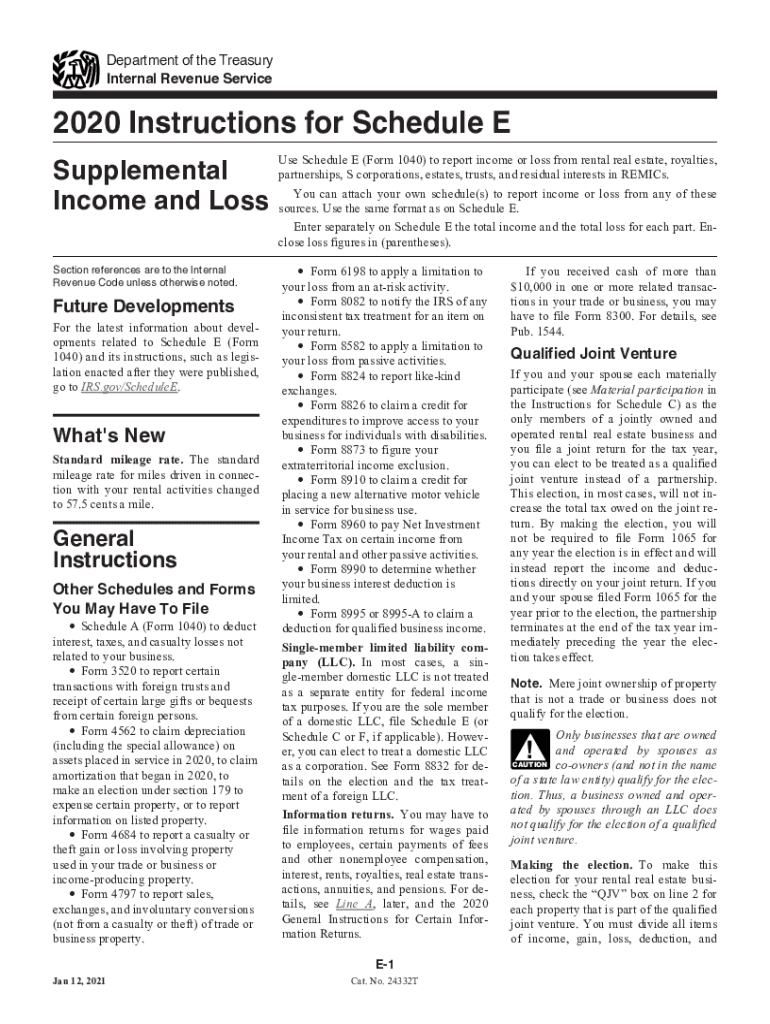
For tax years beginning after 2017 you may be entitled to a deduction of up to 20 of your qualified business income from your qualified trade or General Other Schedules and Forms You May Have To File Schedule A Form 1040 to deduct interest taxes and casualty losses not related to your business. Note. These rules also apply to estates and trusts that hold a residual interest in a REMIC. Be sure to make the appropriate entries on the comparable lines on CAUTION Do not include the amount shown in column c in the total on Schedule E line 39. Part V Summary You will not be charged a penalty for underpayment of estimated tax if 1. Your gross farming or fishing income for 2017 or 2018 is at least two-thirds of your gross income and 2. However if you had an excess farm loss in 2017 you may be able to deduct it in 2018. See Losses Not Allowed in Prior Years Due to the Basis Excess Farm Loss or At-Risk Rules later for more information. Excess business loss limitation. If you report a loss on lin....
Loading

Open form follow the instructions

Easily sign the form with your finger

Send filled & signed form or save
How to fill out the IRS Instruction 1040 - Schedule E online
This guide provides clear instructions for completing the IRS Instruction 1040 - Schedule E online. Users can learn how to accurately report income or loss from various sources, including rental real estate and partnerships, ensuring compliance with IRS regulations.
Follow the steps to fill out Schedule E correctly
- Click ‘Get Form’ button to obtain the form and open it in the editor.
- Begin by entering your personal information at the top of the form, including your name, address, and Social Security number.
- In Part I, list the addresses of each rental property you own and provide the corresponding type of property code.
- Fill in the rental income for each property on Line 3 and any related expenses across the specified lines, ensuring they reflect only ordinary and necessary costs.
- If you are reporting income or losses from partnerships or S corporations, move to Part II and summarize the information received from Schedule K-1.
- In Part III, enter information if you are a beneficiary of an estate or trust, indicating your share of income or losses.
- Complete Part IV if applicable, reporting income or loss from Real Estate Mortgage Investment Conduits (REMICs).
- Review your entries for accuracy and completeness, ensuring all necessary forms and schedules are attached if required.
- Finally, save your changes, download, and print your completed form for submission to the IRS.
Start filling out your IRS Instruction 1040 - Schedule E online today to ensure accurate reporting of your income and losses.
Experience a faster way to fill out and sign forms on the web. Access the most extensive library of templates available.
Related content
Dec 13, 2018 - 2018 Instructions for Schedule E (Form 1040) (2018) ... Use Schedule E...
Apr 15, 2019 - Instructions for 1040 Schedule 8812 ... You can check the status within 24...
11325E Page 2 of 79 of Instructions 1040 10:50 - 3-NOV-2004 The type and rule above prints...
Get answers to your most pressing questions about US Legal Forms API.
Are meals and entertainment deductible 2018?
The Tax Cuts and Jobs Act of 2017 has made significant changes to the deductibility of business meals and entertainment starting in 2018. At a high level, entertainment expenses are nondeductible and most meals are 50 percent deductible. ... We anticipate this area of tax reform will be heavily scrutinized by the IRS.
Can you deduct meals on Schedule E?
You can deduct 50% of meal expenses related to your rental property. When you are working on the Schedule E Rental Income and Expenses section of your return, go to the Expenses area and enter 50% of your total meal expenses as part of the travel expenses.
Where do I report rental income on 1040?
If you rent real estate such as buildings, rooms or apartments, you normally report your rental income and expenses on Form 1040, Schedule E, Part I. List your total income, expenses, and depreciation for each rental property on the appropriate line of Schedule E. See the Instructions for Form 4562 to figure the amount ...
What is the difference between a Schedule C and a Schedule E?
The difference is in the type of income you are reporting. Schedule C is the attachment to a Form 1040 that's used by a self-employed person to report revenue and expenses from a business. ... Schedule E would be used for rental income from real estate and/or income from partnerships, S Corporations, trusts, etc.
What is Schedule E form 1040?
If you answered yes to any of those questions, you'll need to become familiar with IRS Form 1040 Schedule E. Schedule E is used to report income and losses from rental property, and income from trusts, estates, partnerships and S-corporations. This article focuses on income from rental property.
How do I report royalty income on 1040?
You report these on Schedule C of IRS form 1040. If you earn more than $400 through self-employment, including royalties, you must report that income on your tax return. Royalties from one-time earnings (a gig that isn't your primary job), or mineral interests, are reported on Schedule E of IRS Form 1040.
Is Schedule E income considered earned income?
Think of earned income as business income. ... IRS Schedule E is used for supplemental income which is generally considered passive income. As an investor, this is important because rental real estate generates passive income and, as such, we will report the income and loss from rental real estate on Schedule E.
What is passive income on Schedule E?
The purpose of Schedule E is to take Schedule K-1 income from a business owner and include information about whether the income was active or passive (was the owner actively involved in the business). Passive income is treated in a different way by the IRS (explained below).
What is reported on Schedule E?
Schedule E is used to report income and losses from rental property, and income from trusts, estates, partnerships and S-corporations. This article focuses on income from rental property. If you're receiving income from any of the pass-through activities, you should receive a Schedule K-1 from the entity.
What income is reported on Schedule E?
Use Schedule E (Form 1040) to report income or loss from rental real estate, royalties, partnerships, S corporations, estates, trusts, and residual interests in REMICs. You can attach your own schedule(s) to report income or loss from any of these sources.
Use professional pre-built templates to fill in and sign documents online faster. Get access to thousands of forms.
If you believe that this page should be taken down, please follow our DMCA take down process here.