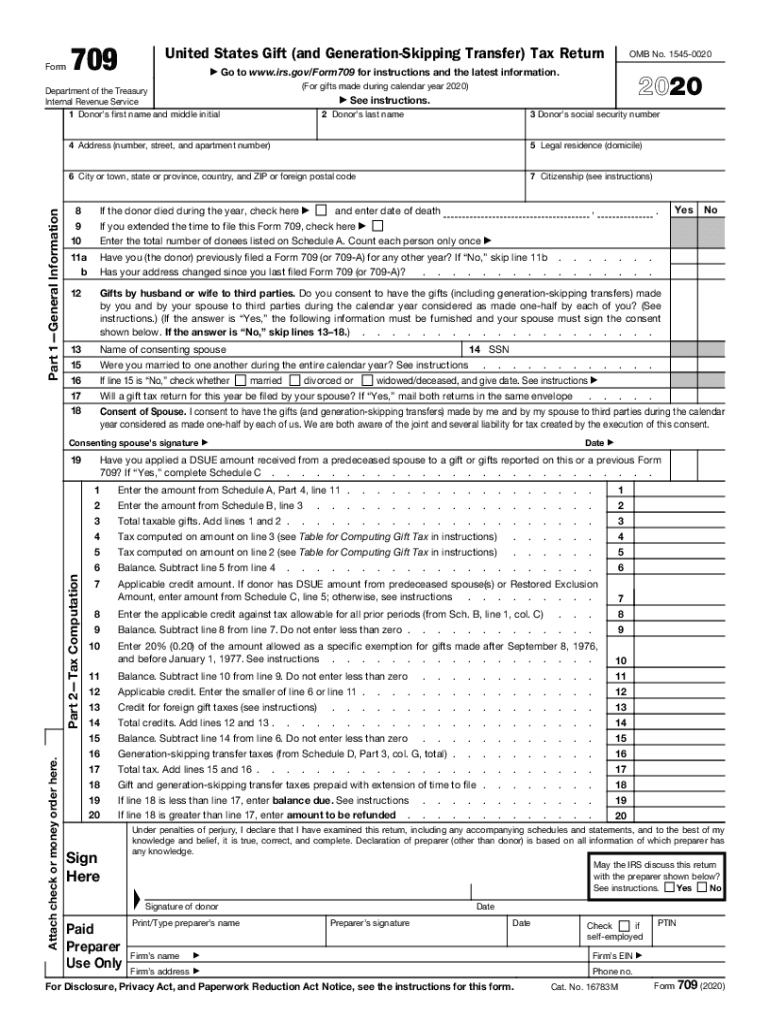
Treasury Internal Revenue Service 1 Donor s first name and middle initial 2020 (For gifts made during calendar year 2020) See instructions. 2 Donor s last name 3 Donor s social security number 4 Address (number, street, and apartment number) 5 Legal residence (domicile) 6 City or town, state or province, country, and ZIP or foreign postal code 7 Citizenship (see instructions) , Yes No 8 9 10 If you extended the time to file this Form 709, check here Enter the total n.
Loading

Open form follow the instructions

Easily sign the form with your finger

Send filled & signed form or save
How to fill out the IRS 709 online
Filling out the IRS Form 709, the United States Gift (and Generation-Skipping Transfer) Tax Return, can seem daunting. This guide provides clear and detailed instructions to help you easily navigate through each component of the form online.
Follow the steps to complete the IRS 709 online.
- Press the ‘Get Form’ button to download the IRS 709 form and open it in your preferred online editor.
- Begin with Part 1—General Information. Fill in the donor's first and last name, social security number, and address. Ensure the legal residence is correctly indicated, and select the appropriate citizenship option.
- Answer the questions regarding past filings in lines 11a and 11b. If applicable, provide consent for gifts made by both partners to be considered as made one-half by each.
- Move on to Part 2—Tax Computation. Enter amounts from Schedule A into the specified lines to compute the tax owing on total taxable gifts.
- Complete Schedule A, detailing specifics for all gifts, including donees’ names, gift descriptions, and valuation details. Calculate totals as required.
- If applicable, fill out Schedule B and C to report gifts from prior periods and any deceased spousal unused exclusion amounts.
- After reviewing all entered information for correctness, save your changes. You can then download, print, or share the completed Form 709 as needed.
Start completing your IRS Form 709 online today!
Experience a faster way to fill out and sign forms on the web. Access the most extensive library of templates available.
Related content
... 656-PPV, Offer in Compromise - Periodic Payment Voucher, 0618, 06/19/2018 ... Form...
Nov 21, 2018 - On November 20, 2018, IRS issued a proposed rule providing that ... filing...
Donald John Trump (born June 14, 1946) is the 45th and current president of the United...
Get answers to your most pressing questions about US Legal Forms API.
How much can I gift tax free?
The annual gift tax exclusion is $15,000 for the 2019 tax year. (It was the same for the 2018 tax year.) This is the amount of money that you can give as a gift to one person, in any given year, without having to pay any gift tax.
Do I have to pay income tax on an inheritance?
The Basic Rule: Inheritances Aren't Taxed as Income An inheritance can be a windfall in many ways the inheritor not only gets cash or a piece of property, but doesn't have to pay income tax on it. Someone who inherits a $500,000 bank account doesn't have to pay any tax on that amount.
How much money can you inherit before you have to pay taxes on it?
The federal government doesn't impose an inheritance tax, and inheritances generally aren't subject to income tax. If your aunt leaves you $50,000, that's not considered income so the cash is tax-free at least as far as the IRS is concerned.
How much can you inherit without paying taxes in 2018?
For 2018, the estate and gift tax exemption is $5.6 million per individual, up from $5.49 million in 2017. That means an individual can leave $5.6 million to heirs and pay no federal estate or gift tax.
How much can you inherit Tax Free 2019?
The Internal Revenue Service announced today the official estate and gift tax limits for 2019: The estate and gift tax exemption is $11.4 million per individual, up from $11.18 million in 2018.
How much can you inherit without paying taxes in 2019?
The Internal Revenue Service announced today the official estate and gift tax limits for 2019: The estate and gift tax exemption is $11.4 million per individual, up from $11.18 million in 2018.
How much money can be legally given to a family member as a gift in 2018?
In 2017, you could give each family member $14,000 for a grand total of $140,000 without owing any gift tax. In 2018, you could give $15,000 to each recipient for a total of $150,000. The annual gift exclusion is available to each taxpayer.
How much money can a person receive as a gift without being taxed?
Most presents to friends and family will fall below the annual threshold for taxable gifts. In 2016 and 2017, a taxpayer could give up to $14,000 per person per year without being taxed on the gift (that rises to $15,000 in 2018).
How much is the gift tax rate for 2019?
If you're lucky enough and generous enough to use up your exclusions, you may indeed have to pay the gift tax. The rates range from 18% to 40%, and the giver generally pays the tax. There are, of course, exceptions and special rules for calculating the tax, so see the instructions to IRS Form 709 for all the details.
What is the maximum gift amount for 2019?
The most important is the annual exclusion amount. Every year, you can give up to a certain amount to anyone you want without having to deal with the gift tax at all. For 2018 and 2019, that amount is $15,000.
Use professional pre-built templates to fill in and sign documents online faster. Get access to thousands of forms.
If you believe that this page should be taken down, please follow our DMCA take down process here.