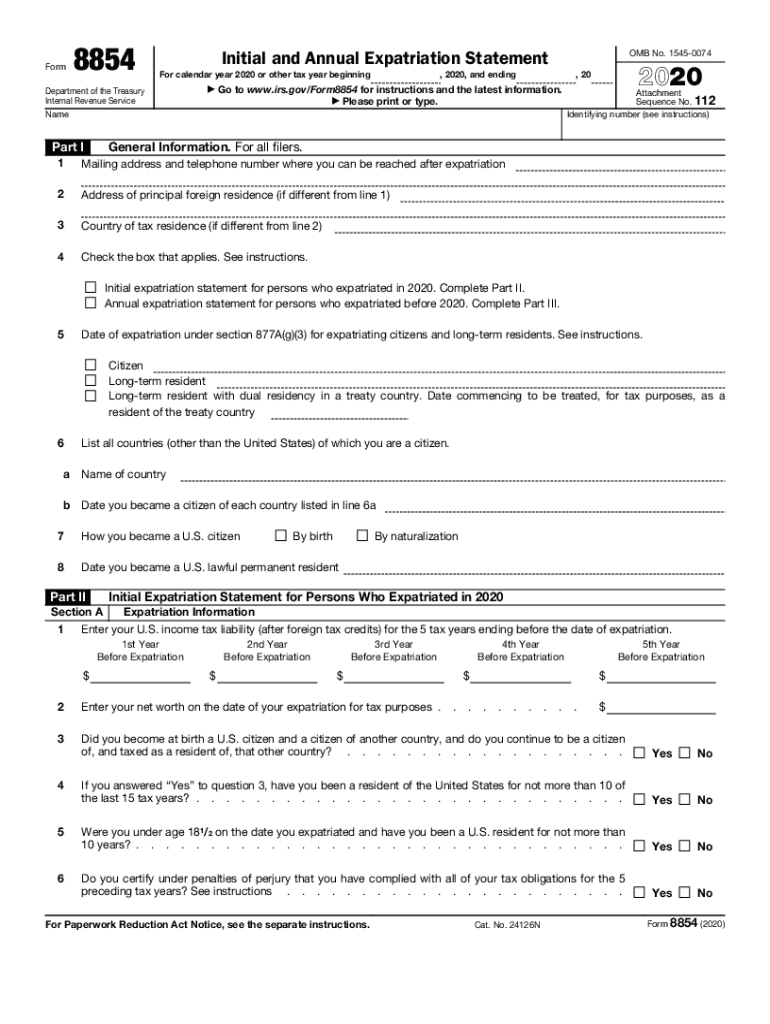
G Name Part I 2020 , 20 Go to www.irs.gov/Form8854 for instructions and the latest information. Please print or type. Attachment Sequence No. 112 Identifying number (see instructions) General Information. For all filers. 1 Mailing address and telephone number where you can be reached after expatriation 2 Address of principal foreign residence (if different from line 1) 3 Country of tax residence (if different from line 2) 4 Check the box that applies. See instructions. Initial.

Open form follow the instructions

Easily sign the form with your finger

Send filled & signed form or save
How to fill out the IRS 8854 online
The IRS Form 8854, known as the Initial and Annual Expatriation Statement, is essential for individuals expatriating from the United States. Completing this form accurately is crucial for properly reporting your tax obligations and status after expatriation. This guide will provide clear steps to help you fill out the IRS 8854 online with ease.
Follow the steps to successfully complete the IRS 8854 online.
- Click ‘Get Form’ button to access the IRS 8854 form and open it within your preferred editor.
- Fill in your personal information in the General Information section, including your mailing address and contact information (lines 1-3). Ensure you provide accurate details.
- Indicate your expatriation type by checking the appropriate box (line 4) and provide your date of expatriation (line 5). Choose whether you are a citizen or a long-term resident.
- List all countries where you are a citizen (line 6) along with the dates you obtained citizenship for each. Provide details on how you became a U.S. citizen and your lawful permanent resident status (lines 7-8).
- Complete Part II for Initial Expatriation Statement, Section A, by entering your U.S. income tax liability for the last five years and your net worth at the time of expatriation (lines 1-2). Answer the eligibility questions regarding your tax obligations (lines 3-6).
- In Section B, create a balance sheet of your assets and liabilities, stating their fair market value and U.S. adjusted basis as of your expatriation date.
- Continue to Section C if applicable, answering questions regarding any eligible or ineligible deferred compensation items and any specified tax-deferred accounts (questions 1a-1d).
- Proceed to Section D if you are electing to defer tax under section 877A(b). Provide necessary details about taxes you would report absent the deferral election.
- Complete Part III if you expatriated before 2020, providing information on property with deferred tax and distributions received from trust or compensation items.
- Review all entered information for accuracy, then save your changes. You can choose to download, print, or share the completed form as needed.
Start filling out your IRS 8854 form online today to ensure compliance and accuracy.
Experience a faster way to fill out and sign forms on the web. Access the most extensive library of templates available.
Related content
Dec 10, 2018 - For the latest information about developments related to Form 8854 and...
December 14, 2018 — IRS issues standard mileage rates for 2019 ...... A copy of the Form...
Apr 1, 2018 - User Manual: Locks April 1, 2018 Mayflower Sales - Current Price Lists....
Get answers to your most pressing questions about US Legal Forms API.
What is covered expatriate?
A covered expatriate is an expatriate who meets one of the three requirements below and must therefore pay an exit tax on all their assets in their final year*.
Does everyone have to file a tax return in the US?
Does Everyone Need to File an Income Tax Return? Not everyone is required to file an income tax return each year. Generally, if your total income for the year doesn't exceed certain thresholds, then you don't need to file a federal tax return.
Do I have to file Canadian taxes if I live in the US?
If you live and work in the U.S. more than 183 days per year, you are considered a non-resident of Canada for tax purposes. ... If you have no Canadian income tax to pay and don't want to claim a refund, you do not need to file a Canadian tax return.
Do green card holders need to file taxes?
For example, all permanent residents, or holders of green cards, are considered to be tax residents. ... United States tax residents must report their entire income to the IRS and pay taxes. It does not matter whether the money was earned within the country or internationally, all income must be reported to the IRS.
Do I need to file a tax return if I live outside the US?
Do I still need to file a U.S. tax return? Yes, if you are a U.S. citizen or a resident alien living outside the United States, your worldwide income is subject to U.S. income tax, regardless of where you live. However, you may qualify for certain foreign earned income exclusions and/or foreign income tax credits.
Do dual citizens have to file US taxes?
The United States imposes taxes on its citizens for income earned anywhere in the world. If you are a dual citizen living abroad, you might owe taxes both to the United States and to the country where the income was earned. ... Even so, dual citizens may be required to file U.S. tax returns.
How is US exit tax calculated?
The Exit Tax is computed as if you sold all your assets on the day before you expatriated, and had to report the gain. Currently, net capital gains can be taxed as high as 23.8%, including the net investment income tax. ... This is the aggregate net value of worldwide assets. It is not just your U.S. assets.
What is US expatriate tax?
An expatriation tax or emigration tax is a tax on persons who cease to be tax resident in a country. This often takes the form of a capital gains tax against unrealised gain attributable to the period in which the taxpayer was a tax resident of the country in question.
Do I have to pay taxes if I renounce my citizenship?
Renouncing U.S. citizenship doesn't free you from U.S. tax obligations and means that even after the renunciation, the IRS could still audit and assess taxes and penalties. There is an Exit Tax imposed on people who meet any of the following criteria: ... If you failed to certify five years of U.S. tax compliance.
Who is a covered expatriate?
A covered expatriate is an expatriate who meets one of the three requirements below and must therefore pay an exit tax on all their assets in their final year*.
Use professional pre-built templates to fill in and sign documents online faster. Get access to thousands of forms.
If you believe that this page should be taken down, please follow our DMCA take down process here.
This form is available in several versions. Select the version you need from the drop-down list below.