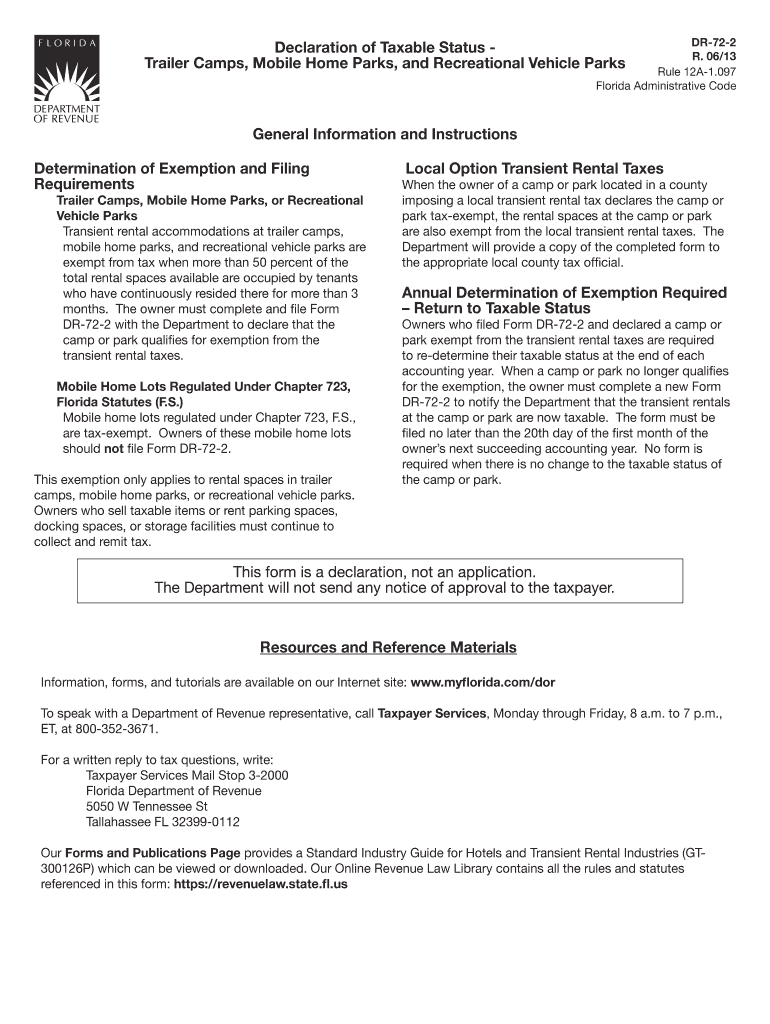
On of Exemption and Filing Requirements Trailer Camps, Mobile Home Parks, or Recreational Vehicle Parks Transient rental accommodations at trailer camps, mobile home parks, and recreational vehicle parks are exempt from tax when more than 50 percent of the total rental spaces available are occupied by tenants who have continuously resided there for more than 3 months. The owner must complete and file Form DR-72-2 with the Department to declare that the camp or park qualifies for exemption.
Loading

Open form follow the instructions

Easily sign the form with your finger

Send filled & signed form or save
How to fill out the FL DR-72-2 online
Completing the FL DR-72-2 form is essential for owners of trailer camps, mobile home parks, and recreational vehicle parks who seek an exemption from transient rental taxes. This guide provides clear, step-by-step instructions to help users easily and accurately fill out the form online.
Follow the steps to complete the FL DR-72-2 form effectively.
- Press the 'Get Form' button to access the FL DR-72-2 form and open it in the designated editing area.
- Begin by entering the business or facility name at the top of the form. Ensure that this information accurately reflects the legal name of your establishment.
- Next, provide the owner's name. This should be the individual or entity that holds ownership of the facility.
- Fill in the owner's address, including the city, state, and ZIP code. Accurate contact information is essential for processing.
- Enter a telephone number and email address where you can be reached for any inquiries regarding the form.
- Input the certificate or business partner number associated with your establishment. This may be necessary for verification purposes.
- If the location address of the facility differs from the owner's address, provide the complete location address, including city, state, and ZIP code.
- Indicate the type of facility by checking the appropriate box for 'Trailer Camp,' 'Mobile Home Park,' or 'Recreational Vehicle Park.'
- In the subsequent section, determine whether the rental spaces at the facility are exempt or taxable by selecting the relevant option.
- If you previously filed Form DR-72-2, indicate the date of that filing; this helps track your records.
- Read the declaration statement carefully. By signing the form, you affirm that the information provided is true and accurate. Be sure to include the signature of the authorized person, their title, and the date.
- Once the form is complete, review it for accuracy. You can then save your changes, download, print, or share the completed form as necessary.
Complete your FL DR-72-2 form online today to ensure your timely exemption from rental taxes.
Experience a faster way to fill out and sign forms on the web. Access the most extensive library of templates available.
Related content
The owner is not required to file Form DR-72-2 to declare the rentals or leases for mobile...
The total amount of tax on cash sales, credit sales, installment sales, or sales made on...
Impedância de Carga: 4 Ω (4 Ω a 8 Ω de tolerância). Faixa de Controle do Equalizador:...
Get answers to your most pressing questions about US Legal Forms API.
Who is exempt from Florida sales tax?
Certain groups or organizations can be exempt from Florida sales tax, including non-profit organizations and government entities. Furthermore, purchases made for specific qualified goods or services may also qualify for exemptions. It is crucial for these entities to complete the appropriate documentation like the FL DR-72-2 to ensure their exempt status is recognized.
What states are not reciprocal with Florida sales tax?
Several states do not have reciprocal sales tax agreements with Florida, including Alabama and Georgia. As a result, businesses operating across these states must take care to handle tax obligations accordingly. Understanding the implications of these boundaries is vital for compliance. The FL DR-72-2 can guide you in managing sales tax requirements effectively.
Is Florida a reciprocal state for sales tax?
Yes, Florida is considered a reciprocal state for sales tax, but its agreements are selective. Certain transactions may qualify for exemptions, provided you follow the right procedures. Utilizing the FL DR-72-2 is essential to ensure compliance with Florida’s specific tax laws, helping you maintain smooth operations in your transactions.
Which property is exempt from property taxes in Florida?
Florida offers several property tax exemptions, particularly for primary residences, seniors, and disabled veterans. Homestead exemptions, for instance, can significantly reduce a property’s taxable value. Additionally, certain agricultural properties may receive favorable tax treatment. Utilizing tools like the FL DR-72-2 can simplify the application process for these exemptions.
Which states have reciprocal sales tax agreements?
Reciprocal sales tax agreements allow states to recognize tax exemptions from other states. In the U.S., notable examples include states like New York, California, and Texas, but Florida's agreements may vary. Understanding these agreements is crucial for vendors and consumers alike. The FL DR-72-2 form can help clarify your obligations when dealing across state lines.
How to avoid paying sales tax on an RV?
In Florida, sales tax on RV purchases can sometimes be avoided through specific exemptions or by claiming a tax exemption form like the FL DR-72-2. To qualify for such exemptions, it is crucial to understand the criteria outlined by Florida tax law. Thorough research and preparation can be invaluable in ensuring you take advantage of available exemptions. Consider consulting with uslegalforms for detailed instructions on how to apply for these exemptions.
Do I need to file a Florida tax return if I have a rental property?
If you own rental property in Florida, you may be required to file a tax return, particularly if the property generates rental income. The FL DR-72-2 can provide guidance on whether you are liable for reporting and which forms to utilize. Clarifying these requirements can ensure you remain compliant. Resources available through uslegalforms can simplify this process for you.
What is FL tax collection allowance?
Florida provides a tax collection allowance, which allows businesses to keep a small percentage of the sales tax they collect. This allowance helps cover administrative costs involved in collecting and remitting the tax. As per the guidelines of FL DR-72-2, understanding this allowance can be beneficial for budgeting and financial planning. Using tools from uslegalforms can assist you in ensuring compliance with these regulations.
How much does FL take out for taxes?
Florida's sales tax rate is currently set at 6%, but some local counties may impose additional taxes on top of this base rate. It is important to account for these local rates to understand your total tax obligations. The FL DR-72-2 form may be needed for specific tax exemptions and should be kept handy for reference. Using uslegalforms can help you navigate Florida tax matters efficiently.
Who is required to collect Florida sales tax?
In Florida, businesses that sell goods or services must collect sales tax, including those making online sales. This requirement applies to both brick-and-mortar and online retailers. Understanding your obligations under the FL DR-72-2 can help you ensure compliance and avoid penalties. If you are unsure about your tax responsibilities, consider using resources like the uslegalforms platform to obtain the correct documents.
Use professional pre-built templates to fill in and sign documents online faster. Get access to thousands of forms.
If you believe that this page should be taken down, please follow our DMCA take down process here.
This form is available in several versions. Select the version you need from the drop-down list below.