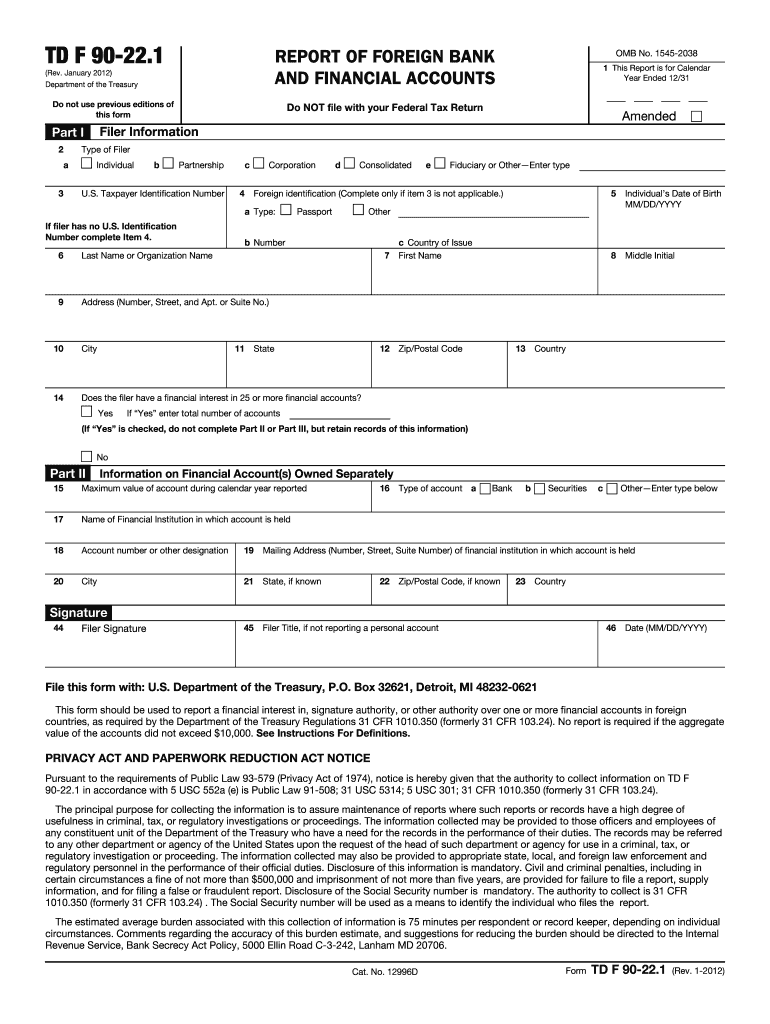
Check appropriate Identification Number 6 Last Name or Organization Name Taxpayer Identification Number Foreign Identification Number Enter identification number here: 16 Type of account a b c 15 Maximum value of account during calendar year reported 17 Name of Financial Institution in which account is held 18 Account number or other designation 19 Mailing Address (Number, Street, Suite Number) of financial institution in which account is held 20 City 21 State, if known 15.
Loading

Open form follow the instructions

Easily sign the form with your finger

Send filled & signed form or save
How to fill out the IRS TD F 90-22.1 online
Filing the IRS TD F 90-22.1, also known as the Report of Foreign Bank and Financial Accounts (FBAR), is essential for U.S. persons with foreign financial interests. This guide offers a clear and structured approach to complete the form online, ensuring compliance with the requirements set by the Department of the Treasury.
Follow the steps to successfully complete and submit your FBAR online.
- Click ‘Get Form’ button to obtain the TD F 90-22.1 form and open it in the editor.
- Enter the calendar year for which you are reporting in item 1. This is crucial as it identifies the period of interest.
- Select the type of filer by checking the appropriate box in item 2. This includes individual, partnership, corporation, and other definitions.
- Provide your U.S. taxpayer identification number in item 3. If you do not have one, complete item 4 instead.
- Fill in your personal details such as name, date of birth, and address in items 5 through 13, depending on your residence.
- In item 14, indicate if you have a financial interest in 25 or more financial accounts and provide the total number if applicable.
- For reporting financial accounts owned separately, complete Part II by providing details such as maximum account value, account type, and financial institution information.
- If reporting joint accounts, move to Part III and enter similar details, ensuring to include the principal joint owner's information.
- For accounts where you have signature authority without financial interest, fill out Part IV, providing necessary details about the accounts.
- If filing a consolidated report, complete Part V with details about each account owned by the entities included.
- Review all entered information for accuracy and completeness to avoid any potential penalties for missing or incorrect information.
- Finally, save your changes, download or print the form, and ensure you submit it to the Department of the Treasury at the specified address.
Start filling out your IRS TD F 90-22.1 online today to ensure compliance with reporting requirements.
Experience a faster way to fill out and sign forms on the web. Access the most extensive library of templates available.
Related content
by P ACT — Form TD F 90-22.1, Report of Foreign Bank and Financial Accounts (the...
The form prescribed under section 5314 is the Report of Foreign Bank and Financial...
May 15, 2014 — See instructions for filing requirements for Form TD F 90-22.1, Report of...
Get answers to your most pressing questions about US Legal Forms API.
What is the best way to file the FBAR?
The best way to file the FBAR is electronically through the Financial Crimes Enforcement Network (FinCEN) website. Filing IRS TD F 90-22.1 electronically provides immediate confirmation of your submission. Also, keep a copy for your records. For those who prefer assistance, uslegalforms offers robust services to ensure accurate filings.
Can you file your own FBAR?
Yes, you can file your own FBAR. The IRS TD F 90-22.1 allows individuals to report foreign bank accounts without needing an intermediary. It is essential to correctly fill out the form to avoid complications. If you're unsure about the process, platforms like uslegalforms can provide helpful guidance.
What happens if I have more than $100,000 in a foreign bank account?
Having more than $100,000 in a foreign bank account requires you to file an FBAR. You must disclose this financial information using IRS TD F 90-22.1. Not filing can result in significant penalties, including hefty fines. It's advisable to consult professionals or use reliable services like uslegalforms to ensure compliance.
What documents are needed for FBAR filing?
When you are preparing to file IRS TD F 90-22.1, you'll need specific documents, including the account number, bank name, and the maximum account balance during the year. It is also helpful to have personal identification information and a record of any associated accounts. Gathering these documents beforehand can streamline your filing process. Using uslegalforms can assist in organizing your paperwork.
How does the IRS know if you have a foreign bank account?
The IRS utilizes several methods to discover foreign bank accounts, including information exchange agreements with other countries. If you do not file the IRS TD F 90-22.1, you may draw attention to your accounts. The IRS’s data analytics capabilities also identify patterns that may indicate undeclared accounts. Transparency about your finances is the best approach.
Do I need to file FBAR if less than $10,000?
If your foreign bank accounts collectively hold less than $10,000, you do not need to file an FBAR. However, if the total balance ever exceeds this amount during the year, you must file IRS TD F 90-22.1. Staying informed about your account balances is essential to remain compliant. Always check your financial records during tax season.
Can I file an FBAR myself?
You can indeed file an FBAR by yourself. The IRS TD F 90-22.1 is designed to be user-friendly, allowing individuals to report their foreign bank accounts without professional help. However, you should ensure that you understand the requirements before proceeding. If anything feels overwhelming, using a platform like uslegalforms can simplify the process.
Does IRS look at FBAR?
Yes, the IRS does review FBAR filings closely. The IRS TD F 90-22.1 is the form you use to report foreign bank accounts, and the IRS expects compliance. Failing to file this form can lead to significant penalties. It is crucial to stay informed and file accurately.
Do I need to file FBAR every year?
Yes, if your foreign bank accounts exceed the $10,000 threshold at any time during the year, you must file the FBAR annually. Consistent reporting helps maintain compliance with IRS TD F 90-22.1 regulations. Staying organized and prepared can make annual filing much smoother.
What if my foreign bank account is less than 10k?
If your foreign bank account remains below $10,000 throughout the year, you do not have to file an FBAR. This can simplify your reporting obligations significantly. However, always keep an eye on your balances to ensure you know if they exceed the threshold.
Use professional pre-built templates to fill in and sign documents online faster. Get access to thousands of forms.
If you believe that this page should be taken down, please follow our DMCA take down process here.