Loading
Form preview
  • US Legal Forms
  • Other Templates
  • Tax Forms
  • Executive Department Treasury IRS Forms
  • Irs Instruction 706 2016

Get Irs Instruction 706 2016

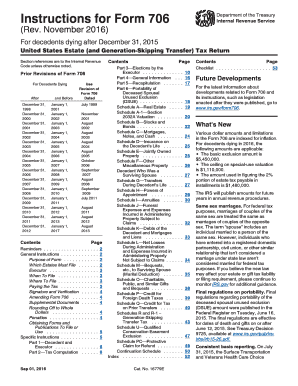
Ule P Credit for Foreign Death Taxes . . . Schedule Q Credit for Tax on Prior Transfers . . . . . Schedules R and R-1 Generation-Skipping Transfer Tax . . . . . . . . Schedule U Qualified Conservation Easement Exclusion . . . . . . . . . . Schedule PC Protective Claim for Refund . . . . . . Continuation Schedule . . . . Index . . . . . . . . . . . . . . . . . . Cat. No. 16779E . . . 10 . . . 16 . . . 17 . . . 18 . . . 19 . . . 20 . . . 22 Contents Page Checklist . . . . . . . .

This website is not affiliated with IRS

How it works

  1. Open form

    Open form follow the instructions

  2. Easily sign form

    Easily sign the form with your finger

  3. Share form

    Send filled & signed form or save

How to fill out the IRS Instruction 706 online

Filing the IRS Form 706 can be a complex process, but this guide simplifies it for you. This form is essential for reporting the estate tax on the decedent's estate, and it is crucial to complete it accurately to ensure compliance with tax regulations.

Follow the steps to complete the IRS Form 706 online.

  1. Click the ‘Get Form’ button to obtain the form and open it in your editing tool.
  2. Begin with Part 1—Decedent and Executor. Fill out the decedent's information, including their name, Social Security number, and date of death.
  3. In Part 2—Tax Computation, enter all relevant values pertaining to the estate to compute the tax liability.
  4. Proceed to Part 3—Elections by the Executor to make necessary elections such as alternate valuation, if applicable.
  5. Complete Part 4—General Information, providing details about the estate and any relationship to the decedent.
  6. Move to Part 5—Recapitulation to summarize the estate values and deductions, ensuring to check all entries accurately.
  7. Fill out any necessary schedules (Schedules A through O) based on the assets included in the estate and claims made.
  8. After completing all required sections and schedules, save your changes and review the form for accuracy.
  9. Finally, print your completed form for filing, along with any attached documents, ensuring all are included in your submission.

Start filing your IRS Form 706 online today for proper estate management.

Get form

Experience a faster way to fill out and sign forms on the web. Access the most extensive library of templates available.

Related content

Instructions for Form 706 (Rev. October 2024)
The executor of a decedent's estate uses Form 706 to figure the estate tax imposed by...
Learn more
Form 706 (Rev. August 2019)
8. If decedent died testate, check here ▷ and attach a certified copy of the will. 9 If...
Learn more
2001 - Instructions for Form 709
securities. instructions for Schedule B of Form 706. For stocks: Also attach any appraisal...
Learn more

Related links form

Broadridge Legal Transfer Form Calyx Request for Title Commitment 2004 Charles Schwab APP30709SI 2004 CitiBank Application Form for Funds Transfer 2013

Questions & Answers

Get answers to your most pressing questions about US Legal Forms API.

Contact support

Currently, TurboTax does not support the direct handling of Form 706 for estate tax filing. You may want to consider other tax preparation software or services that cater specifically to this form. Using resources like US Legal Forms can simplify the process, ensuring you have the required documentation and guidance to file your estate tax efficiently.

The IRS typically takes around four to six months to process Form 706 after receiving your completed paperwork. However, the exact time frame can vary based on their workload and any complications that may arise. By following IRS Instruction 706 closely, you can minimize the risk of delays and facilitate a smoother processing experience.

An estate does not have a specific postal address but instead uses the decedent's last residence address as the estate's official mailing address. When filling out Form 706, IRS Instruction 706 advises you to use the address where the decedent lived at the time of their death. This practice helps establish clarity regarding tax responsibilities and ensures proper communication with the IRS.

Filing Form 706 is necessary for estates where the gross value exceeds the exclusion limit set by the IRS. According to IRS Instruction 706, you need to file it within nine months after the date of death of the decedent, unless an extension applies. It's crucial to review the specific requirements in the instruction, which outline necessary documentation and information you'll need to include.

Currently, the IRS does not allow electronic filing for Form 706. While many taxpayers prefer e-filing for convenience, the filing requirements under IRS Instruction 706 mandate paper submissions. You can still ensure compliance and capture your information correctly by utilizing solutions like US Legal Forms, which help with the preparation of necessary documents.

The address you send your mail to depends on the specific form and your location. For Form 706, you can find the correct address in the IRS Instruction 706. This instruction provides valuable information to help you navigate the mailing process, ensuring your form reaches the right place promptly. Always double-check the address to avoid delays.

To mail Form 706, you should refer to the IRS Instruction 706 guidance for specific mailing addresses. Generally, you must send it to the address that corresponds to your location and the type of return you're filing. Ensure your envelope is properly addressed and includes any required information. Using a tracking method for your mail can provide peace of mind.

Form 706 needs to be filed by the executor of an estate when the total value of the decedent's estate exceeds the federal estate tax exemption amount. This includes estates with complex assets or multiple beneficiaries. Utilizing resources like USLegalForms can simplify the filing process while ensuring all necessary components align with IRS Instruction 706.

Yes, you typically need to report the sale of inherited property to the IRS. Any gains made from the sale may be subject to capital gains taxes. By using IRS Instruction 706 as a guide, heirs can navigate the tax obligations connected to the sale of inherited assets effectively.

Form 706 is designed for estate tax reporting, while form 1041 is used for income tax purposes for estates and trusts. In essence, form 706 addresses the tax due upon death, whereas form 1041 covers income generated by the estate after the person's passing. Understanding these distinctions is crucial for managing estate finances correctly according to IRS Instruction 706.

Get This Form Now!

Use professional pre-built templates to fill in and sign documents online faster. Get access to thousands of forms.
If you believe that this page should be taken down, please follow our DMCA take down processhere.
Get IRS Instruction 706
  • Adoption
  • Bankruptcy
  • Contractors
  • Divorce
  • Home Sales
  • Employment
  • Identity Theft
  • Incorporation
  • Landlord Tenant
  • Living Trust
  • Name Change
  • Personal Planning
  • Small Business
  • Wills & Estates
  • Packages A-Z
  • Affidavits
  • Bankruptcy
  • Bill of Sale
  • Corporate - LLC
  • Divorce
  • Employment
  • Identity Theft
  • Internet Technology
  • Landlord Tenant
  • Living Wills
  • Name Change
  • Power of Attorney
  • Real Estate
  • Small Estates
  • Wills
  • All Forms
  • Forms A-Z
  • Other Templates
  • Legal Hub
  • About Us
  • Help Portal
  • Legal Resources
  • Blog
  • Affiliates
  • Contact Us
  • Delete My Account
  • Site Map
  • Industries
  • Forms in Spanish
  • Localized Forms
  • State-specific Forms
  • Forms Kit
  • Real Estate Handbook
  • All Guides
  • Notarize
  • Incorporation services
  • For Consumers
  • For Small Business
  • For Attorneys
  • USLegal
  • FormsPass
  • pdfFiller
  • signNow
  • altaFlow
  • DocHub
  • Instapage
Form Packages
  • Adoption
  • Bankruptcy
  • Contractors
  • Divorce
  • Home Sales
  • Employment
  • Identity Theft
  • Incorporation
  • Landlord Tenant
  • Living Trust
  • Name Change
  • Personal Planning
  • Small Business
  • Wills & Estates
  • Packages A-Z
Form Categories
  • Affidavits
  • Bankruptcy
  • Bill of Sale
  • Corporate - LLC
  • Divorce
  • Employment
  • Identity Theft
  • Internet Technology
  • Landlord Tenant
  • Living Wills
  • Name Change
  • Power of Attorney
  • Real Estate
  • Small Estates
  • Wills
  • All Forms
  • Forms A-Z
  • Other Templates
Customer Service
  • Legal Hub
  • About Us
  • Help Portal
  • Legal Resources
  • Blog
  • Affiliates
  • Contact Us
  • Delete My Account
  • Site Map
  • Industries
  • Forms in Spanish
  • Localized Forms
  • State-specific Forms
  • Forms Kit
Legal Guides
  • Real Estate Handbook
  • All Guides
Prepared for you
  • Notarize
  • Incorporation services
Our Customers
  • For Consumers
  • For Small Business
  • For Attorneys
Our Sites
  • USLegal
  • FormsPass
  • pdfFiller
  • signNow
  • altaFlow
  • DocHub
  • Instapage
Social Media
Call us now toll free:
+1 833 426 79 33
As seen in:
© Copyright 1999-2026 airSlate Legal Forms, Inc. 17 Station Street, Suite 303, Brookline, MA 02445
  • Your Privacy Choices
  • Terms of Service
  • Privacy Notice
  • Content Takedown Policy
  • Bug Bounty Program
IRS Instruction 706
This form is available in several versions.
Select the version you need from the drop-down list below.
2020 IRS Instruction 706
Select form
  • 2020 IRS Instruction 706
  • 2019 IRS Instruction 706
  • 2018 IRS Instruction 706
  • 2017 IRS Instruction 706
  • 2016 IRS Instruction 706
  • 2015 IRS Instruction 706
  • 1999 IRS Instruction 706
Select form