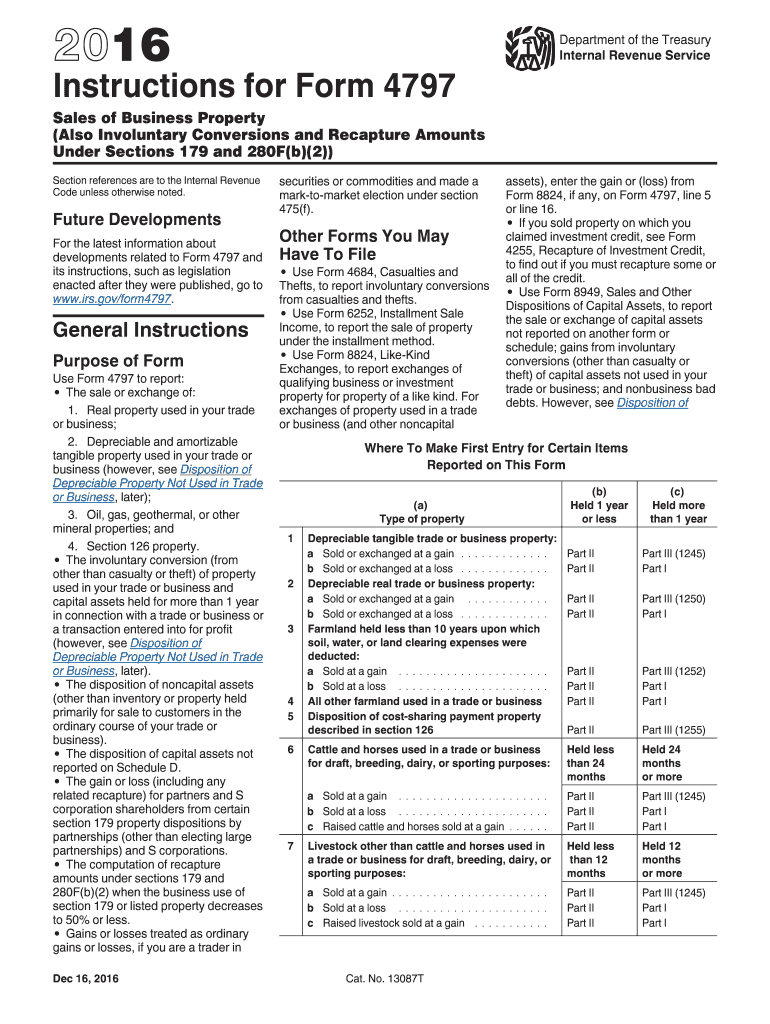
Or more a Sold at a gain . . . . . . . . . . . b Sold at a loss . . . . . . . . . . c Raised livestock sold at a gain Part II Part II Part II Part III (1245) Part I Part I Cat. No. 13087T . . . . . . . . . . . . . . . . . . . . . . . . . . . . . . . . . . . . . . . . . . . . . . . . . . . . . Depreciable Property Not Used in Trade or Business, later. Use the applicable Schedule D, Capital Gains and Losses, for the return you are filing to figure the overall gain or loss from transaction.

Open form follow the instructions

Easily sign the form with your finger

Send filled & signed form or save
How to fill out the IRS Instruction 4797 online
Filling out IRS Instruction 4797 is essential for reporting the sale or exchange of business property, including real estate and depreciable assets. This guide provides clear and comprehensive steps for efficiently completing this form online.
Follow the steps to accurately complete the IRS Instruction 4797.
- Click ‘Get Form’ button to obtain the form and open it in your preferred online editor.
- Begin by entering your name and other identifying information at the top of the form. Ensure this aligns with the information on your tax return.
- Review the sections of the form to determine which apply to your property transactions. The form is divided into multiple parts.
- In Part I, report your sales of business or trade property. Fill in the type of property sold, the date acquired, the date sold, and the amounts involved.
- In Part II, report any ordinary gains or losses on property not reported in Part I. This includes statistics for transactions held for less than a year.
- Part III is for recapturing depreciation on property previously reported on Form 4797. Complete the sections necessary based on your transactions.
- After filling out all applicable parts, review your inputs for accuracy. Ensure all necessary calculations are correctly made, notably in recapture amounts.
- Once you've completed the form, save your changes. You may also download or print the form for your records or to submit.
Start filling out the IRS Instruction 4797 online today to ensure you meet your tax obligations accurately and efficiently.
Experience a faster way to fill out and sign forms on the web. Access the most extensive library of templates available.
Related content
Jan 16, 2025 — Use Part III of Form 4797 to figure the amount of ordinary income...
Report the gain or (loss) following the instructions for Form 1065, Schedule K, line 10...
Dec 21, 2011 — D. File Form 4797 with your Form 1040 for each year in which you sell or...
Get answers to your most pressing questions about US Legal Forms API.
What types of property are depreciated by the IRS?
The IRS allows depreciation on various types of property, including residential and commercial real estate, machinery, and vehicles used for business. Understanding how these are categorized according to IRS Instruction 4797 helps you claim the correct deductions. Depreciation can significantly impact your tax obligations, making it essential to report accurately.
What type of property is a 4797?
Form 4797 is designed for reporting various types of property associated with business and trade. This includes assets like equipment, vehicles, and real estate that have been used in a business context. By utilizing IRS Instruction 4797, you can clearly understand the appropriate classifications for your property.
How do you report gain subject to recapture as ordinary income?
To report gain subject to recapture as ordinary income, you must follow the specific instructions provided in IRS Instruction 4797. This typically involves calculating the gain on the sale and determining the portion subject to recapture. Accurately categorizing this gain is crucial to ensure you comply with tax laws and avoid penalties.
What types of property are covered by Section 1250?
Section 1250 covers depreciable real property, typically buildings or improvements that are used in business. This includes residential rental property and commercial buildings. When dealing with Section 1250 property, IRS Instruction 4797 provides essential guidelines on how to report gains and recapture depreciation.
Do I use schedule D or form 4797?
Whether to use Schedule D or form 4797 depends on the type of property you sold. Form 4797 is specific to the sale of business property, while Schedule D is for capital gains and losses from personal property. Understanding the distinctions outlined in IRS Instruction 4797 can guide you to the correct form based on your situation.
What transactions are reported on form 4797?
You report various types of transactions on form 4797, primarily those involving the sale, exchange, or involuntary conversion of business property. This includes the sale of a partnership interest or property used in trade or business. Referring to IRS Instruction 4797 will help you identify which transactions need reporting and how to handle them correctly.
What type of property goes on form 4797?
Form 4797 is used to report the sale of business property, including both tangible and intangible items. This may involve assets like machinery, vehicles, and real estate used in a business. Understanding IRS Instruction 4797 helps ensure you accurately report these transactions, avoiding potential issues with tax compliance.
Does sale of investment property go on schedule D?
Yes, the sale of investment property typically goes on Schedule D, as it covers capital gains and losses. However, if the investment property was used in a business setting, IRS Instruction 4797 would come into play. It is important to assess the usage of the property to choose the correct form. Utilizing a platform like US Legal Forms can help clarify your specific reporting needs.
Is Schedule D required if form 4797 is used?
If you use Form 4797, you generally do not need to submit Schedule D, as they serve different reporting purposes. IRS Instruction 4797 specifically addresses the reporting of business property sales. However, if you also have capital gains or losses from sales of assets reported on Schedule D, you would need to complete that form as well. Understanding both forms ensures your taxes are filed correctly.
How do you report the sale of real property to the IRS?
To report the sale of real property, you typically use Form 4797, particularly if it's used in a business. IRS Instruction 4797 provides the necessary guidelines on how to capture any gains or losses from the sale accurately. Be sure to keep records of the transaction and consult the form's instructions for detailed reporting requirements. This ensures that your filings are both accurate and compliant.
Use professional pre-built templates to fill in and sign documents online faster. Get access to thousands of forms.
If you believe that this page should be taken down, please follow our DMCA take down process here.
This form is available in several versions. Select the version you need from the drop-down list below.