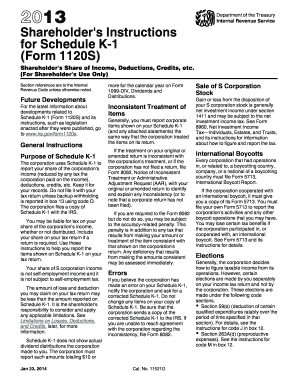
Ly) Section references are to the Internal Revenue Code unless otherwise noted. Future Developments For the latest information about developments related to Schedule K-1 (Form 1120S) and its instructions, such as legislation enacted after they were published, go to www.irs.gov/form1120s. General Instructions Purpose of Schedule K-1 The corporation uses Schedule K-1 to report your share of the corporation's income (reduced by any tax the corporation paid on the income), deductions, credits, e.
Open form follow the instructions
Easily sign the form with your finger
Send filled & signed form or save
How to fill out the IRS Instruction 1120S - Schedule K-1 online
This guide provides clear and supportive instructions for completing the IRS Instruction 1120S - Schedule K-1 online. This form is essential for shareholders of S corporations as it reports their share of income, deductions, and credits from the corporation.
Follow the steps to complete your Schedule K-1 accurately.
- Click the ‘Get Form’ button to access the Schedule K-1 form and open it in your preferred online editor.
- Begin with Part I, which requires you to enter your personal information as the shareholder, including your name, address, and identifying number (SSN or EIN) for accurate reporting.
- Move to Part II to review your share of the corporation's stock and any amounts you invested or loans made to the corporation, which may affect your calculations.
- Proceed to Part III where specific items related to your share of income, deductions, and credits are listed. Ensure to accurately input these amounts as per the corporation's records.
- If there are any adjustments for passive activity or at-risk limitations in relation to income or deductions, document these changes carefully.
- After filling in all relevant sections, double-check your entries for accuracy. It is crucial to ensure that the items you report correspond with how the corporation reported them.
- Once all entries are finalized, save your changes. You can then download, print, or share your completed Schedule K-1 as needed.
Complete your IRS Instruction 1120S - Schedule K-1 online to ensure accurate tax reporting and compliance.
Experience a faster way to fill out and sign forms on the web. Access the most extensive library of templates available.
Related content
General Instructions. Purpose of Schedule K-1. The corporation uses Schedule K-1 to report...
This list identifies the codes used on Schedule K-1 for all shareholders and provides...
Jan 31, 2012 — ... the. • Income reported on Schedule K,. 8918. comparable IRS...
Get answers to your most pressing questions about US Legal Forms API.
Where do distributions go on 1120s k1?
Distributions are reported in Part III of the IRS Instruction 1120S - Schedule K-1, specifically under the section detailing shareholder distributions. This part helps determine how much is distributed to each shareholder from the S Corp’s profits. Properly allocating these distributions is crucial for both the corporation and the shareholders to understand tax implications. Accurate reporting avoids future compliance issues.
Do K1 distributions count as income?
K1 distributions typically do count as income for tax purposes, but with specific considerations. The portion of the distribution that represents profits can indeed affect your taxable income. However, distributions that exceed your investment in the S Corp may trigger capital gains tax. Understanding these nuances is beneficial, and using resources like US Legal Forms can help clarify these details.
How is K1 income from S Corp taxed?
K1 income from an S Corp is usually taxed as ordinary income for the shareholder. This means it is generally reported on the individual's tax return, and the appropriate tax rates apply based on the individual’s tax bracket. It's important to recognize that this income has been previously taxed at the corporate level, avoiding double taxation. Stay aware of your income to ensure proper tax compliance.
What is included on Schedule K-1 form 1120 S?
Schedule K-1 form 1120S includes various details such as the shareholder's share of income, deductions, credits, and any distributions. Additionally, it captures the percentage of ownership and can provide essential information for tax planning. Accurate completion of this form ensures that shareholders report their income correctly. We suggest using the US Legal Forms platform to guide you in filling out this form accurately.
Does a K1 show the percentage of ownership?
Yes, the IRS Instruction 1120S - Schedule K-1 displays the percentage of ownership held by each shareholder. This information is crucial for shareholders to understand their stake in the S Corporation. Moreover, this percentage is important for calculating income allocation, which is equally significant for tax purposes. Knowing your ownership percentage ensures accurate reporting and compliance.
Is S Corp K-1 income considered earned income?
The income from an S Corp K-1 is usually not classified as earned income. Instead, it is considered pass-through income because it flows directly to the shareholders without being taxed at the corporate level. This distinction is important for tax return filings, especially regarding self-employment tax liabilities. Understanding this can help you file your taxes accurately.
How are S Corp K1 distributions taxed?
Distributions reported on the IRS Instruction 1120S - Schedule K-1 are generally taxed differently than regular income. Since S Corp distributions typically come from earnings that have already been taxed, they may not be subject to further taxation. However, if your distribution exceeds your basis in the S Corp, it could be taxed as capital gains. It is always wise to consult a tax professional to navigate these rules effectively.
Does Schedule K-1 need to be filed with 1120s?
Schedule K-1 does not need to be filed with Form 1120S itself; however, it must be provided to shareholders. Each shareholder uses this information to complete their individual tax returns. The IRS Instruction 1120S - Schedule K-1 outlines how shareholders report this data. Ensuring you have your K-1 submitted accurately aids in avoiding potential issues with the IRS.
Who issues a schedule K-1?
The Schedule K-1 is issued by the S Corporation to its shareholders. Each K-1 provides critical tax information based on the corporation's financial performance, following the IRS Instruction 1120S - Schedule K-1 framework. If you are a shareholder, it is essential to receive your K-1 promptly to ensure accurate tax reporting. If there are any discrepancies or delays, it's important to address them with the corporation quickly.
Who prepares the K-1 form?
The preparation of the K-1 form is typically handled by the S Corporation's accountant or tax professional. They must adhere to the guidelines set by the IRS Instruction 1120S - Schedule K-1 to ensure accuracy for all shareholders. You can also seek help from third-party services specializing in tax preparation to make the process smoother. Their expertise can help guarantee your K-1 is completed properly.
Use professional pre-built templates to fill in and sign documents online faster. Get access to thousands of forms.
If you believe that this page should be taken down, please follow our DMCA take down process here.
This form is available in several versions. Select the version you need from the drop-down list below.