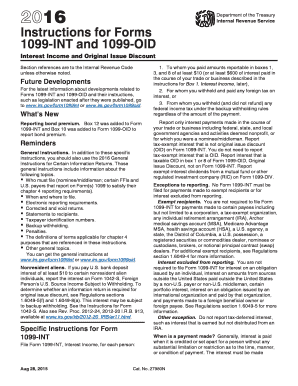
Form 1099-INT for payments made to certain payees including but not limited to a corporation, a tax-exempt organization, any individual retirement arrangement (IRA), Archer medical savings account (MSA), Medicare Advantage MSA, health savings account (HSA), a U.S. agency, a state, the District of Columbia, a U.S. possession, a registered securities or commodities dealer, nominees or custodians, brokers, or notional principal contract (swap) dealers. For additional exempt recipients, see Regulati.
Open form follow the instructions
Easily sign the form with your finger
Send filled & signed form or save
How to fill out the IRS Instruction 1099-INT & 1099-OID online
Navigating the IRS Instruction forms 1099-INT and 1099-OID can be straightforward with the right guidance. This user-friendly guide provides step-by-step instructions on how to accurately fill out these forms online, allowing you to manage your interest income and original issue discount reporting with confidence.
Follow the steps to complete your IRS 1099-INT & 1099-OID forms online.
- Click the ‘Get Form’ button to obtain the form and open it in your online editor.
- Begin with Form 1099-INT, and fill in the recipient's name, address, and taxpayer identification number (TIN), ensuring accuracy for each entry. You must report interest amounts of $10 or more in appropriate boxes.
- Next, review the boxes pertaining to interest income. Use Box 1 for regular interest income and Box 2 for any penalties on early withdrawals.
- If applicable, enter any federal income tax that was withheld from the payee in Box 4. You should also indicate any foreign tax paid in Boxes 6 and 7.
- Complete Form 1099-OID by entering each holder's interest received on original issue discounts. Use Box 1 for OID amounts and Box 2 for any qualified stated interest.
- For both forms, ensure to include state information in Boxes 15-17 if required, and check the box for FATCA filing requirement if necessary.
- Review all entered information for accuracy. Once confirmed, you can save your changes, download, print, or share the completed forms as needed.
Complete your IRS 1099 forms online today for seamless submission and accurate reporting.
Experience a faster way to fill out and sign forms on the web. Access the most extensive library of templates available.
Related content
Report interest that is tax-exempt OID in box 11 of Form 1099-OID, not on Form 1099-INT...
Instructions for Forms 1099-INT and 1099-OID ... Internal Revenue Service. Form 1099-INT...
1 a Enter your child's taxable interest. If this amount is different from the amounts...
Get answers to your most pressing questions about US Legal Forms API.
Is bond premium income or expense?
Bond premium can be classified as an amortized expense over the life of the bond. While it can reduce your taxable interest income, you should understand how to report this accurately. Always consider IRS Instruction 1099-INT & 1099-OID for proper guidance on financial reporting.
Where do I report box 13 on 1099 Div?
Box 13 on the 1099-DIV form typically reports your dividends from investments. The amounts reported here should be included on your tax return under the appropriate dividend income section. It is important to carefully follow IRS Instruction 1099-INT & 1099-OID to ensure you report everything correctly.
How to fill out 1099-INT from IRS?
Filling out 1099-INT involves providing your name, taxpayer identification number, and the recipient's details, along with the interest income amount. Each box must be carefully completed according to IRS guidelines to reflect accurate amounts. If you need assistance, consider using platforms like uslegalforms, which provide templates and detailed instructions related to IRS Instruction 1099-INT & 1099-OID.
How do I report a 1099-OID on my tax return?
To report a 1099-OID on your tax return, first, ensure you have received the 1099-OID form from your issuer. You will need to include the OID amounts in your income on Schedule B or on Form 1040. Following IRS Instruction 1099-INT & 1099-OID helps ensure compliance and accuracy in your tax submission.
Is OID included in 1099-INT?
An Original Issue Discount (OID) is not directly included in 1099-INT. Instead, OID amounts may need to be reported separately under 1099-OID. Understanding the differences between these forms is crucial for accurately reporting your income according to IRS Instruction 1099-INT & 1099-OID.
What is the rule for 1099-INT?
The rule for 1099-INT states that you must report interest income received. If you earned $10 or more in interest, you should receive this form from your payer. Following the guidelines under IRS Instruction 1099-INT & 1099-OID ensures you remain compliant with tax laws. You can access simplified templates and guidelines through uslegalforms to streamline your tax process.
Is there a difference between a 1099 and a 1099-INT?
Yes, there is a difference between a general 1099 form and a 1099-INT. While the general 1099 can report various types of income, the 1099-INT specifically reports interest income earned. Each form has unique reporting requirements, especially as per IRS Instruction 1099-INT & 1099-OID. For more information on how to navigate these forms, uslegalforms offers comprehensive resources.
Why would the IRS send me a 1099-INT?
The IRS sends you a 1099-INT to report the interest income you earned during the tax year. This notification is essential for your tax records as you will need to report this income on your return. It aligns with IRS Instruction 1099-INT & 1099-OID, which helps you ensure proper reporting. If you’re uncertain about how to handle this, consider utilizing uslegalforms for guidance.
Who should get a 1099-INT?
You should receive a 1099-INT if you earned $10 or more in interest from a bank, credit union, or other financial institution during the tax year. This form informs you of the interest income you must report on your tax return. Familiarizing yourself with IRS Instruction 1099-INT & 1099-OID can help you navigate these requirements smoothly. For additional assistance, use uslegalforms.
What are the two types of 1099s?
The two main types of 1099 forms are the 1099-INT and the 1099-OID. The 1099-INT reports interest income you earn from financial institutions, while the 1099-OID reports the original issue discount on notes or bonds. Understanding these forms under IRS Instruction 1099-INT & 1099-OID is vital for accurate tax reporting. You can find more in-depth resources at uslegalforms.
Use professional pre-built templates to fill in and sign documents online faster. Get access to thousands of forms.
If you believe that this page should be taken down, please follow our DMCA take down process here.
This form is available in several versions. Select the version you need from the drop-down list below.