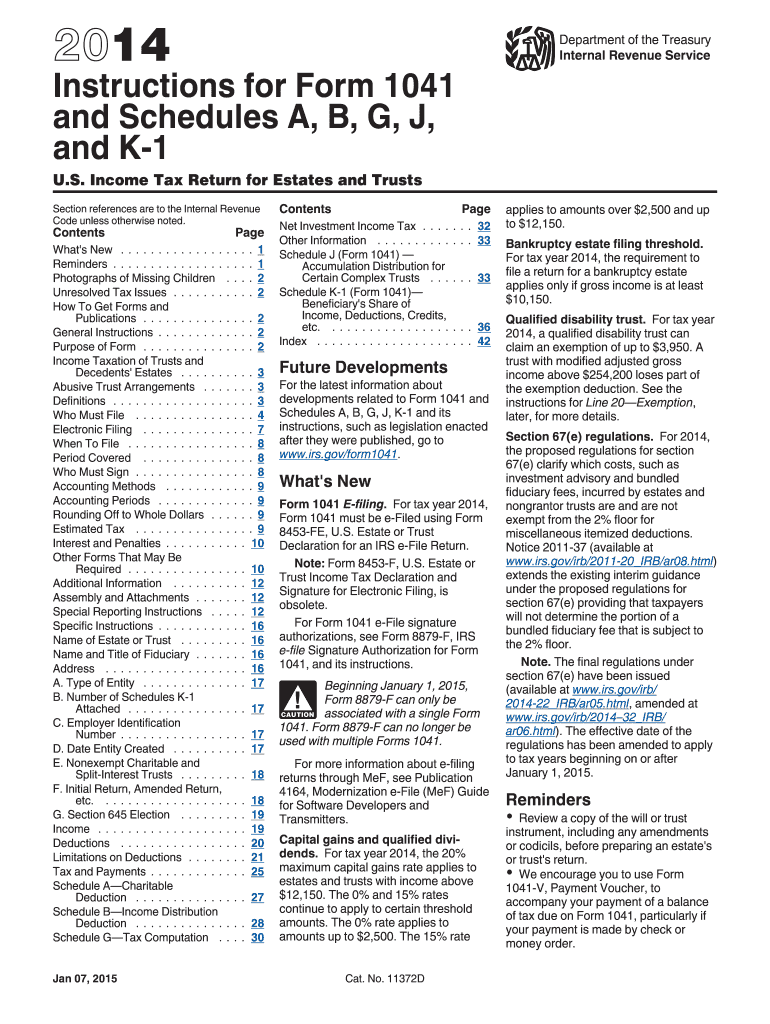
To apply to tax years beginning on or after January 1, 2015. Reminders Review a copy of the will or trust instrument, including any amendments or codicils, before preparing an estate's or trust's return. We encourage you to use Form 1041-V, Payment Voucher, to accompany your payment of a balance of tax due on Form 1041, particularly if your payment is made by check or money order. Net investment income tax. This tax applies to certain investment income of estates and trusts. Use Form 8960 an.

Open form follow the instructions

Easily sign the form with your finger

Send filled & signed form or save
How to fill out the IRS Instruction 1041 online
Filling out the IRS Form 1041 can seem complex, but this guide provides step-by-step instructions to help you complete it online with confidence. Whether you are managing an estate or trust, understanding each section of the form is crucial for accurate tax reporting.
Follow the steps to accurately complete the IRS Form 1041 online.
- Click the ‘Get Form’ button to obtain the IRS Form 1041 and open it in your editor.
- In the 'Name of Estate or Trust' section, accurately enter the formal name as it appears on the Employer Identification Number (EIN) application.
- Provide the name and title of the fiduciary responsible for the estate or trust.
- Fill in the address details, including suite or room number, and ensure it is current.
- In 'Type of Entity', select all applicable boxes that describe the entity for which you are filing.
- Enter the number of Schedules K-1 attached to the Form 1041, if applicable.
- Document the Employer Identification Number (EIN) for the estate or trust if it has been assigned one.
- Record the date the entity was created, or for an estate, the date of the decedent's death.
- Complete the income section, including interest income, dividends, capital gains, and any other sources of income the estate or trust has received.
- Deduct any allowable expenses, including fiduciary fees and other specific deductions as described in the form.
- Calculate the taxable income by following the instructions in the 'Tax and Payments' section.
- Review the information entered to ensure accuracy, then save your completed form.
- Finally, submit the form electronically, or print it for filing by mail, along with any necessary payment vouchers if applicable.
Get started on completing your IRS Form 1041 online.
Experience a faster way to fill out and sign forms on the web. Access the most extensive library of templates available.
Related content
Due date of return. Calendar year estates and trusts must file Form 1041 by April 15...
9. 9. 10. Interest. Check if Form 4952 is attached ©. 10. 11. Taxes. 11. 12. Fiduciary...
Apr 15, 2015 — Instructions for Form 1041, line 15c. When those line instructions refer...
Get answers to your most pressing questions about US Legal Forms API.
How is a home sale reported to the IRS?
A home sale is reported to the IRS using Form 1041, particularly if the home is part of an estate or trust. You'll need to report the sale's details, including proceeds and any related deductions, on Schedule D. IRS Instruction 1041 is your reference point for understanding the reporting process and ensuring everything is in order.
Where to report property taxes on 1041?
Property taxes can be reported on Form 1041 as miscellaneous deductions on the appropriate line of the form, generally under Schedule A. Make sure to refer to IRS Instruction 1041 for precise guidelines on how to categorize these expenses. This keeps your records organized and compliant with IRS regulations.
Do you have to file a final 1041 if there is no income?
You may still need to file a final Form 1041 even if there is no income, especially if the estate or trust has incurred expenses or made distributions prior to closure. IRS Instruction 1041 provides specific scenarios where filing is required. Checking these guidelines can help you ensure compliance.
How to fill out form 1041?
Completing Form 1041 requires you to gather all income sources, deductions, and relevant details about the estate or trust. Follow the guidelines in IRS Instruction 1041 step-by-step, ensuring you insert all necessary information in the appropriate sections. Using this structured approach makes the process straightforward.
Should I file a 1041 if I have no income?
If the estate or trust has no income, it might still be necessary to file Form 1041, particularly if it has incurred expenses or made distributions. IRS Instruction 1041 clarifies these situations, helping you determine the necessity of filing. It's always considerate to check for requirements specific to your situation.
How to calculate tax due on form 1041?
To calculate the tax due on Form 1041, first determine your taxable income by subtracting allowable deductions from your total income. Utilize the tax tables provided in IRS Instruction 1041 to find the correct tax rate. This simple method ensures you accurately assess the liability for the estate or trust.
What is tax form 1041 for dummies?
Tax Form 1041 is used by estates and trusts to report income, deductions, and taxes owed for the tax year. It is essential for fiduciaries in managing estate financial affairs. IRS Instruction 1041 simplifies the filing process, making it easier for you to understand your tax obligations.
How to fill out schedule D form 1041?
To fill out Schedule D of Form 1041, start by listing each capital asset transaction, including sales and exchanges. Report the date of acquisition, date of sale, proceeds from the sale, and any adjustments you may need. IRS Instruction 1041 provides direction on what deductions you may apply to your capital gains, helping you report accurately.
How do I close a trust with the IRS?
Closing a trust with the IRS requires filing the final IRS Instruction 1041 and settling all financial obligations. You must report any income earned until the closure and distribute all assets to the beneficiaries. After completing these steps, ensure you retain copies of the filings for your records. For more assistance, consider using resources available through US Legal Forms.
Can I file IRS Form 1041 electronically?
Yes, you can file IRS Form 1041 electronically using approved software or services. Many taxpayers prefer this method due to the ease of tracking and faster processing times. Be sure to check whether your software includes the latest IRS Instruction 1041 updates. Online resources and services like US Legal Forms can make this process more straightforward.
Use professional pre-built templates to fill in and sign documents online faster. Get access to thousands of forms.
If you believe that this page should be taken down, please follow our DMCA take down process here.
This form is available in several versions. Select the version you need from the drop-down list below.