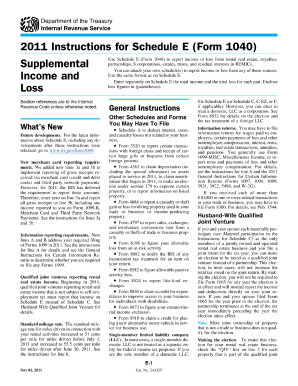
Your spouse filed Form 1065 for the year prior to the election, the partnership terminates at the end of the tax year immediately preceding the year the election takes effect. Note. Mere joint ownership of property that is not a trade or business does not qualify for the election. Making the election. To make this election for your rental real estate business, check the QJV box on line 2 for each property that is part of the qualified joint venture. You must divide all items of income, ga.
Open form follow the instructions
Easily sign the form with your finger
Send filled & signed form or save
How to fill out the IRS Instruction 1040 - Schedule E online
Filling out the IRS Instruction 1040 - Schedule E can be a straightforward process when you follow the right steps. This guide aims to provide clear, supportive instructions to help users accurately report their supplemental income and losses.
Follow the steps to complete Schedule E online effectively.
- Press the ‘Get Form’ button to access the IRS Schedule E form and open it in your editor.
- Carefully read the instructions provided in the form. It’s essential to understand the different types of income and losses you may need to report, such as those from rental real estate, royalties, partnerships, S corporations, or trusts.
- In Part I of Schedule E, report your income or loss from rental real estate and royalties. If you own multiple properties, report each one separately, using additional pages as necessary.
- For each property, fill out the required information, including the property address, days rented, and personal use days. Make sure to follow the guidelines for deducting expenses accurately.
- Complete Parts II and III if applicable, to report your share of income or losses from partnerships and S corporations or your total share from estates and trusts.
- Check for any necessary attachments and forms, such as Form 6198 or Form 8582, based on your reporting requirements.
- Once the form is filled out correctly, you can proceed to save your changes, download, print, or share the completed form as needed.
Start filling out your Schedule E online to ensure accurate reporting of your supplemental income and losses!
Experience a faster way to fill out and sign forms on the web. Access the most extensive library of templates available.
Related content
Use Schedule E (Form 1040) to report income or loss from rental real estate, royalties...
All deductions for depreciation must be explained in Schedule E. If obsolescence is...
Feb 23, 2018 — For example, on your 2017 Schedule E you can deduct fees paid in 2017 to...
Get answers to your most pressing questions about US Legal Forms API.
What is the IRC code for self-rental?
The Internal Revenue Code (IRC) that pertains to self-rental is Section 469, which discusses passive activity loss limitations. This section is particularly relevant when you report activities on IRS Instruction 1040 - Schedule E. Familiarizing yourself with this code can empower you to navigate the complexities of rental income taxation.
What is self-rental on Schedule E?
Self-rental occurs when you rent property to yourself or a pass-through entity where you hold significant ownership. Reporting this on IRS Instruction 1040 - Schedule E requires careful attention to detail to ensure compliance with tax regulations. Understanding the implications of self-rental helps you manage your financial obligations effectively.
How many days can you stay in your own rental property?
While renting out your property, you can stay in it for up to 14 days a year without affecting your rental tax status. If you exceed this duration, the property may qualify as a personal residence instead, which can complicate your taxes on IRS Instruction 1040 - Schedule E. Keeping track of your days can help you maintain the appropriate classification.
How do you avoid self-rental rules?
To avoid self-rental rules when renting to yourself, you should maintain clear business practices. Ensure that the rental agreement is at fair market value and document all transactions. When you file using IRS Instruction 1040 - Schedule E, presenting all details accurately can help you stay within compliance and truly benefit from your rental.
What is the new 1040 form for seniors?
The new 1040 form for seniors primarily simplifies the tax filing process, allowing seniors to report their income more easily. This updated form may include options for various income types, including those from rental properties reported on IRS Instruction 1040 - Schedule E. It aims to provide a straightforward experience for older taxpayers navigating their taxation responsibilities.
What is the income limit for Schedule E?
There is no specific income limit for using IRS Instruction 1040 - Schedule E to report rental income. However, your total income can impact your eligibility for certain deductions and credits. You should consider your overall income situation when filing, as it may affect how much tax you owe.
How does the IRS know if I have rental income?
The IRS learns about your rental income through various sources, including your tax return filing. When you report this income on IRS Instruction 1040 - Schedule E, the IRS can cross-check it with information provided by banks, tenants, and other third parties. Failing to report rental income may result in penalties, so it’s important to accurately disclose all relevant information.
How does the IRS find unreported income?
The IRS employs a range of strategies to discover unreported income. They use data analytics and information from third-party sources, such as banks and rental platforms. If your accounts show significant deposits that do not match reported income on IRS Instruction 1040 - Schedule E, this might trigger an investigation. Remaining diligent in your financial reporting is key to avoiding complications.
Does rent get reported to the IRS?
Yes, rent must be reported to the IRS. Under IRS Instruction 1040 - Schedule E, all rental income must be disclosed, regardless of the amount. This applies to all properties, whether you manage them yourself or use a property management service. Consistent reporting helps you avoid potential legal issues with the IRS.
How is rental income verified?
Rental income verification generally involves cross-referencing reported income with third-party documents, such as bank statements and 1099 forms issued by tenants. The IRS may also use IRS Instruction 1040 - Schedule E to compare your reported income with data from rental platforms. If your reported income seems inconsistent, the IRS may request additional documentation. Staying organized with your financial records can help provide clarity if needed.
Use professional pre-built templates to fill in and sign documents online faster. Get access to thousands of forms.
If you believe that this page should be taken down, please follow our DMCA take down process here.
This form is available in several versions. Select the version you need from the drop-down list below.